Gianduia Gelato
Expect roasted hazelnut in front and milk chocolate a step behind it, sweet, buttery and rounded, with the nut still there long after the spoonful is gone.
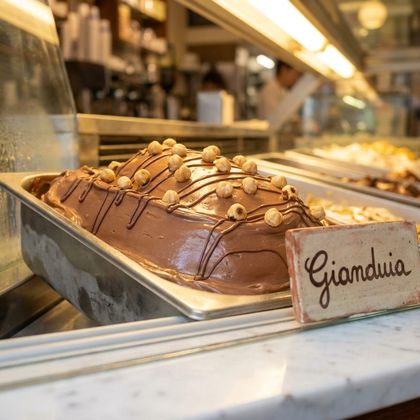
Turin ran short of cocoa under the Napoleonic blockade and stretched what was left with the hazelnut growing on the hills around it, which is why this flavour leads with nut and lets chocolate follow rather than the reverse. The ready-made paste holds that whole idea in one jar and 110 g per kilo is the gelateria dose, but commercial gianduia paste is only about 30 percent hazelnut, so another 40 g of pure Piedmont paste goes in behind it. Those 40 g carry fat and aroma and no sugar at all, which is exactly the trade the flavour wants: more nut, more body, nothing added to the sweetness.
The complication is that the paste is roughly 40 percent sugar, so those 110 g walk in carrying about 44 g of sugar per kilo before a single grain of sucrose is weighed. That is the entire reason the sucrose line here reads 90 g. Set it higher and total sugars break through the 22 percent ceiling and the sheet fails.
Commercial gianduia paste is only around 30 percent hazelnut, which is why 40 g of pure Piedmont paste go in on top. Those 40 g bring fat and aroma and no sugar at all, which is precisely the trade you want. Between them the two pastes deposit 67.4 g of fat per kilo, and that is why there is no cream anywhere in this recipe: 476 g of whole milk, 215 g of skim milk and 25 g of non-fat dry milk do the rest of the work.
Ingredients
Makes 1000 g of finished base.
| Ingredient | Grams | Home measure |
|---|---|---|
| Whole Milk | 476 | 2 cups |
| Skim Milk | 215 | 3/4 cup plus 2 tablespoons |
| Gianduia Paste | 110 | |
| Sugar (Sucrose) | 90 | 1/3 cup plus 2 tablespoons |
| Hazelnut Paste (Piedmont IGP) | 40 | |
| Dextrose (Glucose) | 40 | 3 1/2 tablespoons |
| Non-Fat Dry Milk | 25 | 1/4 cup |
| Stabilizer (Neutral) | 3 | |
| Salt | 1 |
Loads these exact grams into the free balancer, ready to edit.
Method
Fast-chilled paste base, shallow pan, stir every 30 minutes
- 1Whisk every dry ingredient together first: sugars, milk powder, stabiliser and salt. Dry-blending them stops the stabiliser clumping when it meets liquid.
- 2Warm the liquids to 40 C (104 F), then rain the dry mix in while whisking hard.
- 3Heat to 82 C (180 F) and hold for 2 minutes so the stabiliser hydrates.
- 4Off the heat, whisk in the paste, then blend 60 seconds so the fat emulsifies instead of separating.
- 5Chill in an ice bath to under 5 C (41 F) within 2 hours. Slow cooling is where bacteria and coarse crystals both start.
- 6Age 6 to 12 hours in the fridge under 5 C (41 F). This is when the stabiliser and the milk protein take up water.
- 7Freeze in a shallow metal pan 2 to 3 cm deep, breaking the crystals with a fork every 30 to 40 minutes, 4 to 6 times.
- 8Freeze firm, then temper 10 to 15 minutes in the fridge before scooping.
The balance
All six against the professional range for Milk Gelato.
Two numbers explain the shape of the sheet. Sugars finish at 17.2 percent against a window of 16 to 22, low for something this sweet on the tongue, and low on purpose, because the paste is supplying most of the sweetness itself. The second is protein at 4.57 percent against a ceiling of 5, which is what you get when cream is replaced by 215 g of skim milk and 25 g of non-fat dry milk to leave the fat entirely to the pastes. Fat lands at 8.45 percent inside a 6 to 12 window, PAC at 260.81 sits mid-range in 220 to 300 so it scoops cleanly in a -11 to -14 C cabinet, and MSNF stays at 8.62, close to the 8 floor, because the protein ceiling is already tight and there is no room to push milk solids further. Lactose finishes at 7.58 percent of the water phase, clear of the sandiness limit.
Estimated nutrition: ~194 kcal · Fat 8.5 g · Sugars 17.2 g · Protein 4.6 g (per 100 g of mix, from the balanced composition).
Gianduia paste contains cocoa butter, and cocoa butter crystallizes in several polymorphic forms. If the mix sits warm around 25 to 30 C for a long stretch, the unstable crystals form and the gelato develops a grey fatty bloom in storage. Melt the paste at 45 to 50 C, fold it into the already pasteurized base at around 55 to 60 C, blend, and chill FAST to 4 C rather than letting it drift down on the counter. The pure hazelnut paste goes in at the same stage, below 60 C, so the roast notes survive. The single gram of salt is working against the 44 g of sugar that arrived inside the paste: without it, gianduia reads cloying. Do not pasteurize with the paste in the pot, because beyond the aroma loss the free fat emulsifies badly at 85 C and comes back as grease in the mouth. Mature 12 hours so the cocoa butter has time to set in its stable form.
If it goes wrong
Fat bloom. The cocoa butter from the gianduia paste crystallized in an unstable form because the mix sat warm around 25 to 30 C on its way down.
Chill from 55 to 60 C straight to 4 C over an ice bath, then mature 12 hours so the cocoa butter sets stable.
The 40 g of pure hazelnut paste were skipped or cut. Commercial gianduia paste is only about 30 percent hazelnut, so on its own the cocoa side dominates.
Put the full 40 g of Piedmont hazelnut paste back in, added below 60 C. It adds no sugar, so nothing else in the sheet has to move.
The paste went into the pot before or during pasteurization and the free fat emulsified badly at 85 C.
Pasteurize the dairy alone, drop to 55 to 60 C, then add the melted paste and blend it in with a stick blender.
Suitable for: Vegetarian, Egg-free
Allergens: milk, tree nuts
- https://www.thedeliciouscrescent.com/hazelnut-gelato-nocciola-gelato/
- https://madonnadelpiatto.com/2014/09/24/chocolate-hazelnut-bacio-gelato/
- https://www.dreamscoops.com/ice-cream-science/ice-cream-calculator/
- The science behind it: Gianduja Gelato Balancing
- Ingredient sheet: Gianduia Paste
- The story of this recipe: Gianduia Gelato
Want to change an ingredient and watch the numbers move? Open the free balancer