Chestnut Gelato
Thicker on the spoon than a nut gelato and drier on the finish, with a roasted sweetness that arrives late and holds, rounded out by vanilla and cream.
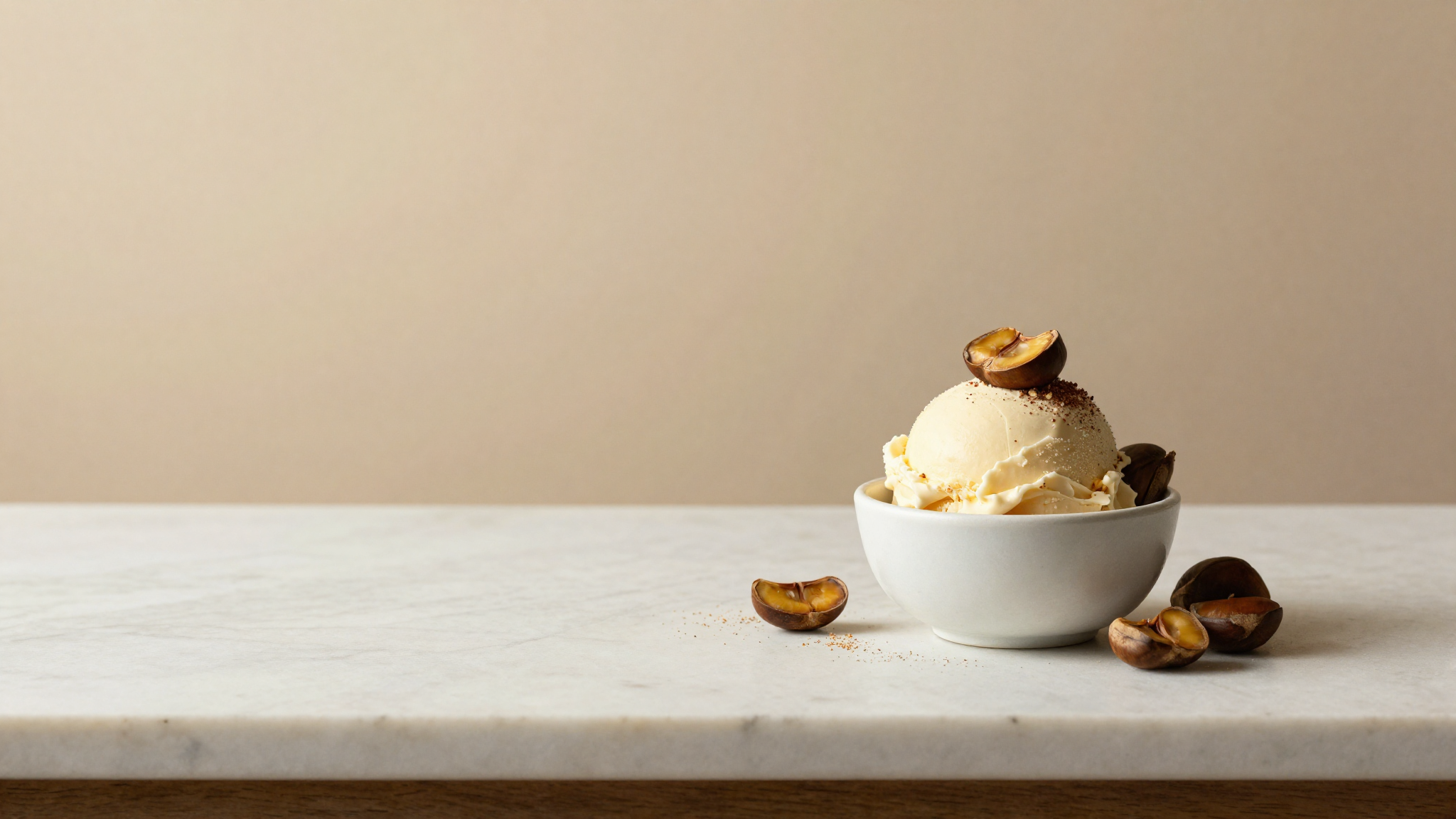
Piedmont and the Ardeche are chestnut country, and both turn the harvest into the same sweetened puree that Italian and French kitchens later fold into frozen desserts. This sheet follows that line: 150 g of chestnut cream per kilo, inside the 12 to 20 percent band those kitchens work in, enough for the flavour to read clearly without the result tasting like frozen puree. The choice then shapes everything downstream. That cream is about 45 percent sugar and carries almost no fat at all, so the free sucrose stays low while the dairy climbs to 185 g of cream, because every gram of fat in the finished gelato has to come from there.
Because the chestnut contributes almost nothing to the fat column, all of it has to come from dairy: 185 g of heavy cream per kilo, which lands fat at 8.45 percent inside a 6 to 12 band. On the sugar side the opposite problem shows up. Chestnut cream at 20 percent is itself about 45 percent sugar, so the 150 g used here delivers around 67.5 g of sugar before a single grain of sucrose is added. That is why added sucrose stops at 65 g.
The starch is not a nuisance, it is the texture. It thickens the mix, ties up free water and gives the gelato a dense, almost pastry-like body. It also means this base behaves strangely during maturation and in storage, in ways the technical note below covers, so read that part before you cook.
Ingredients
Makes 1000 g of finished base.
| Ingredient | Grams | Home measure |
|---|---|---|
| Whole Milk | 506 | 2 cups |
| Heavy Cream 35% | 185 | 3/4 cup plus 1 tablespoon |
| Chestnut Cream 20% | 150 | |
| Sugar (Sucrose) | 65 | 1/3 cup |
| Non-Fat Dry Milk | 46 | 1/2 cup |
| Dextrose (Glucose) | 40 | 3 1/2 tablespoons |
| Carob Seed Flour | 4 | |
| Vanilla Extract | 3 | |
| Salt | 1 |
Loads these exact grams into the free balancer, ready to edit.
Method
Cooked starch base, chilled hard, blended twice while freezing
- 1Whisk every dry ingredient together first: sugars, milk powder, stabiliser and salt. Dry-blending them stops the stabiliser clumping when it meets liquid.
- 2Warm the liquids to 40 C (104 F), then rain the dry mix in while whisking hard.
- 3Heat to 82 C (180 F) and hold for 2 minutes so the stabiliser hydrates.
- 4Chill in an ice bath to under 5 C (41 F) within 2 hours. Slow cooling is where bacteria and coarse crystals both start.
- 5Age 6 to 12 hours in the fridge under 5 C (41 F). This is when the stabiliser and the milk protein take up water.
- 6Freeze in a shallow metal pan 2 to 3 cm deep, breaking the crystals with a fork every 30 to 40 minutes, 4 to 6 times.
- 7Freeze firm, then temper 10 to 15 minutes in the fridge before scooping.
The balance
All six against the professional range for Milk Gelato.
Look at solids and sugars together. Total solids sit at 37.98 percent, comfortably inside 36 to 42, while sugars are only 16.93 percent in a 16 to 22 band. That gap between a healthy solids figure and a modest sugar figure is chestnut starch doing the filling, and it is exactly why this gelato tastes less sweet than most milk bases at the same density. The other lever is milk solids: MSNF reads 9.99 percent against 8 to 11.5, held up by 46 g of non-fat dry milk on top of 506 g of whole milk. That amount of powder is only safe because lactose comes to 8.78 percent of the water phase, still under the point where lactose starts crystallizing and turning the gelato sandy. PAC 262.08 in a 220 to 300 band is a deliberately middling reading: firm enough to be a real gelato, soft enough to serve after a short temper.
Estimated nutrition: ~194 kcal · Fat 8.5 g · Sugars 16.9 g · Protein 3.8 g (per 100 g of mix, from the balanced composition).
This is the only base in the set where the cooking temperature is non-negotiable. Chestnut starch has to gelatinize, which means taking the mix to 82 to 85 C and holding it there. A quick 70 C pasteurization leaves raw starch, which reads both floury and gritty. Stir constantly while you do it: chestnut cream settles and scorches on the bottom with almost no warning, and scorched chestnut is unrecoverable. Pass the hot mix through a fine sieve every time, because commercial chestnut cream carries fiber and small lumps that the spoon will find. Then rest it 8 to 12 hours at 4 C and expect it to thicken far more than a normal gelato mix. That is starch retrograding, it is normal, and a quick blend before freezing puts it right. There is no curdling risk here since chestnut is not acidic. Rum was deliberately left out: even 5 g per kilo moves PAC by roughly 15 points, and there is a dedicated marron glace version that pays for that properly.
If it goes wrong
The starch never gelatinized because the mix was pasteurized fast at a lower temperature.
Take the mix to 82 to 85 C and hold it there for a couple of minutes, stirring the whole time. You will feel it thicken under the spoon when the starch goes.
The chestnut cream sank and caught on the bottom of the pan during heating.
Use a heavy pan, warm the milk first and whisk the chestnut cream in only once the liquid is moving, then stir without stopping. Nothing rescues a scorched batch, so this one is prevention only.
Chestnut starch retrogrades in the freezer, and this base hardens faster in storage than any other in the family.
Treat it as a fast turnover flavor and eat it within a few days. Do not try to fix it by raising PAC, which sits at 262.08 for a reason. Temper it 10 to 15 minutes in the fridge before serving instead.
Suitable for: Vegetarian, Egg-free
Allergens: milk
- https://www.recipesfromitaly.com/chestnut-gelato-recipe/
- https://www.icecreamnation.org/2014/10/chestnut-ice-cream-monte-blanc/
- https://www.madaboutmacarons.com/chestnut-vanilla-ice-cream/
- https://en.wikipedia.org/wiki/Nesselrode_pudding
- The science behind it: Chestnut Paste in Gelato
- Ingredient sheet: Chestnut Cream 20%
- The story of this recipe: Chestnut Gelato Recipe
Want to change an ingredient and watch the numbers move? Open the free balancer