Pomegranate Sorbet
It hits tart and stays tart: thin on the tongue, very cold, with a tannic dryness that pulls at the palate and a colour that stains the spoon.
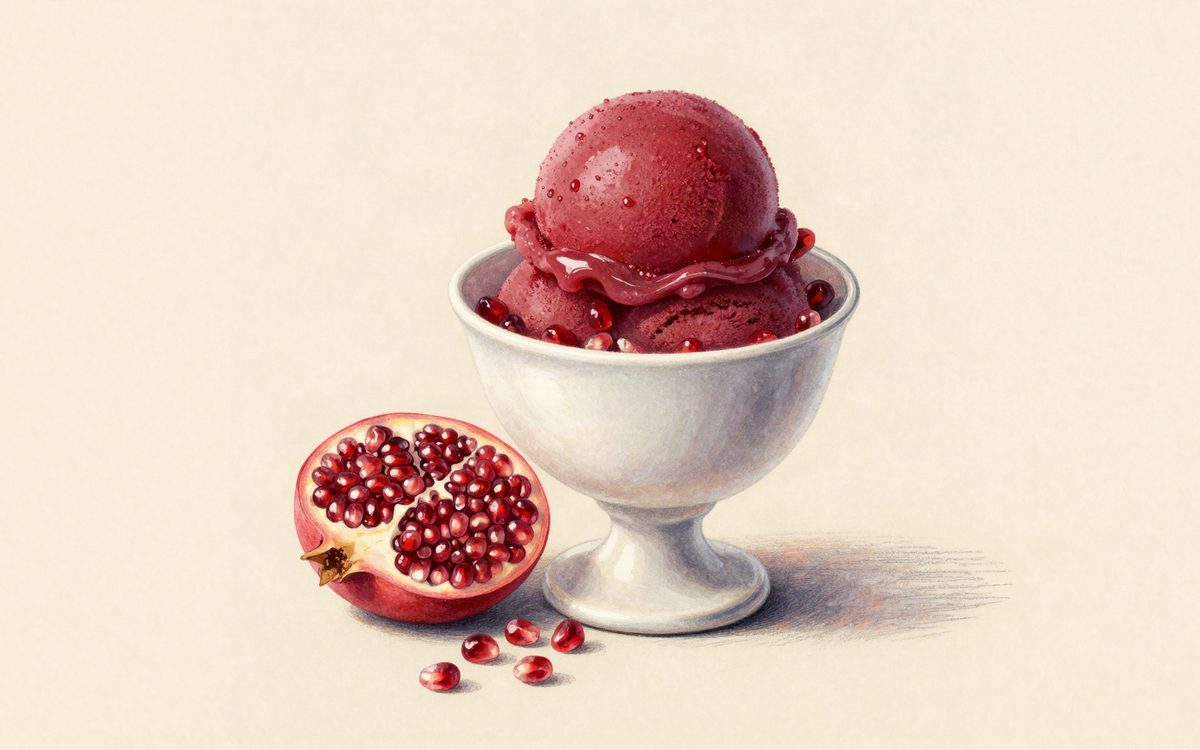
There is no soft entry to this one. The first second is acid and astringent at once, the cold registering before any sweetness does, and the tannin drying the sides of the tongue the way strong tea does. The body is deliberately light, closer to a granita than to a cream, and it melts quickly because there is no fat to slow it down. What lingers is not sweetness but that dry, faintly resinous edge, and it lingers longer than the fruit itself. All of it comes from the arils, seeds included, at 225 g per kilo, with lemon juice sharpening the front end.
Worth saying plainly: a bench recipe built on strained juice would pour 500 to 600 g per kilo. Balanced against the eight indicators, 225 g of whole aril is correct; measured against normal practice it is a light dose. Pomegranate carries it better than most fruit would, because at 22.5 percent it already delivers colour and audible tannin.
With little fruit on the sheet, the levers do the work: 110 g of sucrose, 80 g of dextrose, 77 g of maltodextrin and 494 g of water. Sugars close at 28.77 percent inside 25 to 31, and the upper half of that band is deliberate, since sugar is the main defence against astringency. Solids read 30.98 percent, PAC 325.76 and POD 207.06 under a 270 ceiling.
Ingredients
Makes 1000 g of finished base.
| Ingredient | Grams | Home measure |
|---|---|---|
| Water | 494 | 2 cups |
| Pomegranate | 225 | |
| Sugar (Sucrose) | 110 | 1/2 cup plus 1 tablespoon |
| Dextrose (Glucose) | 80 | 1/3 cup plus 2 tablespoons |
| Maltodextrin | 77 | |
| Lemon Juice | 10 | |
| Carob Seed Flour | 3 | |
| Guar Gum | 1 |
Loads these exact grams into the free balancer, ready to edit.
Method
Chilled tray, forked, juice folded in cold
- 1Whisk every dry ingredient together first: sugars, milk powder, stabiliser and salt. Dry-blending them stops the stabiliser clumping when it meets liquid.
- 2Warm the liquids to 40 C (104 F), then rain the dry mix in while whisking hard.
- 3Heat to 82 C (180 F) and hold for 2 minutes so the stabiliser hydrates.
- 4Chill in an ice bath to under 5 C (41 F) within 2 hours. Slow cooling is where bacteria and coarse crystals both start.
- 5Age 6 to 12 hours in the fridge under 5 C (41 F). This is when the stabiliser and the milk protein take up water.
- 6Fold the fruit in cold, after ageing. Heating it costs you the fresh aroma and nothing is gained.
- 7Freeze in a shallow metal pan 2 to 3 cm deep, breaking the crystals with a fork every 30 to 40 minutes, 4 to 6 times.
- 8Freeze firm, then temper 10 to 15 minutes in the fridge before scooping.
The balance
All six against the professional range for Sorbetto.
With the fruit at 225 g, solids and sweetness have to come from somewhere else, which is why 77 g of maltodextrin and 80 g of dextrose are on the list and why sugars finish at 28.77 percent, in the upper half of a 25 to 31 band. That choice is also a flavour decision: at 0.23 percent fat there is nothing here to soften tannin, so sugar has to do it. PAC 325.76 keeps it scoopable and water at 69.02 percent, inside 66 to 72, is what the 494 g on the ingredient list is buying.
Estimated nutrition: ~125 kcal · Fat 0.2 g · Sugars 28.8 g · Protein 0.5 g (per 100 g of mix, from the balanced composition).
The astringency of pomegranate comes from hydrolysable tannins, the punicalagins, and cold plus zero fat both amplify it. Two defences, and they are structural rather than cosmetic: keep sugar in the upper half of its band, which this recipe does at 28.77 percent, and never press the seeds. Take the arils out, press them gently, and throw the woody seed away whole, because its oil and its tannin are where the bitterness lives. Colour is pH dependent: pomegranate anthocyanins go from ruby to a brownish grey above about pH 4, so the 10 g of lemon juice is functional, not seasoning. Pasteurise only the syrup of water, sugars and the 3 g of carob seed flour with 1 g of guar at 85 C, chill it to 4 C, and add the pomegranate juice cold, because heating it destroys the anthocyanin and with it the reason anyone wanted this flavour. Keep the mix away from light while it ages.
If it goes wrong
Tannin. Either the seeds were pressed hard, or sugar was reduced. At 0.23 percent fat there is nothing in this base to soften punicalagins.
Press the arils gently and discard the whole seed, and leave sugars where they are at 28.77 percent. This is one recipe where cutting sugar makes it taste worse, not lighter.
Either the pH drifted above 4, or the pomegranate juice was heated with the syrup.
Keep the 10 g of lemon juice, pasteurise the syrup on its own at 85 C, chill it to 4 C, and add the juice cold. Age it covered and out of the light.
Crushed woody seed made it through into the mix.
Press lightly and strain. The seed is a structural part of the aril and it is not meant to end up in the sorbet.
Suitable for: Vegan, Vegetarian, Lactose-free, Egg-free
No ingredient in this recipe contains gluten.
- USDA FoodData Central, Pomegranates, raw versus Pomegranate juice, bottled (contraste de proteina: cerca de 1,67 g/100 g no arilo contra 0,15 g/100 g no suco)
- Underbelly, Sample Sorbet Recipe (https://under-belly.org/sample-sorbet-recipe/), metodo de balanceamento fruta e xarope
- Luca Caviezel, Scienza e Tecnologia del Gelato Artigianale, capitulo de sorbetti e frutas ricas em polifenois
- Dream Scoops, Ice Cream Calculator e notas de ciencia do sorvete (https://www.dreamscoops.com/ice-cream-science/ice-cream-calculator/)
- The science behind it: Anthocyanin Color Stability in Sorbet
- Ingredient sheet: Pomegranate
Want to change an ingredient and watch the numbers move? Open the free balancer