Pear Sorbet
Late sweetness is the whole story here: cool and nearly neutral at first, then a honeyed spread that fills the mouth and clears slowly over a soft body.
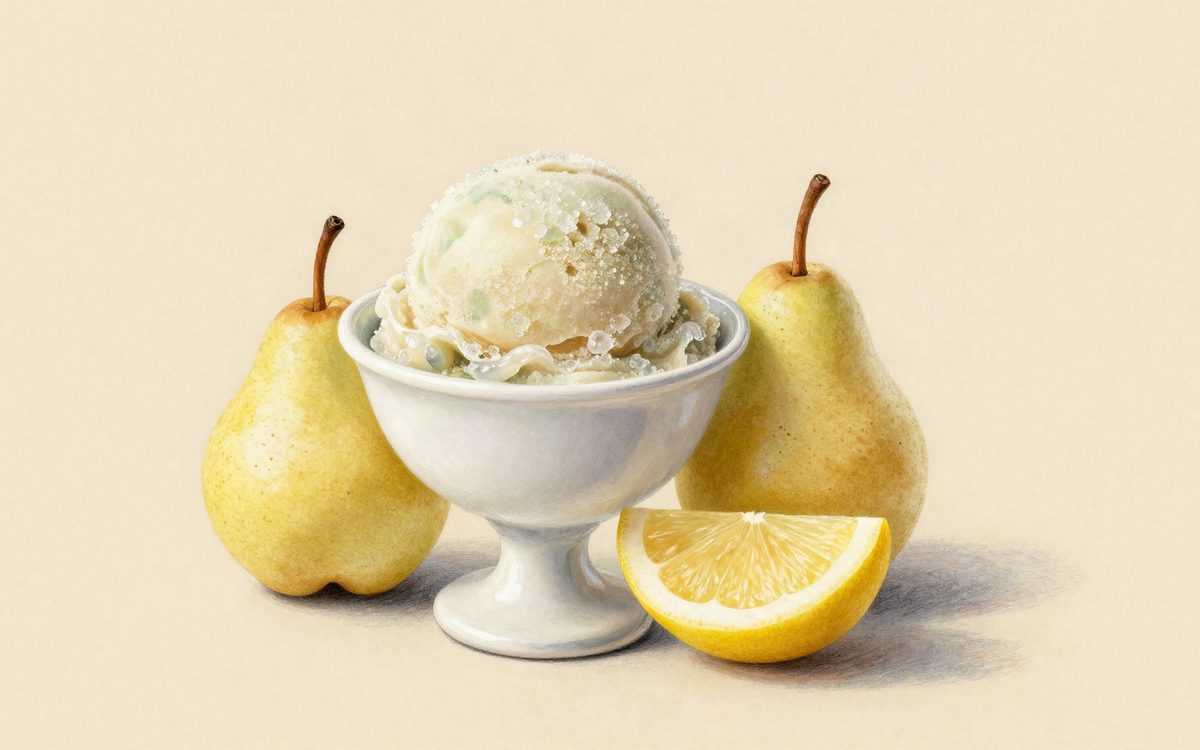
Give the first mouthful a moment. It opens cool and almost neutral, then the sweetness spreads late and wide, rounded rather than sharp, and stays a good while before it clears. That slow build is the fruit's own doing: at 560 g per kilo it brings a great deal of sweetening power on very little dry matter, so the added sugar stays modest and maltodextrin and glucose powder take on the job of building solids without piling on more sweetness. Squeezed lemon juice at 20 g per kilo keeps the whole thing from reading flat, and the high freezing point depression leaves the finished sorbet soft under the scoop instead of hard.
That is why the sugar list looks strange next to other sorbets. Sucrose stops at 70 g, the lowest of the family, while maltodextrin climbs to 45 g and glucose powder to 60 g. Both are dry extract with very little sweetness of their own, and they are what let total solids reach 31.04 percent inside a 28 to 34 range while POD still closes at 211.68, low in a 200 to 270 range. Take the maltodextrin out and solids fall toward the floor.
Added water is only 191 g per kilo, the smallest amount on any sorbet sheet in this group, because 560 g of pear already brings its own. Protein reads 0.23 percent inside a 0 to 1 band, so the dose is decided by flavour and sweetness rather than by a protein limit. PAC lands at 327.63 in a 280 to 340 band, so it stays soft and generous in a cabinet at -13.1 C.
Ingredients
Makes 1000 g of finished base.
| Ingredient | Grams | Home measure |
|---|---|---|
| Pear | 560 | |
| Water | 191 | 3/4 cup plus 1 tablespoon |
| Sugar (Sucrose) | 70 | 1/3 cup |
| Glucose Powder | 60 | 1/4 cup plus 1 tablespoon |
| Dextrose (Glucose) | 50 | 1/4 cup |
| Maltodextrin | 45 | |
| Lemon Juice (Squeezed) | 20 | |
| Stabilizer (Neutral) | 4 |
Loads these exact grams into the free balancer, ready to edit.
Method
Fruit blended straight into the lemon, cold process, churned same day
- 1Whisk every dry ingredient together first: sugars, milk powder, stabiliser and salt. Dry-blending them stops the stabiliser clumping when it meets liquid.
- 2Warm the liquids to 40 C (104 F), then rain the dry mix in while whisking hard.
- 3Heat to 82 C (180 F) and hold for 2 minutes so the stabiliser hydrates.
- 4Chill in an ice bath to under 5 C (41 F) within 2 hours. Slow cooling is where bacteria and coarse crystals both start.
- 5Age 6 to 12 hours in the fridge under 5 C (41 F). This is when the stabiliser and the milk protein take up water.
- 6Fold the fruit in cold, after ageing. Heating it costs you the fresh aroma and nothing is gained.
- 7Freeze in a shallow metal pan 2 to 3 cm deep, breaking the crystals with a fork every 30 to 40 minutes, 4 to 6 times.
- 8Freeze firm, then temper 10 to 15 minutes in the fridge before scooping.
The balance
All six against the professional range for Sorbetto.
POD at 211.68 sits low in a 200 to 270 range. Pear arrives sweet on very little dry matter, so the way to reach 31.04 percent solids without piling on sweetness was to swap sucrose for neutral solids, which is exactly what 45 g of maltodextrin and 60 g of glucose powder are doing while sucrose sits at just 70 g. Total sugars come to 27.18 percent inside a 25 to 31 range, lower than the acid fruit sorbets need, because there is no sharp acidity here to be buffered. PAC at 327.63 in 280 to 340 comes from that blend and is what keeps the texture soft, which suits a fruit whose aroma is fragile and easily muted by cold. Protein at 0.23 percent sits low in a 0 to 1 range, so the fruit could have gone higher on that count alone.
Estimated nutrition: ~124 kcal · Fat 0 g · Sugars 27.2 g · Protein 0.2 g (per 100 g of mix, from the balanced composition).
Pear browns faster than any other fruit you are likely to put in a sorbet. Its polyphenol oxidase is strongly inhibited by ascorbic acid, with around 0.20 percent ascorbic acid suppressing close to 79 percent of PPO activity in pear juice, and that is both why the lemon is at 20 g per kilo and why the fruit has to be blended directly into the acid rather than cut and left waiting. Use Williams or Abate at full ripeness. An unripe pear is gritty from its stone cells and has no aroma to give, and neither problem is fixable later. Work cold throughout and churn the same day, because pear keeps oxidising even in the freezer.
If it goes wrong
Oxidation. The pear was peeled and cut in advance, or blended before the lemon went into the jug.
Pour the 20 g of lemon juice in first and drop the pear straight onto it as you cut. Colour lost this way does not come back.
Stone cells in underripe pear. They are not lactose crystals, and there is no dairy in this recipe at all.
Use Williams or Abate that yields to a thumb at the neck. Sieving the puree helps a little but does not save a hard pear.
Extra sucrose was added, or maltodextrin was replaced with more sugar because it was not in the cupboard.
Keep sucrose at 70 g. POD sits at 211.68, low in a 200 to 270 range, and the neutral solids are what let this recipe hold 31.04 percent solids without tasting sweet.
Suitable for: Vegan, Vegetarian, Lactose-free, Egg-free
- https://pubmed.ncbi.nlm.nih.gov/30263251/
- https://pastryartsmag.com/sponsored/simple-sorbet-science/
- https://extension.psu.edu/preserving-color-and-preventing-browning-of-foods
- The science behind it: Sorbitol in Gelato
- Ingredient sheet: Pear
- The story of this recipe: Pear Sorbetto Recipe
Want to change an ingredient and watch the numbers move? Open the free balancer