Matcha Gelato
Grassy bitterness on the first spoon, umami close behind it, carried by a base kept lean on purpose so nothing fatty sits between the tea and your tongue.
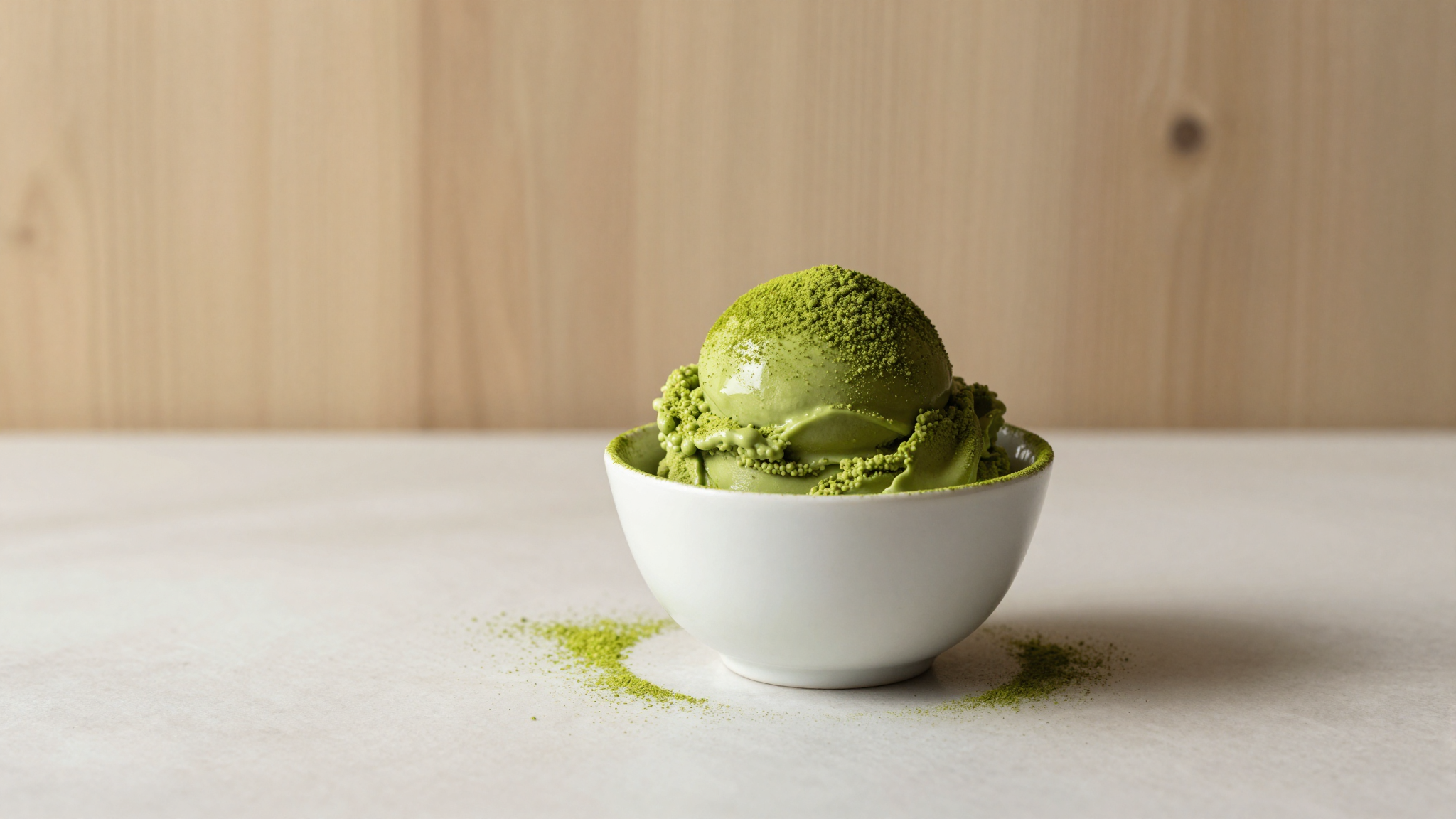
Whisked rather than steeped, and swallowed whole rather than strained away, the Japanese powder brings its entire body into whatever it is mixed with. That single fact shapes this base. Dosed at somewhere between 6 and 12 g per kilo, it carries around 95 percent dry solids along with protein and catechin, so it counts as a real ingredient in the balance and not as a perfume. It is also easy to smother: fat above 9 percent wraps the volatiles and mutes the aroma. So the fat here stops near 7.7 percent and the cream is deliberately held back, leaving a vehicle that gets out of the way of the tea.
Adding it is a swap, not an addition. Take the matcha out of the whole milk: for a 10 g dose, drop the milk from 595 g to 585 g. Solids then move from 37.73 percent to roughly 38.6, still inside 36 to 42, and protein rises about 0.3 of a point from 3.72, still inside 3 to 5. Nothing else in the list changes.
The base was built lean on purpose. Fat closes at 7.73 percent, well under a 12 percent ceiling that most milk gelato flavours use up, because fat above about 9 percent coats the matcha volatiles and flattens the aroma. Sugars sit at 19.52 percent, in the upper half of the 16 to 22 band, and that is also deliberate: catechins read as bitterness on the palate and need covering. MSNF at 10.04 percent and 60 g of glucose powder supply the solids that the low fat would otherwise cost, and PAC lands at 258.25 in a 220 to 300 band.
Ingredients
Makes 1000 g of finished base.
| Ingredient | Grams | Home measure |
|---|---|---|
| Whole Milk | 595 | 2 1/2 cups |
| Heavy Cream 35% | 160 | 2/3 cup |
| Sugar (Sucrose) | 120 | 1/2 cup plus 2 tablespoons |
| Glucose Powder | 60 | 1/4 cup plus 1 tablespoon |
| Skim Milk Powder | 40 | 1/3 cup plus 2 tablespoons |
| Dextrose (Glucose) | 20 | 1 1/2 tablespoons |
| Carob Seed Flour | 4 | |
| Salt | 1 |
Loads these exact grams into the free balancer, ready to edit.
Method
Sieve and slurry the matcha cold, then chilled tray with a fork
- 1Whisk every dry ingredient together first: sugars, milk powder, stabiliser and salt. Dry-blending them stops the stabiliser clumping when it meets liquid.
- 2Warm the liquids to 40 C (104 F), then rain the dry mix in while whisking hard.
- 3Heat to 82 C (180 F) and hold for 2 minutes so the stabiliser hydrates.
- 4Chill in an ice bath to under 5 C (41 F) within 2 hours. Slow cooling is where bacteria and coarse crystals both start.
- 5Age 6 to 12 hours in the fridge under 5 C (41 F). This is when the stabiliser and the milk protein take up water.
- 6Freeze in a shallow metal pan 2 to 3 cm deep, breaking the crystals with a fork every 30 to 40 minutes, 4 to 6 times.
- 7Freeze firm, then temper 10 to 15 minutes in the fridge before scooping.
The balance
All six against the professional range for Milk Gelato.
Fat at 7.73 percent is the one indicator here that was set against the flavour rather than against a rule. A milk gelato can run to 12 percent, and most do, but fat over roughly 9 percent encapsulates the volatile compounds that carry matcha, so this base stops well short and pays for the missing solids elsewhere: 40 g of skim milk powder and 60 g of glucose powder bring MSNF to 10.04 percent and total solids to 37.73. The second deliberate number is sugars at 19.52 percent, in the upper half of 16 to 22, because catechin bitterness has to be covered. The rest sits where it should: POD 167.96 against a 200 ceiling, PAC 258.25 in 220 to 300, protein 3.72 in 3 to 5, water 62.27 in 58 to 64. Lactose is 5.47 percent of the mix and 8.78 percent of the water, and it clears the sandiness check.
Estimated nutrition: ~190 kcal · Fat 7.7 g · Sugars 19.5 g · Protein 3.7 g (per 100 g of mix, from the balanced composition).
Matcha does not go into the pasteuriser. Under heat, and worse still at low pH, the magnesium at the centre of the chlorophyll molecule is swapped for hydrogen, the bright green becomes olive brown pheophytin, and the damage is chemical and permanent. Adding more powder afterwards does not undo it. The routine: sieve the matcha, work it into a smooth slurry with a little of the base at 40 C, homogenise it, and stir it in only after pasteurisation and cooling, before ageing. Throwing dry powder straight into a cold mix gives you lumps that no amount of beating will break. Two consequences for the balance. Sugar has to work in the upper half of its window, which is why this sheet reads 19.52 percent. And the grade matters: shade grown matcha, higher in theanine and lower in catechin, is the only kind that tastes sweet, while old culinary grade that has already oxidised delivers a metallic bitterness the sugar cannot hide. Store it away from light and oxygen, because matcha oxidises quickly once opened.
If it goes wrong
The matcha was heated. Chlorophyll converted to pheophytin, and that reaction does not reverse.
Pasteurise the base without the tea, cool it, then stir the slurry in before ageing. Once the colour has turned, more powder will not bring it back.
Old or oxidised culinary grade powder, high in catechin. Sugars are already at 19.52 percent, in the upper half of 16 to 22, so there is no room to sweeten your way out.
Use shade grown matcha, higher in theanine, from a tin that has been kept sealed and away from light.
Dry powder was tipped into a cold base. Matcha does not disperse that way.
Sieve the powder, make a smooth paste with a little base at 40 C, then blend that paste into the rest.
Suitable for: Vegetarian, Egg-free
Allergens: milk
No ingredient in this recipe contains gluten.
- https://asktheicecreamqueen.com/recipes/matcha-ice-cream-with-xanthan-gum/
- https://www.chefmian.com/recipes/matcha-gelato
- https://first-agri.jp/matcha/columns/018
- https://richingmatcha.com/why-matcha-ice-cream-manufacturing-requires-a-dedicated-ingredient-grade-strategy/
- The science behind it: Delta E Color Tolerance for Gelato Batch Consistency
- The story of this recipe: Matcha Gelato
Want to change an ingredient and watch the numbers move? Open the free balancer