Horchata Gelato
Starts silky and faintly starchy rather than rich, warm with cinnamon over a soft almond backdrop, and finishes clean instead of coating the mouth.
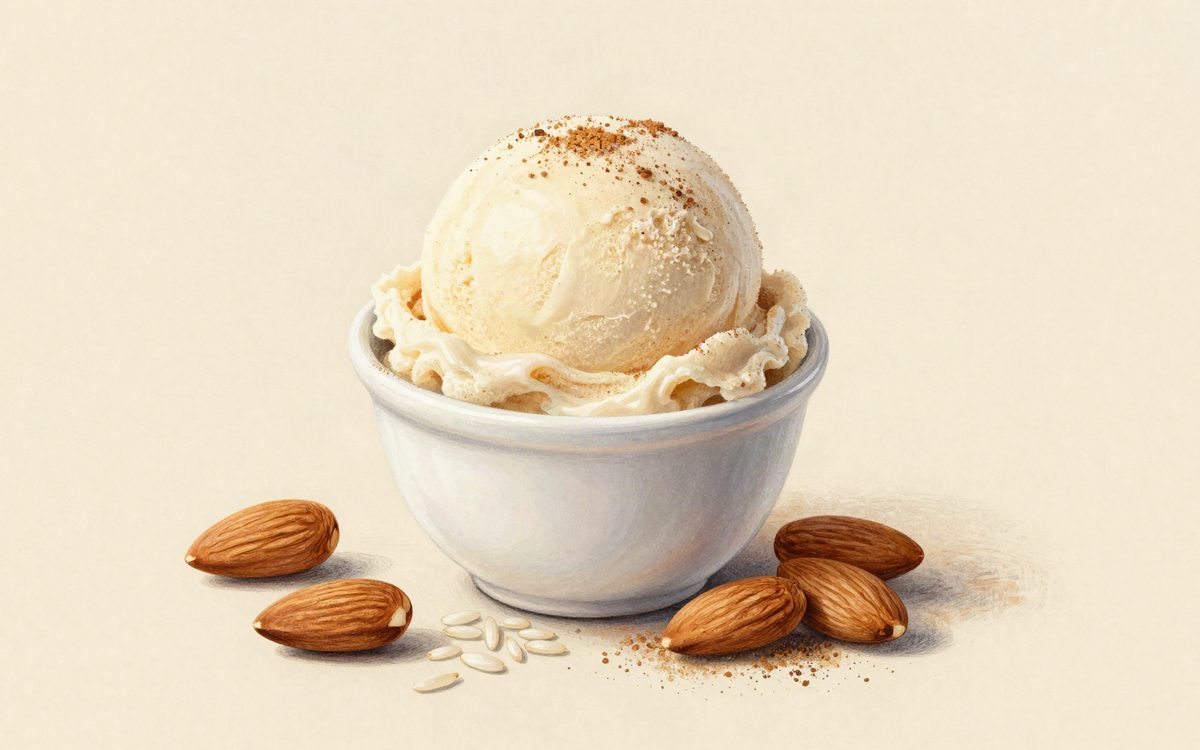
Made in Mexico and in Spain, and not from the same thing in either place: the Valencian version leans on tiger nut, the Mexican one on soaked rice with cinnamon and an almond backdrop behind it. With no chufa and no rice extract to hand, the honest route to the second is rice flour cooked straight into the base, 30 g per kilo, which reproduces what the drink actually does in the mouth, viscosity without fat. Cinnamon sits at 4 g/kg, below what a cinnamon gelato would take, because here it accompanies rather than leads, and the almond milk stays what it is, an aroma behind the rice rather than a source of solids.
30 g of rice flour per kilo is the dose. It is around 90% solids, about 6.2% protein, and close to zero PAC, so it thickens without sweetening and without touching the freezing point. That figure lines up with Italian gelato di riso, which uses 80 to 120 g of already cooked rice per kilo, roughly the same amount of starch by another route.
The commercial almond milk is here for flavour, not for structure. At about 3% solids it is flavoured water, which is why 104 g per kilo can go in without upsetting anything: it tunes water and protein rather than contributing solids. Cinnamon sits at 4 g per kilo, below what a dedicated cinnamon gelato would take, because here it accompanies rather than leads.
Ingredients
Makes 1000 g of finished base.
| Ingredient | Grams | Home measure |
|---|---|---|
| Whole Milk | 472 | 2 cups |
| Heavy Cream 35% | 160 | 2/3 cup |
| Sugar (Sucrose) | 135 | 2/3 cup |
| Almond Milk (Commercial) | 104 | |
| Skim Milk Powder | 51 | 1/2 cup plus 1 tablespoon |
| Dextrose (Glucose) | 35 | 3 tablespoons |
| Rice Flour | 30 | |
| Cinnamon Powder | 4 | |
| Vanilla Extract | 4 | |
| Carob Seed Flour | 4 | |
| Salt | 1 |
Loads these exact grams into the free balancer, ready to edit.
Method
Cook the rice flour into the base, chill hard, still-freeze
- 1Whisk every dry ingredient together first: sugars, milk powder, stabiliser and salt. Dry-blending them stops the stabiliser clumping when it meets liquid.
- 2Warm the liquids to 40 C (104 F), then rain the dry mix in while whisking hard.
- 3Heat to 82 C (180 F) and hold for 2 minutes so the stabiliser hydrates.
- 4Chill in an ice bath to under 5 C (41 F) within 2 hours. Slow cooling is where bacteria and coarse crystals both start.
- 5Age 6 to 12 hours in the fridge under 5 C (41 F). This is when the stabiliser and the milk protein take up water.
- 6Freeze in a shallow metal pan 2 to 3 cm deep, breaking the crystals with a fork every 30 to 40 minutes, 4 to 6 times.
- 7Freeze firm, then temper 10 to 15 minutes in the fridge before scooping.
The balance
All six against the professional range for Milk Gelato.
Total solids reach 37.92% in a 36 to 42 window and fat sits at 7.47% in a 6 to 12 range, which is a conventional milk base on purpose: everything distinctive here is textural, not compositional. The rice flour adds solids and viscosity but gives nothing to sweetness or to PAC, so 135 g of sucrose and 35 g of dextrose per kilo carry the whole freezing job alone. That is how PAC lands at 257.99, mid-window, and POD at 167.37 against a 140 to 200 range. MSNF finishes at 9.97% and protein at 3.96%, both comfortable, and lactose at 8.76% of the water phase clears the sandiness check even with 51 g of skim milk powder in the mix.
Estimated nutrition: ~189 kcal · Fat 7.5 g · Sugars 16.8 g · Protein 4 g (per 100 g of mix, from the balanced composition).
Everything depends on gelatinizing the starch properly. The rice flour needs 82 to 85 C for at least two minutes with constant agitation, otherwise it stays raw, tastes chalky and builds no body at all. Once it gelatinizes the viscosity climbs fast, so blend the base while it is still hot. Rice starch retrogrades at 4 C, so cap the rest at 12 hours or the base turns grainy and releases water during freezing. Add the cinnamon during cooling rather than into the hot pan, the same rule that applies to any cinnamon base.
If it goes wrong
The rice flour never gelatinized. Below 82 C, or with less than two minutes of agitation, it stays raw starch.
Hold at 82 to 85 C for at least two minutes with a whisk moving, and blend the base while it is still hot.
The base rested too long. Rice starch retrogrades at 4 C and squeezes water back out.
Cap the rest at 12 hours and freeze the same day.
It went into the hot pan and its volatile oils cooked off, leaving the powder behind.
Stir the 4 g of cinnamon in during cooling, once the starch has already gelatinized.
Suitable for: Vegetarian, Egg-free
Allergens: milk, tree nuts
- https://www.carolinescooking.com/spanish-horchata-de-chufa/
- https://www.jessicagavin.com/homemade-horchata/
- https://www.thekitchn.com/making-horchata-which-rice-is-93485
- https://www.saveur.com/article/Recipes/Horchata-de-Arroz-con-Almendras/
- The science behind it: Almond Milk Gelato
- Ingredient sheet: Almond Milk (Commercial)
Want to change an ingredient and watch the numbers move? Open the free balancer