Marron Glace Gelato
Dense and sweet on the tongue, cut across by a resinous honey bitterness, with a warm spirit lift that keeps the finish from turning sticky.
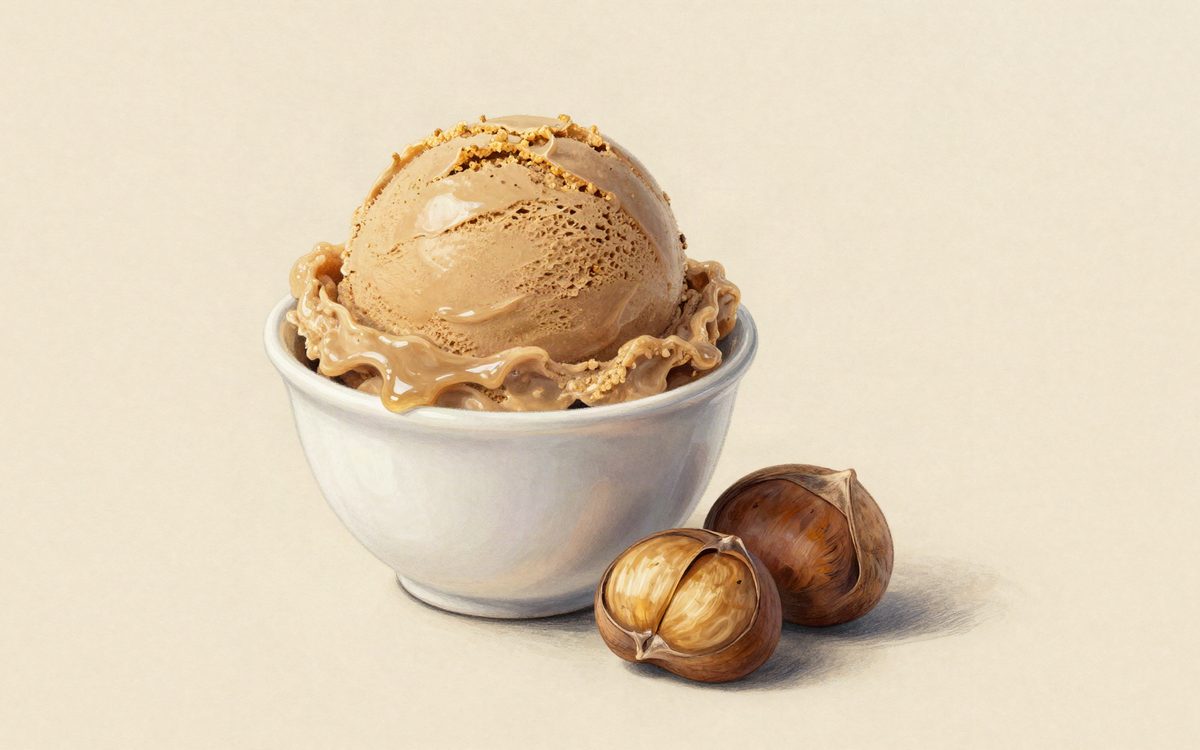
Piedmont and the Ardèche are the chestnut country this one comes from, and what the recipe is built on is the candied nut: steeped in successive syrup baths until part of its starch has been replaced by sucrose. Flavour and sweetener arrive as the same ingredient, which changes everything downstream. At 180 g per kilo the chestnut cream alone brings in close to half the sugar in the mix, so the free sucrose falls back to 70 g. The bitterness has to come from somewhere else, and it comes from 22 g of chestnut honey, resinous and tannic rather than floral, with 12 g of rum lengthening the finish.
Here 180 g of chestnut cream per kilo brings about 81 g of sugar with it, close to half of everything sweet in the recipe, since total sugars read 16.81 percent against a ceiling of 22. That headroom is the only reason this much candied chestnut fits at all. Added sucrose still had room to sit at 70 g, and the rest of the sweetness comes from the ingredient that also carries the flavor.
Two additions do the balancing work on the palate rather than in the spreadsheet. Chestnut honey at 22 g per kilo is bitter, resinous and tannic, nothing like acacia, and that bitterness is what stops candied chestnut from being sickly. The 12 g of rum comes straight from the classic marron puree, which rests in rum, and it also buys real freezing point depression: those 12 g alone account for roughly 35 of the 274.93 PAC points on this sheet.
Ingredients
Makes 1000 g of finished base.
| Ingredient | Grams | Home measure |
|---|---|---|
| Whole Milk | 478 | 2 cups |
| Heavy Cream 35% | 185 | 3/4 cup plus 1 tablespoon |
| Chestnut Cream 20% | 180 | |
| Sugar (Sucrose) | 70 | 1/3 cup |
| Skim Milk Powder | 45 | 1/3 cup plus 2 tablespoons |
| Chestnut Honey | 22 | |
| Rum | 12 | |
| Carob Seed Flour | 4 | |
| Vanilla Extract | 3 | |
| Salt | 1 |
Loads these exact grams into the free balancer, ready to edit.
Method
Cooked base, still-freeze, rum stirred in at the end
- 1Whisk every dry ingredient together first: sugars, milk powder, stabiliser and salt. Dry-blending them stops the stabiliser clumping when it meets liquid.
- 2Warm the liquids to 40 C (104 F), then rain the dry mix in while whisking hard.
- 3Heat to 82 C (180 F) and hold for 2 minutes so the stabiliser hydrates.
- 4Chill in an ice bath to under 5 C (41 F) within 2 hours. Slow cooling is where bacteria and coarse crystals both start.
- 5Age 6 to 12 hours in the fridge under 5 C (41 F). This is when the stabiliser and the milk protein take up water.
- 6Freeze in a shallow metal pan 2 to 3 cm deep, breaking the crystals with a fork every 30 to 40 minutes, 4 to 6 times.
- 7Freeze firm, then temper 10 to 15 minutes in the fridge before scooping.
The balance
All six against the professional range for Milk Gelato.
PAC 274.93 in a 220 to 300 band is noticeably higher than a plain chestnut base at 262.08, and almost all of that difference is the rum. It buys a softer scoop after the fridge rest the method calls for, which matters because the other half of this recipe pulls the opposite way: chestnut starch retrogrades and hardens the gelato as the days pass. The second reading to watch is protein at 3.70 percent, inside 3 to 5, held there by 45 g of skim milk powder. Chestnut carries only about 0.7 percent protein, so without that powder the mix would be thin and would crystallize, and MSNF would fall out of its 8 to 11.5 band rather than sitting at 9.59. Fat reads 8.38 percent with 185 g of cream doing all of it, since chestnut brings roughly 1 percent fat and contributes nothing here.
Estimated nutrition: ~194 kcal · Fat 8.4 g · Sugars 16.8 g · Protein 3.7 g (per 100 g of mix, from the balanced composition).
Two things are specific to this flavor. First the starch: pasteurize at 85 C as usual but do not extend the hold, and accept that the gelato will keep firming up over the following days. Plan on eating it within three to five days rather than storing it. Second the rum: it goes in at the end of freezing, never into the pasteurization, where the alcohol would simply leave and take the 35 PAC points with it. Dissolve the chestnut honey into the mix at around 40 C, not in a boiling pot, so its aromatics survive. If you want visible pieces of candied chestnut, they are a fold-in after freezing and are not part of the balance: a solid inclusion that is itself 60 percent sugar would wreck the whole PAC calculation if it were stirred into the mix.
If it goes wrong
Chestnut starch retrogradation, which this base has more of than the plain chestnut version because there is more chestnut cream in it, 180 g per kilo.
Temper 10 to 15 minutes in the fridge before serving, and treat the batch as something to finish in three to five days. Do not compensate by pouring in more rum.
More than 12 g of rum per kilo, or rum added early enough that it was measured but not enough of it evaporated to matter.
Hold the rum to 12 g per kilo and add it at the end of freezing. The balance already counts those grams, so more is not a rounding error, it is a formula change.
A mild honey was used in place of chestnut honey.
Chestnut honey is structural here, not decorative. Its bitterness is the counterweight to a candied ingredient that is nearly half sugar. If you cannot find it, a few grams less sucrose helps, but the flavor will still read rounder and sweeter.
Suitable for: Vegetarian, Egg-free
Contains alcohol.
Allergens: milk
- https://www.jopistacchio.it/gelato-al-marron-glace-agrimontana/
- https://gelatoincasa.org/gelato-ai-marron-glaces/
- https://www.cucina.li/gelato-di-castagne-e-marrons-glaces/
- The science behind it: Chestnut Paste in Gelato
- Ingredient sheet: Chestnut Cream 20%
Want to change an ingredient and watch the numbers move? Open the free balancer