Apricot Gelato
Soft fresh acidity leads, the fruit fills out into something creamy and warm, and the tartness comes back at the end so nothing sits heavy on the palate.
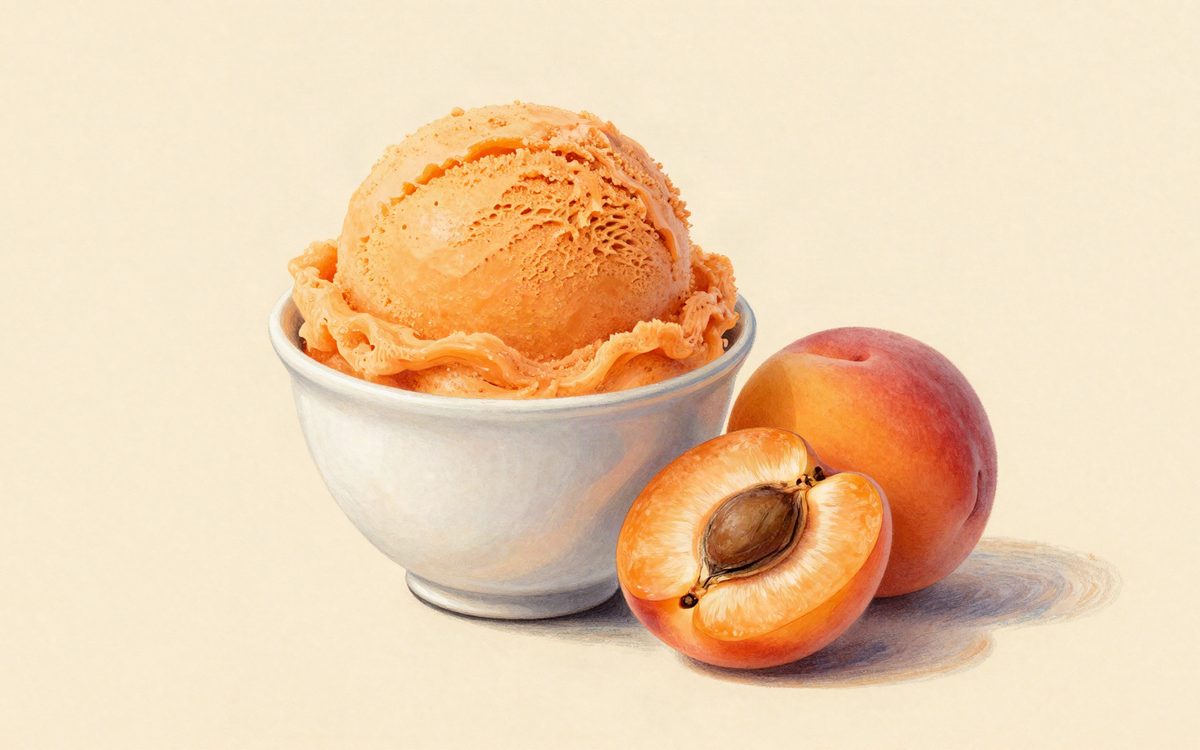
Read the label before anything else, because two versions of the same fruit reach the freezer. Whether you buy it fresh or as a purée, what you want is fruit and nothing else: the cheap tubs come cut with water and syrup, which is a different ingredient wearing the same name. The balance here counts on roughly 13.5 percent solids and 9.2 percent sugar arriving with the fruit, and added syrup moves both. Ripeness is the second thing to check, since fully ripe apricot carries the pectin that holds free water and keeps crystals small. That is why 270 g of fruit per kilo needs only 3 g of stabiliser, with 6 g of lemon juice to give that pectin the acidity it sets in.
Apricot is the reason the stabilizer line is short. It is a high methoxyl pectin fruit, and in the presence of sugar and acid that pectin sets. It holds free water on its own, so the neutral stabilizer sits at 3 g per kilo, the working floor, instead of the 4 to 5 g a waterier fruit would need. The 6 g of lemon juice do two jobs at once: they pull the pH down far enough for that pectin to gel, and they correct a ripe apricot that has drifted above pH 4.0.
PAC comes out at 255.53 in a 240 to 310 window. That is deliberately not at the top. A domestic freezer runs colder than a display cabinet, and a PAC in the lower part of the band gives you something that scoops cleanly after its 10 to 15 minutes in the fridge without turning to soup halfway through the bowl.
Ingredients
Makes 1000 g of finished base.
| Ingredient | Grams | Home measure |
|---|---|---|
| Whole Milk | 357 | 1 1/2 cups |
| Apricot | 270 | |
| Heavy Cream 35% | 140 | 1/2 cup plus 2 tablespoons |
| Sugar (Sucrose) | 100 | 1/2 cup |
| Glucose Powder | 60 | 1/4 cup plus 1 tablespoon |
| Non-Fat Dry Milk | 48 | 1/2 cup |
| Dextrose (Glucose) | 15 | 1 1/2 tablespoons |
| Lemon Juice | 6 | |
| Stabilizer (Neutral) | 3 | |
| Salt | 1 |
Loads these exact grams into the free balancer, ready to edit.
Method
Scald first, shallow pan freeze
- 1Whisk every dry ingredient together first: sugars, milk powder, stabiliser and salt. Dry-blending them stops the stabiliser clumping when it meets liquid.
- 2Warm the liquids to 40 C (104 F), then rain the dry mix in while whisking hard.
- 3Heat to 82 C (180 F) and hold for 2 minutes so the stabiliser hydrates.
- 4Chill in an ice bath to under 5 C (41 F) within 2 hours. Slow cooling is where bacteria and coarse crystals both start.
- 5Age 6 to 12 hours in the fridge under 5 C (41 F). This is when the stabiliser and the milk protein take up water.
- 6Fold the fruit in cold, after ageing. Heating it costs you the fresh aroma and nothing is gained.
- 7Freeze in a shallow metal pan 2 to 3 cm deep, breaking the crystals with a fork every 30 to 40 minutes, 4 to 6 times.
- 8Freeze firm, then temper 10 to 15 minutes in the fridge before scooping.
The balance
All six against the professional range for Milk Gelato with Fruit.
Two numbers explain the sugar line. Sugars total 19.56 percent against a 17 to 25 window, and POD stops at 168.07 with 230 available. Apricot arrives with 9.2 percent of its own sugar, so 270 g of fruit already spends part of the budget before you weigh anything. That is why the added sugar is split: 100 g of sucrose as the backbone, 60 g of glucose powder to lift solids to 35.94 percent without lifting sweetness much, and only 15 g of dextrose to trim PAC to 255.53. Swap the glucose powder for more sucrose and you keep the same solids, but POD climbs and the gelato reads candied. The other figure worth watching is lactose: 4.68 percent of the mass and 7.31 percent of the water phase, comfortably below the point where lactose crystallizes and the texture turns sandy in storage.
Estimated nutrition: ~175 kcal · Fat 6.3 g · Sugars 19.6 g · Protein 3.5 g (per 100 g of mix, from the balanced composition).
Apricot is one of the few stone fruits that is better cooked briefly than used raw here. Pit and scald the fruit for 2 to 3 minutes in about 30 percent of the recipe sugar until the flesh gives, then chill it fast to 4 C. That short cook does three things: it kills the polyphenol oxidase that turns apricot beige within minutes of cutting, it pulls the pectin out of the flesh, and it concentrates the lactones that carry the apricot smell, which are heat stable and survive it. Blend, then sieve out the skin, which stays fibrous. Fold the purée into a base that is already pasteurized, matured and cold, never warm. Add the lemon juice last and cold, because acid on a hot mix inverts sucrose and moves the PAC you calculated.
If it goes wrong
Polyphenol oxidase in the raw flesh, which starts acting within minutes of cutting.
Scald the pitted fruit 2 to 3 minutes with part of the sugar and chill it to 4 C before blending. The 6 g of lemon juice help by pH, but on their own they only slow it down.
Under ripe apricot. Astringency does not disappear under sugar, it just sits alongside it.
Use fruit that yields to a thumb. Do not try to correct it with more sugar.
Apricot skin, which stays fibrous even after the scald.
Sieve the purée after blending and before it meets the base.
Suitable for: Vegetarian, Egg-free
Allergens: milk
- USDA FoodData Central - composicao do damasco cru (https://fdc.nal.usda.gov)
- Belitz, H.-D.; Grosch, W.; Schieberle, P. - Food Chemistry, 4a ed., Springer, 2009 (pectina de alto metoxilo: gelificacao dependente de acucar e acido)
- Goff, H.D.; Hartel, R.W. - Ice Cream, 7a ed., Springer, 2013 (hidrocoloides e controle de agua livre)
- Corvitto, A. - Los secretos del helado: el helado sin secretos, Vilbo, 2004 (albicocca em base leite: dose e correcao acida)
- The science behind it: Polyphenol Oxidase
- Ingredient sheet: Apricot
- The story of this recipe: Apricot Gelato Recipe
Want to change an ingredient and watch the numbers move? Open the free balancer