White Chocolate Gelato
Buttery sweetness fills the mouth first, vanilla lifts it, and a deliberate pinch of salt supplies the contrast that a bar with no cocoa bitterness cannot.
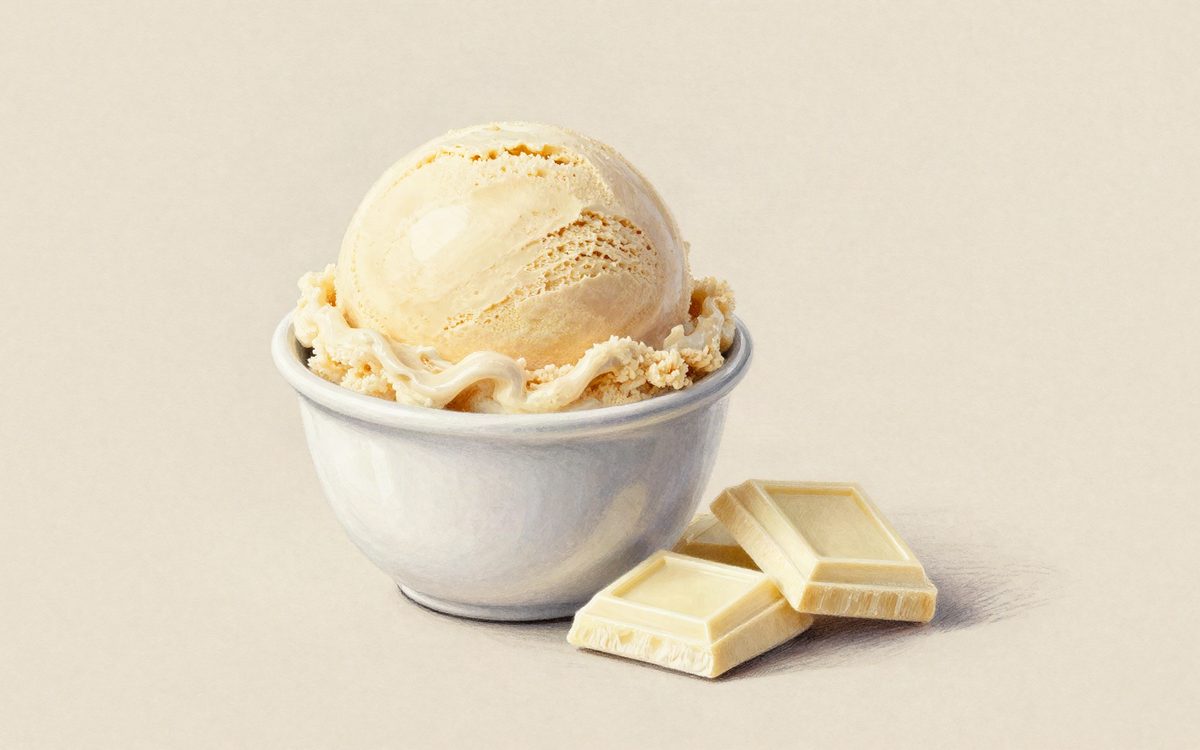
Which fat is in the bar? That is what the back of the packet is for, and at 200 g per kilo the answer decides the whole sheet: cocoa butter melts at body temperature and lets the flavour go, while the vegetable fats that stand in for it on cheap bars hang on and leave a waxy film no amount of balancing will lift. Either way the bar behaves as a premix, not a flavouring. Those 200 g deliver 11.8% sugar, 6.4% fat and 3.3% MSNF on their own, so free sucrose falls to 35 g and dextrose takes over the job of keeping the texture soft. Salt and vanilla go in because there is no cocoa bitterness to lean on.
The classic complaint about white chocolate is that it is too sweet with too little body, and the formulation answer is to trade sweetening power for freezing point depression. Dextrose at 30 g is that lever, PAC 173 against POD 64, so it lowers the freezing point without making anything sweeter. Sugars close at 18.08 percent in a 16 to 22 band, POD 165.47 against a 200 ceiling, and PAC 258.44 mid band.
Salt goes to 2 g, double what a dark chocolate base takes, because there is no cocoa bitterness here to push against and salt is the only contrast available. The 4 g of vanilla extract is not decoration either: without it, white chocolate reads as cold condensed milk. The dairy side is 300 g whole milk, 341 g skim milk, 70 g cream and 15 g of non fat dry milk, closing at 9.95 percent fat, 10.89 percent MSNF and 4.02 percent protein.
Ingredients
Makes 1000 g of finished base.
| Ingredient | Grams | Home measure |
|---|---|---|
| Skim Milk | 341 | 1 1/3 cups |
| Whole Milk | 300 | 1 1/4 cups |
| White Chocolate | 200 | |
| Heavy Cream 35% | 70 | 1/4 cup plus 1 tablespoon |
| Sugar (Sucrose) | 35 | 3 tablespoons |
| Dextrose (Glucose) | 30 | 2 1/2 tablespoons |
| Non-Fat Dry Milk | 15 | 2 1/2 tablespoons |
| Vanilla Extract (Pure) | 4 | |
| Stabilizer (Neutral) | 3 | |
| Salt | 2 |
Loads these exact grams into the free balancer, ready to edit.
Method
Base pasteurised at 80 to 82 C, chocolate melted in at 45 C, aged 6 to 8 hours, tray frozen and forked
- 1Whisk every dry ingredient together first: sugars, milk powder, stabiliser and salt. Dry-blending them stops the stabiliser clumping when it meets liquid.
- 2Warm the liquids to 40 C (104 F), then rain the dry mix in while whisking hard.
- 3Heat to 82 C (180 F) and hold for 2 minutes so the stabiliser hydrates.
- 4Melt the chocolate to 45 C (113 F) and stir it into the hot base off the heat, then blend 60 seconds until glossy.
- 5Chill in an ice bath to under 5 C (41 F) within 2 hours. Slow cooling is where bacteria and coarse crystals both start.
- 6Age 6 to 12 hours in the fridge under 5 C (41 F). This is when the stabiliser and the milk protein take up water.
- 7Freeze in a shallow metal pan 2 to 3 cm deep, breaking the crystals with a fork every 30 to 40 minutes, 4 to 6 times.
- 8Freeze firm, then temper 10 to 15 minutes in the fridge before scooping.
The balance
All six against the professional range for Milk Gelato.
Almost every number on this sheet is a consequence of the 200 g of white chocolate. It carries 11.8 percent sugar into the mix, which is why sucrose only needs 35 g to reach 18.08 percent sugars. It carries 6.4 percent fat, which is why cream stays at 70 g and most of the dairy is milk, with fat still closing at 9.95 percent. And it carries 3.3 percent MSNF, which pushes MSNF to 10.89 percent in an 8 to 11.5 band and holds non fat dry milk to just 15 g. Lactose is what makes that cap matter: 5.94 percent of the mass and 9.55 percent of the water, high enough that adding milk powder would risk a sandy texture later. Dextrose at 30 g is the remaining free lever, chosen for PAC 173 against POD 64 because the mix needs a lower freezing point and does not need more sweetness.
Estimated nutrition: ~201 kcal · Fat 10 g · Sugars 18.1 g · Protein 4 g (per 100 g of mix, from the balanced composition).
White chocolate scorches and seizes far more easily than dark, because it has milk protein and sugar without the cocoa solids that act as a buffer. Never melt it in contact with a base hotter than 45 C. Heat the dairy, pasteurise at 80 to 82 C, cool to 40 to 45 C, and only then stir in the chopped chocolate. Added at 80 C, the sugar on the surface of each piece caramelises and you get yellow flecks through an ivory base. The cocoa butter needs immediate hot homogenisation and a fast chill to 4 C; cooled slowly it crystallises coarse and leaves a waxy feel on the roof of the mouth. Six to eight hours of ageing is enough here and longer does not improve it. Watch the lactose as well: the bar itself is 16.5 percent MSNF, so its 200 g carry 3.3 percent MSNF into the mix, and this sheet already reads 9.55 percent lactose in the water.
If it goes wrong
The chocolate went into a base that was still too hot, and the sugar on the surface of the pieces caramelised.
Cool the pasteurised base to 40 to 45 C before the 200 g of chopped chocolate goes in, and stir it to dissolve off the heat.
Cocoa butter crystallised coarse because the base was chilled slowly.
Homogenise while hot and get the base down to 4 C fast, then age 6 to 8 hours. Longer ageing does not repair a slow chill.
Lactose crystallising. The sheet already reads 9.55 percent lactose in the water phase, with the 200 g of chocolate contributing 3.3 percent MSNF to the mix.
Do not raise the 15 g of non fat dry milk. If the body feels thin, add fat through the 70 g of cream rather than more milk solids.
Suitable for: Vegetarian, Egg-free
Allergens: milk
- https://icecreamcalc.com/2021/03/12/chocolate-gelato/
- https://www.gavinpublishers.com/article/view/functional-gelato-how-to-reduce-the-excessive-amount-of-added-sugars-while-still-maintaining--the-perfect-taste
- https://thisvegangirl.com/white-vegan-chocolate/
- The science behind it: White Chocolate Couverture for Gelato
- Ingredient sheet: White Chocolate
Want to change an ingredient and watch the numbers move? Open the free balancer