Watermelon Sorbet
Barely there, then everywhere at once: thin, very cold, sweet for a second or two and gone before the next spoon arrives.
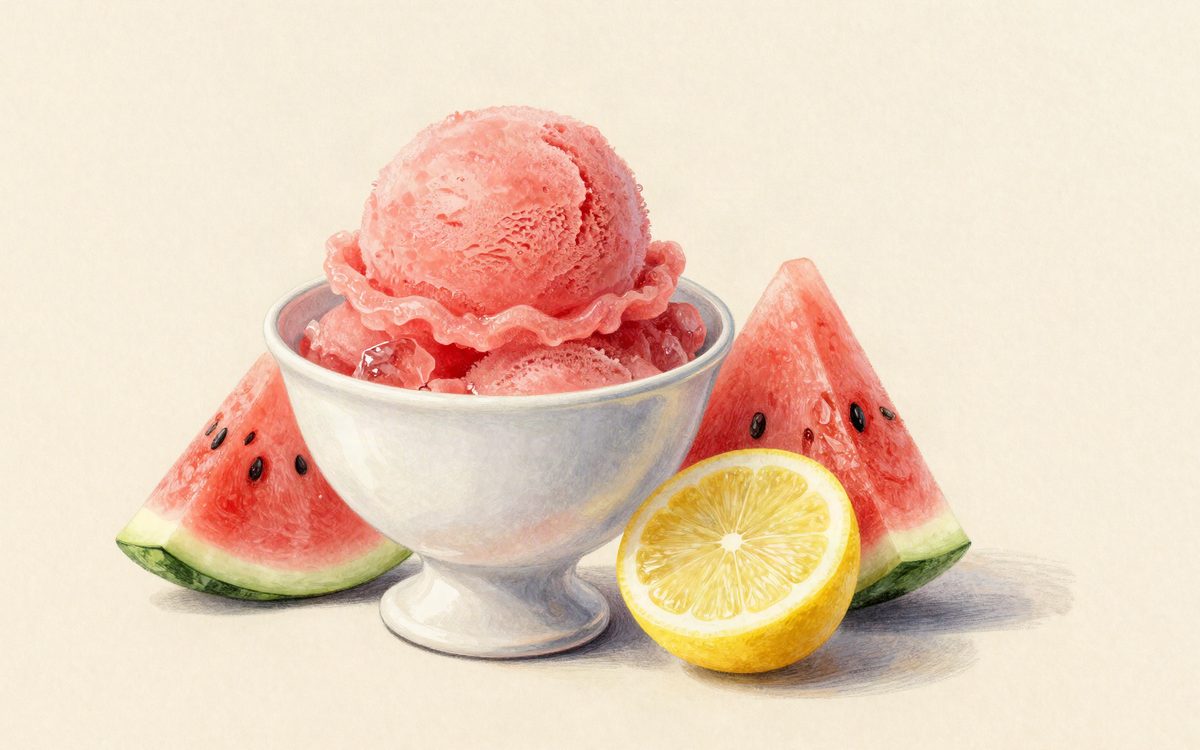
Eat it fast and the impression is mostly temperature, because the flavour is fragile and short, on the tongue and then gone, which is the honest character of the fruit and not a fault in the recipe. What keeps it from reading as flavoured ice is guar gum, hydrated cold since this mix is never heated, giving just enough drag for the mouth to notice body before the melt. Fruit sits at 620 g per kilo and cannot go higher: at 91.4 per cent water, more of it would leave no mass to carry the solids the base needs, and water already closes at 69.21 per cent.
The awkward part is that the aroma is faint and short lived, so a high fruit dose is not optional either. Both constraints pull in the same direction and meet at 620 g. The rest of the sheet is sugar work: 70 g sucrose, 65 g dextrose, 90 g glucose powder and 38 g of maltodextrin, closing at 28.96 percent sugars with POD 205.48.
PAC 322.23 in a 280 to 340 band is what keeps this from setting into a block. A fruit that is nearly all water needs an aggressive freezing point depression, which is why dextrose sits at 65 g against only 70 g of sucrose. The 90 g of glucose powder and 38 g of maltodextrin are there for dry matter and body rather than for sweetness. Guar gum at 3 g is the thickener instead of a neutral blend for one reason: it hydrates cold, and nothing on this sheet is allowed to be heated.
Ingredients
Makes 1000 g of finished base.
| Ingredient | Grams | Home measure |
|---|---|---|
| Watermelon | 620 | |
| Water | 99 | 1/3 cup plus 1 tablespoon |
| Glucose Powder | 90 | 1/3 cup plus 2 tablespoons |
| Sugar (Sucrose) | 70 | 1/3 cup |
| Dextrose (Glucose) | 65 | 1/3 cup |
| Maltodextrin | 38 | |
| Lemon Juice (Squeezed) | 15 | |
| Guar Gum | 3 |
Loads these exact grams into the free balancer, ready to edit.
Method
Juiced raw, acidified fresh, cold syrup folded in, tray frozen and forked the same day
- 1Whisk every dry ingredient together first: sugars, milk powder, stabiliser and salt. Dry-blending them stops the stabiliser clumping when it meets liquid.
- 2Warm the liquids to 40 C (104 F), then rain the dry mix in while whisking hard.
- 3Heat to 82 C (180 F) and hold for 2 minutes so the stabiliser hydrates.
- 4Chill in an ice bath to under 5 C (41 F) within 2 hours. Slow cooling is where bacteria and coarse crystals both start.
- 5Age 6 to 12 hours in the fridge under 5 C (41 F). This is when the stabiliser and the milk protein take up water.
- 6Fold the fruit in cold, after ageing. Heating it costs you the fresh aroma and nothing is gained.
- 7Freeze in a shallow metal pan 2 to 3 cm deep, breaking the crystals with a fork every 30 to 40 minutes, 4 to 6 times.
- 8Freeze firm, then temper 10 to 15 minutes in the fridge before scooping.
The balance
All six against the professional range for Sorbetto.
Water is the governing number. At 69.21 percent inside a 66 to 72 band, with the fruit itself at 91.4 percent water, 620 g of watermelon per kilo already spends most of the allowance. That is why only 99 g of extra water appears on the sheet, and it is why the solids have to be built from sugars rather than from more fruit. Sugars close at 28.96 percent, high in a 25 to 31 band, and PAC 322.23 comes out of the choice of which sugars: 65 g of dextrose against only 70 g of sucrose, because dextrose depresses the freezing point far harder for the same weight. That is what lets a mix this watery still scoop, while POD stays at 205.48 rather than becoming cloying. Fat at 0.01 percent and protein at 0.39 percent are what a fruit and water sheet looks like when nothing else is hiding in it.
Estimated nutrition: ~123 kcal · Fat 0 g · Sugars 29 g · Protein 0.4 g (per 100 g of mix, from the balanced composition).
Nothing here gets pasteurised, and nothing that touches the fruit gets heated. Heat treatment is the documented reason watermelon juice is not sold commercially in most countries: cooked, it loses the fresh note and picks up a pumpkin backnote. Juice the flesh, strain out the seeds, acidify with the 15 g of lemon juice straight away, fold in the cold syrup and freeze the same day. The guar gum is on the sheet because it hydrates in the cold, so you are never forced to warm anything to activate a stabiliser. And measure the fruit: watermelon Brix moves between 7 and 11 across the season, so the same 620 g is not always the same sugar load.
If it goes wrong
Something in the fruit path was heated. Watermelon aroma does not survive cooking and what is left reads as gourd.
Keep every step cold. Make the syrup separately, cool it fully, and only then combine it with the raw juice.
Brix drifts from 7 to 11 across the season, and at 620 g per kilo the fruit is most of the mass.
Measure the Brix of the juice and adjust the 70 g of sucrose up or down, leaving the dextrose alone since it is carrying PAC 322.23.
The sugar split was changed, usually by replacing the dextrose with plain sugar.
Keep the 65 g of dextrose, which is the piece pulling the freezing point down to PAC 322.23. The 90 g of glucose powder and 38 g of maltodextrin are doing a different job, solids and body without sweetness, so do not swap one for the other.
Suitable for: Vegan, Vegetarian, Lactose-free, Egg-free
No ingredient in this recipe contains gluten.
- https://www.ncbi.nlm.nih.gov/pmc/articles/PMC12163749/
- https://pastryartsmag.com/sponsored/simple-sorbet-science/
- https://bakersjournal.com/ingredients/the-scoop-on-gelato-4350
- The science behind it: How to Balance a Sorbetto Recipe
- Ingredient sheet: Watermelon
Want to change an ingredient and watch the numbers move? Open the free balancer