Water Based Dark Chocolate Sorbetto
Intense and almost austere, cocoa hitting hard and cold with no dairy to round it off, yet it scoops smooth instead of icy and melts clean off the tongue.
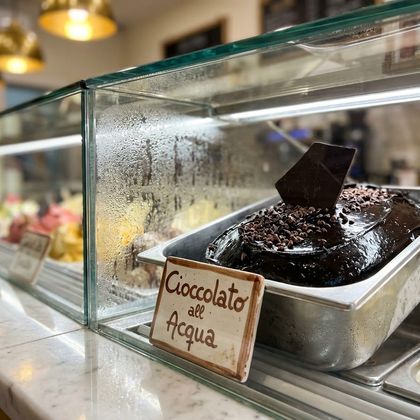
The home version of this usually comes out like a chocolate ice lolly: hard, crystalline, thin in the mouth once it warms. Water based chocolate has no milk fat and no milk solids to interrupt the ice, so the body has to be built on purpose rather than borrowed from more cocoa. Cocoa butter at 41 g per kilo is pure fat and thickens the mouthfeel without adding bitterness, while 80 g of polydextrose lifts total solids to 40.1 percent without making the sorbetto any sweeter. That is the difference between a block you chip at and something that scoops.
The cocoa itself stays moderate, 40 g of paste and 20 g of powder per kilo, lighter than a professional counter sorbetto. That keeps the bitterness in check and still leaves room to go darker: protein closes at 0.92 percent in a 0.5 to 3 range, and the questions below show a swap that keeps the balance. What gives the chocolate its weight is cocoa butter, free up to 50 g and used here at 41 g. It is pure fat, so it adds body and chocolate mouthfeel without adding bitterness. Fat closes at 6.72 percent inside a 3 to 10 band.
The squeeze is on the sugar side. Sugars have to land between 22 and 29 percent, and solids between 34 and 44. Sucrose at 200 g plus 25 g of glucose syrup DE42 put sugars at 22.07 percent, just over the floor, and every gram past that adds sweetness to a flavour meant to be dark, so the rest of the dry matter comes from something that is not a sugar: 80 g of polydextrose. Solids close at 40.1 percent, POD 210.7 inside a 160 to 250 band, PAC 270.55 inside 250 to 320, and 589 g of water.
Ingredients
Makes 1000 g of finished base.
| Ingredient | Grams | Home measure |
|---|---|---|
| Water | 589 | 2 1/2 cups |
| Sugar (Sucrose) | 200 | 1 cup |
| Polydextrose (Fiber) | 80 | |
| Cocoa Butter | 41 | |
| Cocoa Paste | 40 | |
| Glucose Syrup DE42 | 25 | 1 tablespoon |
| Cocoa Powder 22-24% | 20 | |
| Stabilizer (Neutral) | 4 | |
| Salt | 1 |
Loads these exact grams into the free balancer, ready to edit.
Method
Syrup boiled to 85 C, poured over the cocoa off the heat, blended twice, tray frozen and forked
- 1Whisk every dry ingredient together first: sugars, milk powder, stabiliser and salt. Dry-blending them stops the stabiliser clumping when it meets liquid.
- 2Warm the liquids to 40 C (104 F), then rain the dry mix in while whisking hard.
- 3Heat to 82 C (180 F) and hold for 2 minutes so the stabiliser hydrates.
- 4Melt the chocolate to 45 C (113 F) and stir it into the hot base off the heat, then blend 60 seconds until glossy.
- 5Off the heat, whisk in the paste, then blend 60 seconds so the fat emulsifies instead of separating.
- 6Chill in an ice bath to under 5 C (41 F) within 2 hours. Slow cooling is where bacteria and coarse crystals both start.
- 7Age 6 to 12 hours in the fridge under 5 C (41 F). This is when the stabiliser and the milk protein take up water.
- 8Freeze in a shallow metal pan 2 to 3 cm deep, breaking the crystals with a fork every 30 to 40 minutes, 4 to 6 times.
- 9Freeze firm, then temper 10 to 15 minutes in the fridge before scooping.
The balance
All six against the professional range for Water-Based Chocolate.
Sugars at 22.07 percent, just over the 22 floor, are the number that writes this recipe. They fix sucrose at 200 g: any less and the sheet drops under the floor, any more and a dark flavour starts to taste sweet. Once that is settled, the second job is solids at 40.1 percent inside 34 to 44: sucrose and glucose syrup stop at 22.07 percent, so 80 g of polydextrose carries the dry matter that is neither sugar nor cocoa. Cocoa butter at 41 g does the same trick on the fat side, adding structure without adding bitterness. Protein closes at 0.92 percent, low in a 0.5 to 3 range, because the cocoa is held at 60 g per kilo. Glucose syrup DE42 is chosen over more sucrose because in a water base it is what holds the structure and keeps the crystals small, with POD 40 against PAC 64.
Estimated nutrition: ~194 kcal · Fat 6.7 g · Sugars 22.1 g · Protein 0.9 g (per 100 g of mix, from the balanced composition).
Boil the water with the sugars and the polydextrose to 85 C, pour it over the cocoa paste and cocoa powder off the heat, blend for two minutes, then add the melted cocoa butter and blend again. Chocolate sorbetto is notoriously gritty, and the fix is blending twice, once while warm and once again just before freezing, which is what breaks up the cocoa starch clumps. There is no dairy here, so there is no casein to bind tannin and the astringency shows up raw. Do not reach for more salt to cover it: the 1 g stays where it is, and dextrose is the lever if you need to soften the edge. On intensity: this sheet holds total cocoa near 60 g per kilo, where professional formulas run 90 to 110 g and land at 1.3 to 2.2 percent protein, still inside the 0.5 to 3 range. Going darker is a flavour choice and does not break the balance, as long as you follow the swap in the questions below.
If it goes wrong
Cocoa starch clumped. Cocoa powder hydrates badly and one pass with the blender does not break it up.
Blend twice: two minutes when the 85 C syrup is poured over the cocoa off the heat, and again when cold, just before the mix goes into the freezer.
Tannin with nothing to bind it. A milk base has casein for that job and this sheet has none.
Leave the 1 g of salt where it is and add dextrose instead. Salt sharpens the astringency here rather than covering it.
Dry matter was cut, usually by dropping the polydextrose because it looks like an optional extra.
Keep the 80 g. It carries solids to 40.1 percent without adding sweetness, and removing it drops the sheet below the 34 percent solids floor and PAC below its 250 floor.
Suitable for: Vegan, Vegetarian, Lactose-free, Egg-free
- https://asktheicecreamqueen.com/recipes/chocolate-sorbet/
- https://buttermilkbysam.com/chocolate-sorbet/
- https://icecreamcalc.com/2021/03/12/chocolate-gelato/
- The science behind it: Cocoa Powder in Gelato
- Ingredient sheet: Cocoa Paste
- The story of this recipe: Chocolate Gelato Without a Machine (Water-Based, Intense)
Want to change an ingredient and watch the numbers move? Open the free balancer