Vegan Oat Milk Vanilla Gelato
It coats the palate before it cools it, vanilla arriving just behind, then settles into a warm cereal background that keeps going once everything else fades.
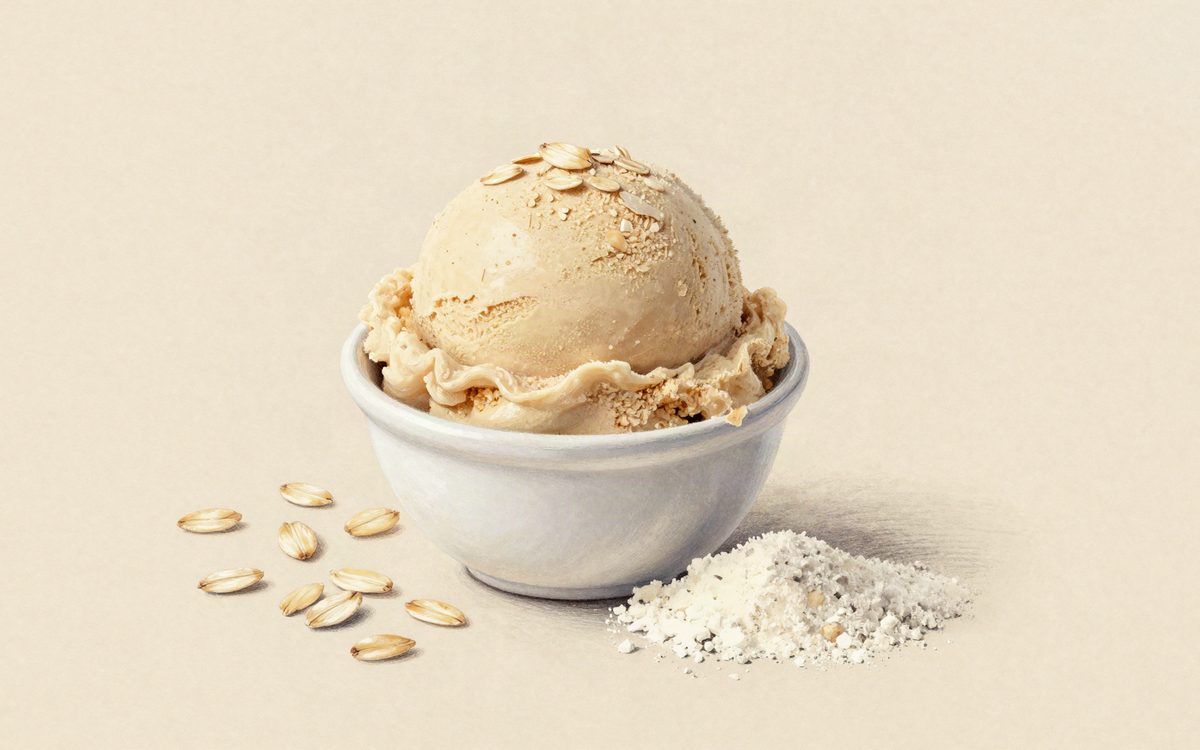
What registers first is not sweetness but coating: fat from coconut and cashew films the palate almost at once, which is what stops a dairy-free scoop feeling thin and icy. Vanilla comes through just behind, seed specks and all, and the background settles into something faintly cereal, closer to warm oats than to anything neutral. That tail is the last thing to leave. It is also why 55 g of oat flour sits in the formula and not as bulk: barista oat milk alone cannot reach the protein a vegan base needs, so the flour and the cashew paste carry it to 2.36 percent while the gelatinised starch does the job milk solids would do elsewhere.
It is structural. Barista oat milk carries roughly 1 percent protein and the plant base requires at least 1 percent in the finished mix. No combination of oat milk and added fat gets there on its own. Oat flour at about 14 percent protein plus 50 g of cashew paste at about 18 percent takes the sheet to 2.36 percent, and the gelatinised oat starch also covers part of what dried skim milk would do in a dairy recipe.
Fat is the mirror image of the same problem. Oat milk alone does not pass 2 percent, so 32 g of coconut oil and 120 g of coconut milk were left free for the solver, and fat closes at 10.04 in a 7 to 13 band. Solids land at 38.56, PAC at 255.79, and POD at 162.67 against a 195 ceiling, which is why the vanilla comes through as vanilla rather than as sweetness.
Ingredients
Makes 1000 g of finished base.
| Ingredient | Grams | Home measure |
|---|---|---|
| Oat Milk (Barista) | 399 | 1 2/3 cups |
| Water | 155 | 1/2 cup plus 2 tablespoons |
| Coconut Milk | 120 | 1/2 cup |
| Sugar (Sucrose) | 105 | 1/2 cup plus 1 tablespoon |
| Dextrose (Glucose) | 65 | 1/3 cup |
| Oat Flour | 55 | |
| Cashew Paste 100% | 50 | |
| Coconut Oil | 32 | |
| Vanilla Bean | 6 | |
| Vanilla Extract | 5 | |
| Carob Seed Flour | 4 | |
| Soy Lecithin | 3 | |
| Salt | 1 |
Loads these exact grams into the free balancer, ready to edit.
Method
Pod infused at 65 C, oat starch gelatinised at 85 C, extract added under 30 C, aged cold
- 1Whisk every dry ingredient together first: sugars, milk powder, stabiliser and salt. Dry-blending them stops the stabiliser clumping when it meets liquid.
- 2Warm the liquids to 40 C (104 F), then rain the dry mix in while whisking hard.
- 3Heat to 82 C (180 F) and hold for 2 minutes so the stabiliser hydrates.
- 4Off the heat, whisk in the paste, then blend 60 seconds so the fat emulsifies instead of separating.
- 5Chill in an ice bath to under 5 C (41 F) within 2 hours. Slow cooling is where bacteria and coarse crystals both start.
- 6Age 6 to 12 hours in the fridge under 5 C (41 F). This is when the stabiliser and the milk protein take up water.
- 7Freeze in a shallow metal pan 2 to 3 cm deep, breaking the crystals with a fork every 30 to 40 minutes, 4 to 6 times.
- 8Freeze firm, then temper 10 to 15 minutes in the fridge before scooping.
The balance
All six against the professional range for Vegan Creamy Base.
Protein 2.36 percent and fat 10.04 percent both sit mid band, and neither arrived by itself. Protein comes from the oat flour and the cashew: the 55 g of oat flour at roughly 14 percent protein and the 50 g of cashew paste at about 18 percent take it to 2.36, well above the 1 percent floor. Fat is the reason coconut appears twice, as 32 g of oil and 120 g of milk, since oat milk tops out near 2 percent on its own. MSNF is zero against a 1 percent ceiling, so there is no lactose anywhere and the sandiness check passes outright, but that also means the gelatinised oat starch is carrying dry extract that skim milk powder would normally supply. PAC 255.79 sits comfortably inside the 220 to 310 window, so the base firms at a rate you can fork rather than setting hard.
Estimated nutrition: ~204 kcal · Fat 10 g · Sugars 18.9 g · Protein 2.4 g (per 100 g of mix, from the balanced composition).
The oat starch has to gelatinise, and that is the step this sheet lives or dies by. Take the mix to 85 C and hold 2 to 3 minutes with constant agitation, otherwise the 55 g of oat flour settles and the base tastes of raw porridge. The opposite risk is real too: oat plus residual enzymes ferments and sweetens itself if it sits warm, so chill below 10 C inside two hours. For the vanilla, split and scrape the pod and infuse seeds and husk together in the liquid at 65 C for 30 minutes before climbing to 85 C, then pull the husk before homogenising. The 5 g of extract goes in after cooling, with the base below 30 C, so the vanillin does not leave with the steam. One to two minutes with a stick blender after pasteurising is what makes the oat flour disappear on the palate.
If it goes wrong
The base never reached gelatinisation. At 55 g of oat flour per kilo the starch has to be cooked or it stays sandy and cereal flavoured.
Hold 85 C for 2 to 3 minutes stirring, then blend for a minute with a stick blender before chilling.
It cooled too slowly. Oat enzymes keep working while the mix is warm and break starch down into sugar.
Ice bath it to under 10 C within two hours of cooking, then age at 4 C.
The extract went in hot. Vanillin is volatile and leaves with the steam at 85 C.
Infuse the 6 g of pod hot, but add the 5 g of extract only once the base is below 30 C.
Suitable for: Vegan, Vegetarian, Lactose-free, Egg-free
Allergens: gluten, soy, tree nuts
- https://www.icecreamscience.com/blog/vegan-ice-cream-selecting-a-non-dairy-fat
- https://books.lib.uoguelph.ca/icecreamtechnologyebook/chapter/milk-solids-not-fat/
- https://www.recipal.com/ingredients/22555-nutrition-facts-calories-protein-carbs-fat-oat-flour-whole-grain
- https://icecreamcalc.com/stabilizers/
- The science behind it: Complete Guide to Vegan Gelato
- Ingredient sheet: Oat Milk (Barista)
Want to change an ingredient and watch the numbers move? Open the free balancer