Vegan Oat Milk Coffee Gelato
The coffee reads cleaner than it would with milk fat rounding it off, over a firm, cold body that turns creamy on the tongue as it melts.
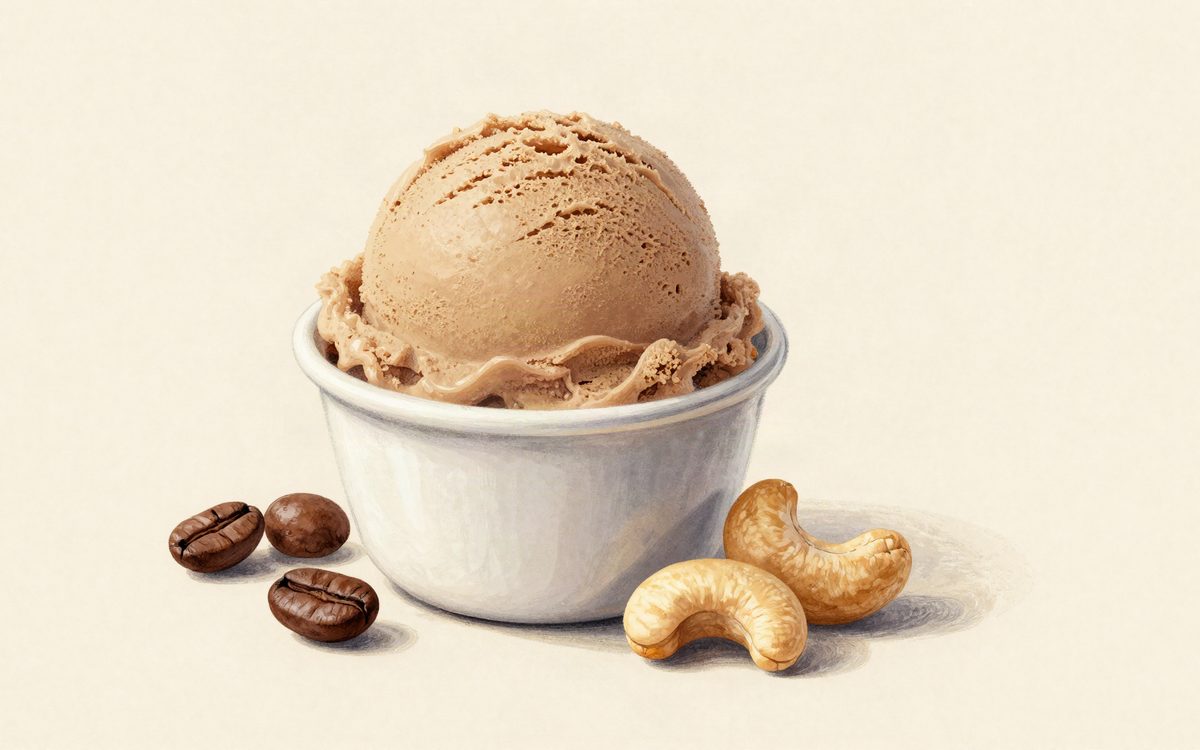
Set it beside a dairy coffee gelato and the losses are worth naming: milk fat coats the tongue in a way coconut oil only approximates, and the structure milk protein gives a base has to be assembled here out of parts. What it wins is the coffee, which comes through sharper and cleaner with no dairy fat rounding off the bitter edges. Three plant levers cover three separate jobs. Cashew paste at 88 g is the one ingredient that brings fat and protein together while staying neutral enough not to argue with espresso, coconut oil sets firm at cabinet temperature, and 25 g of oat flour supplies the beta glucan that reads as creaminess.
Cashew paste at 88 g is the first, and the only ingredient in the catalogue that fixes fat and protein at the same time, at roughly 47 percent fat and 18 percent protein. It is also the most neutral tasting of them, which matters when the flavour is coffee. Coconut oil at 44 g is pure fat and nothing else, highly saturated, so it sets firm at serving temperature. Oat flour at 25 g brings beta glucan, the polysaccharide behind the creamy feel of oats, plus solids that do not sweeten.
Coffee comes in twice: 90 g of espresso and 8 g of instant. That split keeps intensity high without flooding a base that already depends on plant liquid for structure. Sugars land at 18.61 percent, low in a 17 to 24 band, and POD at 160.23 sits far under the 195 ceiling, so this one reads of coffee rather than of sweet. Fat closes at 9.98 and protein at 2.5.
Ingredients
Makes 1000 g of finished base.
| Ingredient | Grams | Home measure |
|---|---|---|
| Oat Milk (Barista) | 400 | 1 2/3 cups |
| Water | 170 | 2/3 cup plus 1 tablespoon |
| Sugar (Sucrose) | 105 | 1/2 cup plus 1 tablespoon |
| Espresso (Rich) | 90 | |
| Cashew Paste 100% | 88 | |
| Dextrose (Glucose) | 65 | 1/3 cup |
| Coconut Oil | 44 | |
| Oat Flour | 25 | |
| Instant Coffee | 8 | |
| Carob Seed Flour | 4 | |
| Salt | 1 |
Loads these exact grams into the free balancer, ready to edit.
Method
Carob and oat flour hydrated at 80 to 85 C, coconut oil sheared in hot, coffee added cold, aged 12 hours
- 1Whisk every dry ingredient together first: sugars, milk powder, stabiliser and salt. Dry-blending them stops the stabiliser clumping when it meets liquid.
- 2Warm the liquids to 40 C (104 F), then rain the dry mix in while whisking hard.
- 3Heat to 82 C (180 F) and hold for 2 minutes so the stabiliser hydrates.
- 4Off the heat, whisk in the paste, then blend 60 seconds so the fat emulsifies instead of separating.
- 5Chill in an ice bath to under 5 C (41 F) within 2 hours. Slow cooling is where bacteria and coarse crystals both start.
- 6Age 6 to 12 hours in the fridge under 5 C (41 F). This is when the stabiliser and the milk protein take up water.
- 7Freeze in a shallow metal pan 2 to 3 cm deep, breaking the crystals with a fork every 30 to 40 minutes, 4 to 6 times.
- 8Freeze firm, then temper 10 to 15 minutes in the fridge before scooping.
The balance
All six against the professional range for Vegan Creamy Base.
Fat 9.98 and protein 2.5 are both built rather than inherited, and that is the story of this sheet. Without casein there is no protein network holding water, so the recipe leans harder on viscosity: the carob seed flour and the 25 g of oat flour together stand in for it, which is why the hydration step is not optional. PAC 252.63 in a 220 to 310 band sets the freezing behaviour, and it is doing more work than usual because sugars sit low in their band at 18.61 percent, meaning very little of the antifreeze arrives as sweetness you can taste. Water at 61.66 percent against a 65 ceiling is tight for a recipe with 90 g of espresso in it, and that is exactly why part of the coffee is 8 g of instant, which brings flavour with almost no water attached.
Estimated nutrition: ~203 kcal · Fat 10 g · Sugars 18.6 g · Protein 2.5 g (per 100 g of mix, from the balanced composition).
Three temperature rules, all specific to this base. First, hydrate the carob seed flour and the oat flour at 80 to 85 C for at least 2 minutes with the whisk moving, because if the gum does not develop there is nothing holding the water and you will taste ice. Oat starch gelatinises in the same window and thickens further once cold, so judge viscosity after ageing and never in the pan. Second, the coconut oil goes in hot, into a hot base, under a high shear stick blender: added cold, or merely stirred, it separates and comes back as fat specks on the spoon. Third, the coffee goes in cold at the end. There is no acid risk to curdle anything here, but there is aroma to lose to heat. Age 12 hours minimum at 4 C so the coconut fat crystallises properly. Worth saying plainly: this is not a pure oat recipe, it needs the cashew to reach fat and protein at all.
If it goes wrong
The carob seed flour and the oat flour never hydrated. Below 80 C the gum does not develop, and with no casein there is nothing else holding water.
Hold 80 to 85 C for at least 2 minutes with constant agitation before chilling.
The 44 g of coconut oil was stirred in rather than emulsified, or it went into a base that had already cooled.
Blend it into the hot base with a stick blender for a full minute, then chill fast.
The espresso went in while the base was still hot, so the volatile aroma left with the steam and the cereal note moved to the front.
Cool the base first, then add the 90 g of espresso and the 8 g of instant coffee cold, at the end.
Suitable for: Vegan, Vegetarian, Lactose-free, Egg-free
Allergens: gluten, tree nuts
- https://foodnouveau.com/how-to-make-vegan-gelato/
- https://under-belly.org/vegan-ice-cream-it-can-actually-be-good/
- https://www.cucina.li/en/how-to-make-vegan-ice-cream-from-ingredient-selection-to-balancing/
- https://www.texanerin.com/vegan-chocolate-ice-cream/
- The science behind it: Complete Guide to Vegan Gelato
- Ingredient sheet: Espresso (Rich)
Want to change an ingredient and watch the numbers move? Open the free balancer