Vegan Mango Gelato
The fruit leads and coconut answers underneath, on a body that melts slowly and never announces itself as the version without any milk in it.
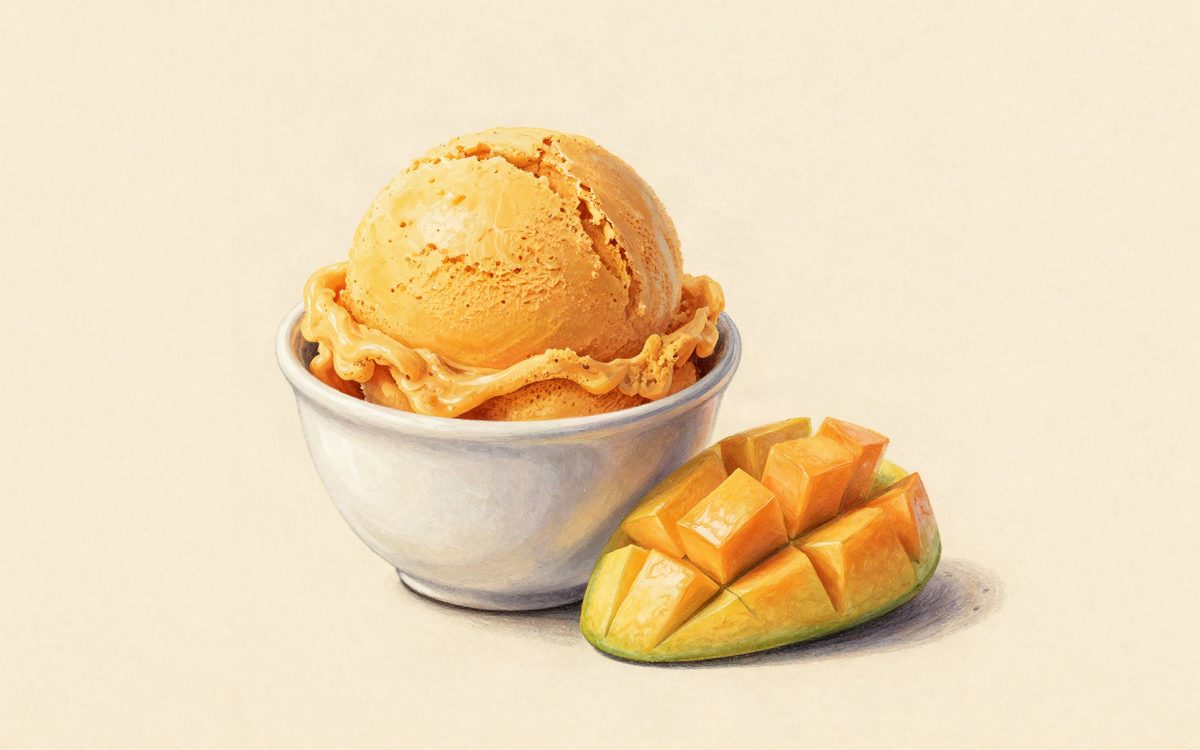
Taking the dairy out of a mango gelato costs less than most people expect and more than nothing at all. Coconut milk supplies the fat the fruit has none of, cashew paste covers the protein, and the mix closes at 10.45% fat, so the body is genuinely creamy rather than icy. The loss is that coconut is not neutral the way milk is: you taste it beside the fruit instead of behind it. Sweetness is the other constraint, since ripe fruit arrives sweet already and POD closes at 185.71 against a 195 ceiling for a plant base, which is why sucrose sits at its floor of 80 g and glucose powder carries solids that sugar would otherwise have to bring.
That single number explains the sugar split. Sucrose sits at 80 g, its floor here, because every extra gram of sucrose spends POD the recipe does not have. Glucose powder at 40 g and dextrose at 35 g do the rest, adding solids and PAC without adding much perceived sweetness. PAC lands at 255.17 in a 220 to 310 band, so the mix stays workable in a cabinet held at -11 to -14 C.
Mango carries almost no fat and about 1 percent protein, so both have to come from elsewhere. Coconut milk at 319 g is the fat, and the pairing is not decoration: it is what puts fat at 10.45 in a 7 to 13 band while making a flavour combination that already works. Cashew paste at 70 g brings protein to 2.35 percent. Lemon juice at 6 g is small and load bearing, because a ripe mango with no perceived acidity reads cloying.
Ingredients
Makes 1000 g of finished base.
| Ingredient | Grams | Home measure |
|---|---|---|
| Coconut Milk | 319 | 1 1/3 cups |
| Mango | 310 | |
| Oat Milk (Barista) | 120 | 1/2 cup |
| Sugar (Sucrose) | 80 | 1/3 cup plus 1 tablespoon |
| Cashew Paste 100% | 70 | |
| Glucose Powder | 40 | 3 1/2 tablespoons |
| Dextrose (Glucose) | 35 | 3 tablespoons |
| Inulin (Vegetable Fiber) | 15 | |
| Lemon Juice | 6 | |
| Carob Seed Flour | 4 | |
| Coconut Oil | 1 |
Loads these exact grams into the free balancer, ready to edit.
Method
White base cooked and chilled first, raw mango puree folded in cold, tray frozen and forked
- 1Whisk every dry ingredient together first: sugars, milk powder, stabiliser and salt. Dry-blending them stops the stabiliser clumping when it meets liquid.
- 2Warm the liquids to 40 C (104 F), then rain the dry mix in while whisking hard.
- 3Heat to 82 C (180 F) and hold for 2 minutes so the stabiliser hydrates.
- 4Off the heat, whisk in the paste, then blend 60 seconds so the fat emulsifies instead of separating.
- 5Chill in an ice bath to under 5 C (41 F) within 2 hours. Slow cooling is where bacteria and coarse crystals both start.
- 6Age 6 to 12 hours in the fridge under 5 C (41 F). This is when the stabiliser and the milk protein take up water.
- 7Fold the fruit in cold, after ageing. Heating it costs you the fresh aroma and nothing is gained.
- 8Freeze in a shallow metal pan 2 to 3 cm deep, breaking the crystals with a fork every 30 to 40 minutes, 4 to 6 times.
- 9Freeze firm, then temper 10 to 15 minutes in the fridge before scooping.
The balance
All six against the professional range for Vegan Creamy Base.
POD 185.71 and fat 10.45 govern this sheet. POD is close to its 195 ceiling because 310 g of mango arrives already sweet, so the sugar system had to be built out of glucose powder and dextrose rather than sucrose, and sucrose stayed pinned at 80 g. That is why the gelato reads as fruit and not as syrup even at 21.2 percent total sugars. Fat at 10.45 is the second one, and none of it comes from the mango: 319 g of coconut milk, 70 g of cashew paste and a single gram of coconut oil is the entire fat system. Protein 2.35 in a 1 to 3.5 band is almost all cashew, since mango contributes about 1 percent. Water at 61.4 percent sits mid band, which matters on a fruit sheet, because fruit is mostly water and it is easy to end up over the 65 percent limit with ice you can feel.
Estimated nutrition: ~207 kcal · Fat 10.5 g · Sugars 21.2 g · Protein 2.4 g (per 100 g of mix, from the balanced composition).
The one number here you cannot take from a table is the mango itself. Variety and ripeness swing Brix from around 12 to over 20, and the balance assumes 14 percent sugar. A very ripe fruit can push POD past 195 on its own, so measure with a refractometer before you commit. Mango also carries long fibres near the stone; push the puree through a fine sieve or you will feel threads between your teeth. The fruit goes in raw and cold, after the coconut and cashew base has been pasteurised and chilled. Mango does contain active proteases, milder than pineapple or papaya but present, and on this base that is a non issue rather than a hazard, since there is no milk protein for them to break down. Even so, do not hold the finished mix more than 24 hours before freezing.
If it goes wrong
The fruit was riper than the 14 percent sugar the balance assumes, so POD went past its 195 ceiling. Sweetness above that level buries fruit aroma.
Check Brix with a refractometer. If the mango reads above 16, cut the 40 g of glucose powder first, then the dextrose, and leave the 80 g of sucrose alone.
Puree went straight from the blender into the base. The fibres that sit against the stone survive both blending and freezing.
Sieve the puree fine before weighing the 310 g into the mix.
Water ran over. Mango is mostly water and this sheet already sits at 61.4 percent against a 65 ceiling, so extra juice or thinner coconut milk tips it.
Use full fat coconut milk, add no water or juice beyond the 6 g of lemon, and fork the crystals every 30 to 40 minutes while it freezes.
Suitable for: Vegan, Vegetarian, Lactose-free, Egg-free
Allergens: gluten, tree nuts
- https://www.aprifel.com/en/nutritional-sheet/mango/
- https://www.eccounpoco.com/blog/sugars-in-gelato
- https://scoop-science.com/blog/pac-vs-pod
- https://www.icecreamscience.com/blog/vegan-ice-cream-selecting-a-non-dairy-fat
- The science behind it: Complete Guide to Vegan Gelato
- Ingredient sheet: Mango
Want to change an ingredient and watch the numbers move? Open the free balancer