Vegan Dulce de Leche Gelato with Coconut
There is caramel and molasses at the front, coconut underneath, and a thick, slow melt that never once reads as a stand-in for something dairy.
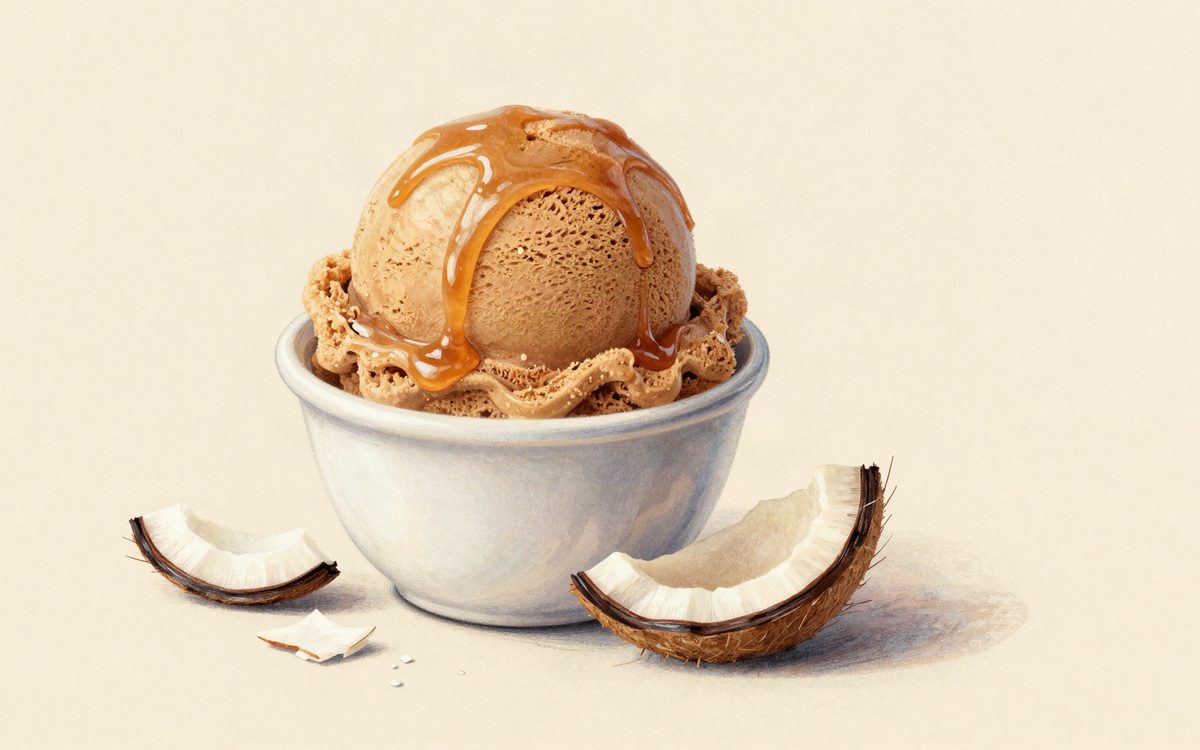
What Argentina and the River Plate do with a tin of condensed milk, cook it slowly until the sugar browns and the whole thing thickens, is the method being copied here without the cow. Vegetable condensed milk is the right starting point because it is structurally the same object: sugar and fat already concentrated together at 71.5 percent solids and 46.7 percent sugars, so 180 g per kilo bring around 84 g of sugars on their own and free sucrose falls back to 35 g. Muscovado supplies the molasses note a weaker vegetable Maillard will not build alone, and soy milk is in there purely for protein, which the condensed milk has none of.
It also explains the number that looks strange at first glance: 302 g of added water. When the flavour ingredient is a concentrate, the water has to be deliberately put back. Water closes at 61.7 percent and solids at 38.3, the lowest solids in this set and still comfortably inside a 35 to 42 band.
The structural gap is protein. Vegetable condensed milk has none, and the base needs at least 1 percent. Cashew paste supplies some, but each gram of cashew brings nearly half a gram of fat, and the ceiling is 13 percent. So 187 g of soy milk, at 3.5 percent protein against only 2.1 percent fat, is the protein lever, cashew stays contained at 83 g, and the sheet closes at 2.51 percent protein with fat at 10.52. 25 g of muscovado covers the molasses note that vegetable browning, which is weaker, will not produce on its own.
Ingredients
Makes 1000 g of finished base.
| Ingredient | Grams | Home measure |
|---|---|---|
| Water | 302 | 1 1/4 cups |
| Soy Milk (Unsweetened) | 187 | |
| Vegetable Condensed Milk | 180 | |
| Coconut Milk | 110 | 1/3 cup plus 2 tablespoons |
| Cashew Paste 100% | 83 | |
| Dextrose (Glucose) | 50 | 1/4 cup |
| Sugar (Sucrose) | 35 | 3 tablespoons |
| Muscovado Sugar | 25 | |
| Coconut Milk Powder | 20 | |
| Stabilizer (Neutral) | 4 | |
| Salt | 2 | |
| Inulin (Vegetable Fiber) | 2 |
Loads these exact grams into the free balancer, ready to edit.
Method
Condensed milk caramelised alone at 105 to 110 C, dissolved into the warm base, aged 8 to 12 hours
- 1Whisk every dry ingredient together first: sugars, milk powder, stabiliser and salt. Dry-blending them stops the stabiliser clumping when it meets liquid.
- 2Warm the liquids to 40 C (104 F), then rain the dry mix in while whisking hard.
- 3Heat to 82 C (180 F) and hold for 2 minutes so the stabiliser hydrates.
- 4Off the heat, whisk in the paste, then blend 60 seconds so the fat emulsifies instead of separating.
- 5Chill in an ice bath to under 5 C (41 F) within 2 hours. Slow cooling is where bacteria and coarse crystals both start.
- 6Age 6 to 12 hours in the fridge under 5 C (41 F). This is when the stabiliser and the milk protein take up water.
- 7Freeze in a shallow metal pan 2 to 3 cm deep, breaking the crystals with a fork every 30 to 40 minutes, 4 to 6 times.
- 8Freeze firm, then temper 10 to 15 minutes in the fridge before scooping.
The balance
All six against the professional range for Vegan Creamy Base.
Protein 2.51 percent and fat 10.52 percent are the pair that decides everything else. The flavour ingredient contributes zero protein, so the 1 percent floor has to be met by ingredients that are not the flavour, and the cheapest way to buy protein without buying fat is soy milk at 3.5 percent protein to 2.1 percent fat, the best protein to fat ratio available on the plant side. On the sugar side, 180 g of condensed milk already carries around 84 g of sugars, so the sheet closes at 19.81 percent sugars with only 35 g of free sucrose, and the 50 g of dextrose is there for PAC rather than for sweetness: PAC 253.09 in a 220 to 310 band with POD at 184.84 under a 195 ceiling. Inulin drops to 2 g on this one, because the condensed milk is already supplying the dry extract that inulin has to cover for elsewhere.
Estimated nutrition: ~206 kcal · Fat 10.5 g · Sugars 19.8 g · Protein 2.5 g (per 100 g of mix, from the balanced composition).
Caramelise the vegetable condensed milk on its own, in a water bath or over very low heat, to an amber colour, roughly 105 to 110 C for 20 to 30 minutes, and only then dissolve it into the warm base. Caramelise it together with the coconut milk and the lauric fat separates and will not re emulsify. Expect the colour to arrive slower and paler than dairy dulce de leche, because there is no casein and no lactose driving the browning: the 25 g of muscovado and the 2 g of salt are the compensation for that, not decoration. The other risk is soy protein flocculating, so never acidify this base and never pour the soy milk onto the hot caramel. Always the other way round. Pasteurise at 85 C for 30 seconds and age 8 to 12 hours at 4 C.
If it goes wrong
The condensed milk was caramelised together with the coconut milk. Lauric fat separates at those temperatures and does not re emulsify.
Caramelise the 180 g of condensed milk alone in a water bath, then dissolve the finished caramel into the warm base.
The browning did not go far enough, or the muscovado and salt were skipped. With no casein and no lactose, vegetable Maillard is slow and pale by nature.
Hold the caramelisation at 105 to 110 C for the full 20 to 30 minutes until it is genuinely amber, and keep the 25 g of muscovado and 2 g of salt in. They are structural to the flavour here.
The soy milk was poured onto hot caramel. Soy protein flocculates against heat shock and the change is permanent.
Reverse the order: bring the caramel into the soy milk base, warm, stirring, never the reverse. Do not add anything acidic to this mix at any stage.
Suitable for: Vegan, Vegetarian, Lactose-free, Egg-free
Allergens: soy, tree nuts
- Goff & Hartel, Ice Cream, 7th ed., Springer 2013, cap. 4, funcao das proteinas na estrutura e no overrun: https://link.springer.com/book/10.1007/978-1-4614-6096-1
- University of Guelph, Ice Cream Structure (estabilizacao de bolha de ar por proteina e gordura): https://www.uoguelph.ca/foodscience/book-page/ice-cream-structure
- USDA FoodData Central, composicao de leite de soja, leite de coco e leite de coco em po: https://fdc.nal.usda.gov/
- The science behind it: Complete Guide to Vegan Gelato
- Ingredient sheet: Coconut Milk
Want to change an ingredient and watch the numbers move? Open the free balancer