Vegan Date Caramel Gelato
Cooked flavour with nothing cooked in it: deep, treacly and faintly salty, thick enough to coat the tongue and slow to fade once the cold lets go.
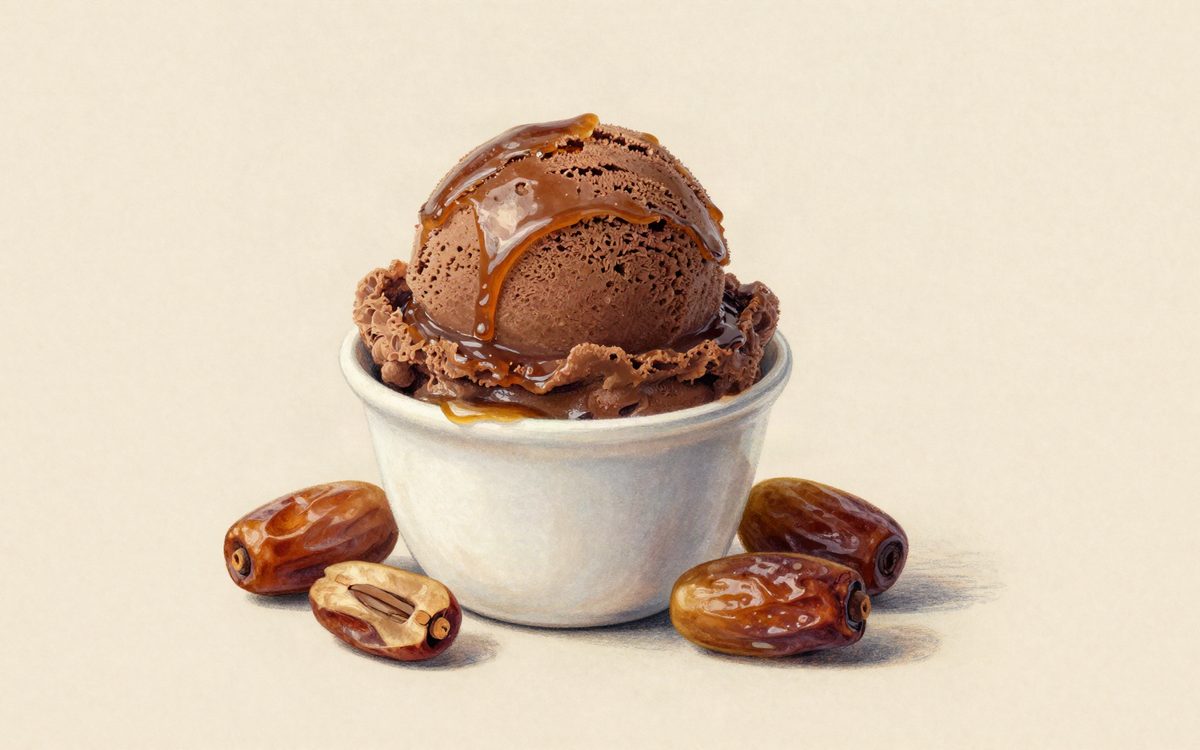
Long after the spoon has gone, something rich is still sitting on the tongue. That tail is the fat: cashew and coconut coat the palate on contact, so the entry is round rather than sharp, and the whole scoop eats warmer than a freezer would suggest. The caramel builds in between, dried fruit and a little molasses and the toasted edge the fruit picked up as it dried, never the scorch of burnt sugar. Salt turns up halfway through and cuts the sweetness before it can settle. At 160 g per kilo the dates carry about half the sweet load, which is why the added sucrose stays down at 40 g.
That is why free sucrose is only 40 g, and it has to be. Sugars close at 18.22 percent, low in a 17 to 24 band, yet there is simply no room to add more. At the same time POD reads 188.36 against a 195 ceiling. Put those two side by side and you have the whole recipe: low sugar by weight, close to the most sweetness by perception, because inverted sugars are sweeter per gram than sucrose.
20 g of coconut sugar reinforces the molasses note without weighing much on the sugar line, and 2 g of salt is what separates the taste of dates from the taste of caramel. Fat and protein are assembled from 84 g of cashew paste, 120 g of coconut milk and 30 g of coconut oil, closing at 10.49 percent fat and 2.5 percent protein, and 17 g of inulin covers for MSNF, which reads 0.00.
Ingredients
Makes 1000 g of finished base.
| Ingredient | Grams | Home measure |
|---|---|---|
| Oat Milk (Barista) | 318 | 1 1/3 cups |
| Water | 205 | 3/4 cup plus 2 tablespoons |
| Dried Dates | 160 | |
| Coconut Milk | 120 | 1/2 cup |
| Cashew Paste 100% | 84 | |
| Sugar (Sucrose) | 40 | 3 1/2 tablespoons |
| Coconut Oil | 30 | |
| Coconut Sugar | 20 | |
| Inulin (Vegetable Fiber) | 17 | |
| Stabilizer (Neutral) | 4 | |
| Salt | 2 |
Loads these exact grams into the free balancer, ready to edit.
Method
Dates soaked at 60 to 70 C, blended and pushed through a fine sieve, pasteurised at 85 C
- 1Whisk every dry ingredient together first: sugars, milk powder, stabiliser and salt. Dry-blending them stops the stabiliser clumping when it meets liquid.
- 2Warm the liquids to 40 C (104 F), then rain the dry mix in while whisking hard.
- 3Heat to 82 C (180 F) and hold for 2 minutes so the stabiliser hydrates.
- 4Off the heat, whisk in the paste, then blend 60 seconds so the fat emulsifies instead of separating.
- 5Chill in an ice bath to under 5 C (41 F) within 2 hours. Slow cooling is where bacteria and coarse crystals both start.
- 6Age 6 to 12 hours in the fridge under 5 C (41 F). This is when the stabiliser and the milk protein take up water.
- 7Freeze in a shallow metal pan 2 to 3 cm deep, breaking the crystals with a fork every 30 to 40 minutes, 4 to 6 times.
- 8Freeze firm, then temper 10 to 15 minutes in the fridge before scooping.
The balance
All six against the professional range for Vegan Creamy Base.
Sugars at 18.22 percent sitting low in a 17 to 24 band while POD reads 188.36 just under a 195 ceiling is not a coincidence, it is the whole design. Date sugars are already inverted, and inverted sugars are both sweeter per gram and more anticryoscopic per gram than sucrose. So 160 g of dates buys sweetness and freezing point depression at the same time, and the recipe runs out of POD headroom long before it runs out of sugar allowance. That is exactly why free sucrose is held down at 40 g. PAC lands at 259.03 in a 220 to 310 window, which is mid band and deliberate, because pushing the dates higher would carry PAC up with them and the base would never firm properly. Fat at 10.49 percent is split three ways so that raising cashew paste to serve protein, which sits at 2.5 percent, does not immediately threaten the 13 percent fat ceiling, since every gram of cashew brings nearly half a gram of fat with it.
Estimated nutrition: ~207 kcal · Fat 10.5 g · Sugars 18.2 g · Protein 2.5 g (per 100 g of mix, from the balanced composition).
Dried dates are fibrous and the fibre is the whole problem. Soak them in part of the liquid at 60 to 70 C for 20 minutes, blend to a smooth paste, and push that paste through a fine sieve before it goes anywhere near the base. Skip the sieve and the insoluble fibre is noticeable on the spoon: the gelato reads sandy even though there is no lactose in it at all and nothing crystalline to blame. Pasteurise the base at 85 C for 30 seconds. Do not caramelise the 20 g of coconut sugar separately, since it already carries its own Maillard compounds and its residual proteins scorch easily. One thing to watch: the free fructose in dates is hygroscopic, so if your fruit is very dry the real PAC runs above the calculated 259.03 and the result is softer than expected. Buy plump, soft dried fruit rather than the hardest you can find, because this sheet has no free dextrose to trim as a correction. The only free sugar in it is 40 g of sucrose, and sugars already sit low in their band.
If it goes wrong
The date paste was not sieved. That is insoluble fibre, not sugar crystals and not lactose, since this base has none of either.
Blend the soaked dates smooth and force the paste through a fine sieve. Discard what stays behind. It is fibre and it will not dissolve later.
Very dry dates carry more free fructose per gram than the sheet assumes, so the real PAC ran above the calculated 259.03.
Use plump, soft dried dates and weigh them at 160 g. There is no free dextrose here to cut back on, and the 40 g of sucrose already leaves sugars low in their band.
The 2 g of salt or the 20 g of coconut sugar was left out. Those two are what read as caramel; the dates on their own read as fruit.
Put both back at full dose. Salt at 2 g per kilo is twice what most of these bases carry, and that is the point on this flavour.
Suitable for: Vegan, Vegetarian, Lactose-free, Egg-free
Allergens: gluten, tree nuts
- Goff & Hartel, Ice Cream, 7th ed., Springer 2013, cap. 3, adocantes e depressao crioscopica: https://link.springer.com/book/10.1007/978-1-4614-6096-1
- University of Guelph, Dairy Science and Technology, Ice Cream Manufacture (papel dos acucares e do PAC na base): https://www.uoguelph.ca/foodscience/book-page/ice-cream-manufacture
- USDA FoodData Central, composicao de tamara desidratada (acucares, fibra, umidade): https://fdc.nal.usda.gov/
- The science behind it: Complete Guide to Vegan Gelato
- Ingredient sheet: Dried Dates
Want to change an ingredient and watch the numbers move? Open the free balancer