Vegan Cookies and Cream Gelato
Biting through the biscuit is unchanged; what shifts is the base under it, lighter and cooler in the mouth, with a coconut note sitting behind the vanilla.
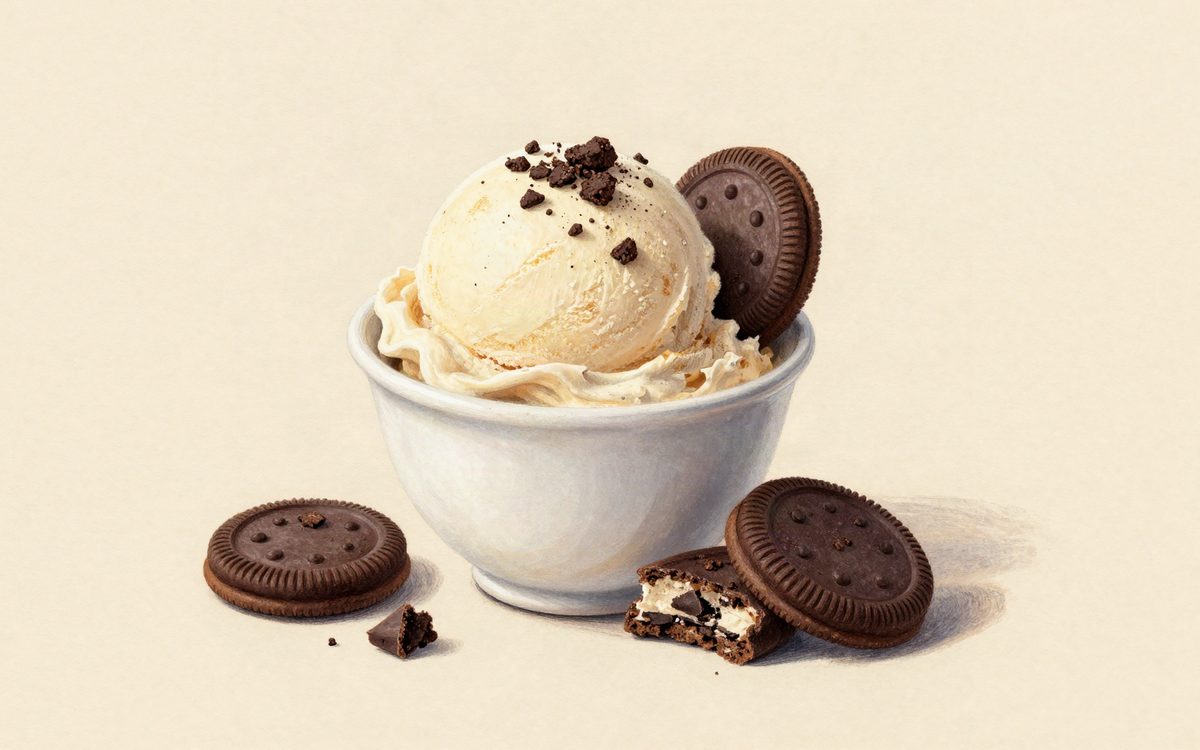
Swapping the dairy out costs this base its milk-protein backbone and buys back a cooler, cleaner mouth. What it loses is structure: with no MSNF at all the body is softer and the melt quicker, and protein sits at 2.34 percent. What it gains is definition, because coconut fat melts low and sharp, so the cocoa biscuit comes through less muffled than it does under butterfat. Oat milk and cashew paste rebuild what they can, coconut milk carries fat to 10.45 percent, and the biscuit goes in at 95 g per kilo. One label check decides the whole thing: many cocoa biscuits contain milk fat or whey, so the packet has to say dairy-free.
That is why free sucrose sits at 80 g, the bottom of its range, with 60 g of dextrose alongside, and sugars still close at 19.29 percent. The rest of the fat, up to 10.45 percent, comes from 200 g of coconut milk. Protein is the gap, because biscuit carries barely any at around 5.5 percent, so 58 g of cashew paste plus 349 g of barista oat milk bring it to 2.34.
One thing this page has to say out loud, because the numbers cannot: the biscuit has to be certified dairy free. A generic cocoa biscuit is very often made with milk fat or whey, and if yours is, the recipe contradicts its own title while all eight indicators stay exactly where they are. MSNF reads 0.00 here only because the ingredient list says it should.
Ingredients
Makes 1000 g of finished base.
| Ingredient | Grams | Home measure |
|---|---|---|
| Oat Milk (Barista) | 349 | 1 1/2 cups |
| Coconut Milk | 200 | 3/4 cup plus 1 tablespoon |
| Water | 145 | 1/2 cup plus 2 tablespoons |
| Chocolate Biscuit | 95 | |
| Sugar (Sucrose) | 80 | 1/3 cup plus 1 tablespoon |
| Dextrose (Glucose) | 60 | 1/4 cup plus 1 tablespoon |
| Cashew Paste 100% | 58 | |
| Vanilla Extract | 5 | |
| Carob Seed Flour | 4 | |
| Soy Lecithin | 3 | |
| Salt | 1 |
Loads these exact grams into the free balancer, ready to edit.
Method
Half the biscuit milled fine into the cold base, half broken in at the freeze, low overrun
- 1Whisk every dry ingredient together first: sugars, milk powder, stabiliser and salt. Dry-blending them stops the stabiliser clumping when it meets liquid.
- 2Warm the liquids to 40 C (104 F), then rain the dry mix in while whisking hard.
- 3Heat to 82 C (180 F) and hold for 2 minutes so the stabiliser hydrates.
- 4Melt the chocolate to 45 C (113 F) and stir it into the hot base off the heat, then blend 60 seconds until glossy.
- 5Off the heat, whisk in the paste, then blend 60 seconds so the fat emulsifies instead of separating.
- 6Chill in an ice bath to under 5 C (41 F) within 2 hours. Slow cooling is where bacteria and coarse crystals both start.
- 7Age 6 to 12 hours in the fridge under 5 C (41 F). This is when the stabiliser and the milk protein take up water.
- 8Freeze in a shallow metal pan 2 to 3 cm deep, breaking the crystals with a fork every 30 to 40 minutes, 4 to 6 times.
- 9Freeze firm, then temper 10 to 15 minutes in the fridge before scooping.
The balance
All six against the professional range for Vegan Chocolate Base.
The 95 g of biscuit sets two of the eight numbers before anything else gets decided. At 36 percent sugar it contributes a large share of the sweetening load, which is why free sucrose is pinned down at 80 g and sugars still close at 19.29 percent inside a 19 to 27 band. At 23 percent fat it also contributes structurally, so the 200 g of coconut milk only has to finish the job to 10.45 percent instead of carrying all of it. Protein is where the biscuit gives nothing back, so 2.34 percent against a 1 percent floor is built entirely from the cashew paste and the oat milk. PAC at 255.28 sits inside the 240 to 320 band for a vegan chocolate base, and that matters more here than on a plain base: a hard frozen mix makes biscuit pieces feel like gravel, and a PAC inside the band keeps the gelato soft enough that the biscuit reads as the crunchy part rather than the only part.
Estimated nutrition: ~206 kcal · Fat 10.5 g · Sugars 19.3 g · Protein 2.3 g (per 100 g of mix, from the balanced composition).
The biscuit goes in at two separate moments and the calculation assumes both. About half is milled fine into the base before freezing, because that is what makes the grey colour and puts cookie flavour underneath everything else. The other half goes in broken coarse at the end, for the crunch. Biscuit stirred into the base takes up water and softens within a few hours, and that is expected behaviour, not a fault. What you must not do is pasteurise biscuit with the base: its sugar caramelises and the vegetable fat in the filling destabilises the emulsion while hot, so it always goes in once the base is cold. If you are using a filled sandwich biscuit, subtract the filling from the sugar calculation, because the 80 g of free sucrose is already at its floor. Churn to the lowest overrun you can manage so the pieces sit in gelato rather than in foam.
If it goes wrong
All of it went into the base, where it absorbed water. Biscuit in a wet base softens within hours, and no amount of freezing prevents that.
Split the 95 g. Mill half into the base for colour and background flavour, and fold the other half in broken coarse at the moment of freezing.
The biscuit was pasteurised with the base. Its 23 percent fat, which is vegetable fat from the filling, separated at temperature, and the sugar started to caramelise.
Pasteurise the base plain, cool it fully, and only then stir the milled biscuit in. Nothing biscuit shaped goes near the heat.
A filled sandwich biscuit was used and the filling was not discounted. The 95 g was calculated at 36 percent sugar, and a cream filling runs far above that.
Scrape the filling out and weigh only the cocoa wafer, or accept the extra sweetness knowing the free sucrose is already at its 80 g floor and cannot be cut further to compensate.
Suitable for: Vegan, Vegetarian, Lactose-free, Egg-free
Allergens: gluten, soy, tree nuts
Vegan only if the chocolate and biscuits you buy are labelled dairy-free.
- https://www.icecreamscience.com/blog/why-are-emulsifiers-used-in-ice-cream
- https://under-belly.org/sugars-in-ice-cream/
- https://www.icecreamscience.com/blog/vegan-ice-cream-selecting-a-non-dairy-fat
- https://icecreamcalc.com/2021/07/06/ingredient-tutorial/
- The science behind it: Complete Guide to Vegan Gelato
- Ingredient sheet: Chocolate Biscuit
Want to change an ingredient and watch the numbers move? Open the free balancer