Vegan Coffee Gelato
It eats cold and thick for a beat before the coffee arrives, and then the bitterness stays, carried by coconut and cashew fat that coats without turning heavy.
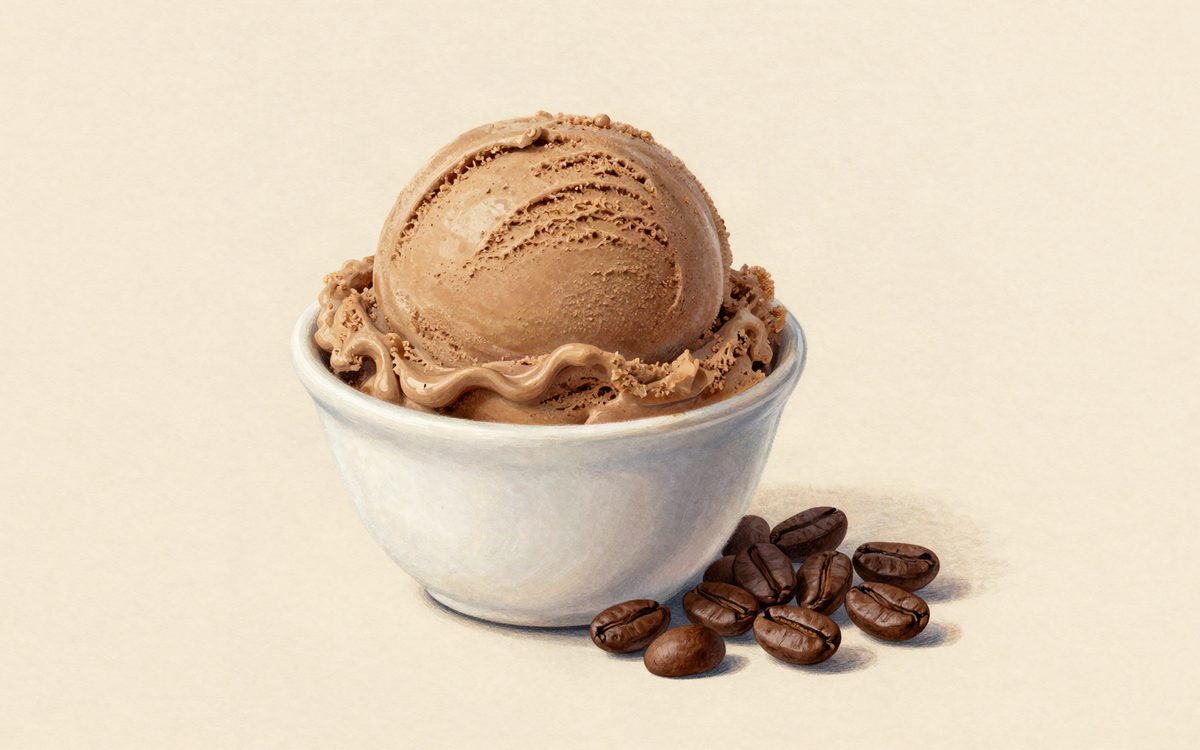
There is a beat of cold before anything tastes of coffee at all, which is what a mix this cold does to aromatics. Then it opens: espresso acidity first, bright and short, and behind it the instant coffee, which is the bitter part and the part that stays. Fat does the carrying, 10.46% of it out of coconut milk, coconut oil and cashew paste, coating the palate the way dairy would without the same weight. With no milk solids anywhere in the sheet, body has to be built from the nut paste and the carob flour, and that is why the finish reads clean rather than creamy, with the coffee still there after the cold has gone.
Between them the coffee contributes essentially no fat and no PAC. It is an ingredient that only subtracts, so everything structural has to come from elsewhere. Fat arrives from three places at once here: 180 g of coconut milk, 21 g of coconut oil and 70 g of cashew paste, closing at 10.46 percent in a 7 to 13 band. The cashew paste is also the protein lever, and protein lands at 2.09 percent, in the lower half of a 1 to 3.5 band.
All three sugar levers stay open for the same reason: 90 g sucrose, 55 g dextrose and 55 g glucose powder, giving 21.51 percent sugars, POD 165.87 and PAC 261.73. Solids close at 38.94, the highest of these vegan sheets, and that is what keeps a base carrying 120 g of espresso from freezing icy. The plant milk is barista oat, chosen both for the flavour pairing and because it is formulated not to curdle against an acidic drink.
Ingredients
Makes 1000 g of finished base.
| Ingredient | Grams | Home measure |
|---|---|---|
| Oat Milk (Barista) | 315 | 1 1/3 cups |
| Coconut Milk | 180 | 3/4 cup |
| Espresso (Rich) | 120 | |
| Sugar (Sucrose) | 90 | 1/3 cup plus 2 tablespoons |
| Water | 80 | 1/3 cup |
| Cashew Paste 100% | 70 | |
| Dextrose (Glucose) | 55 | 1/4 cup plus 1 tablespoon |
| Glucose Powder | 55 | 1/4 cup plus 1 tablespoon |
| Coconut Oil | 21 | |
| Instant Coffee | 6 | |
| Carob Seed Flour | 4 | |
| Soy Lecithin | 3 | |
| Salt | 1 |
Loads these exact grams into the free balancer, ready to edit.
Method
Instant coffee dissolved in the hot phase, espresso stirred in cold below 20 C, aged 8 to 12 hours
- 1Whisk every dry ingredient together first: sugars, milk powder, stabiliser and salt. Dry-blending them stops the stabiliser clumping when it meets liquid.
- 2Warm the liquids to 40 C (104 F), then rain the dry mix in while whisking hard.
- 3Heat to 82 C (180 F) and hold for 2 minutes so the stabiliser hydrates.
- 4Off the heat, whisk in the paste, then blend 60 seconds so the fat emulsifies instead of separating.
- 5Chill in an ice bath to under 5 C (41 F) within 2 hours. Slow cooling is where bacteria and coarse crystals both start.
- 6Age 6 to 12 hours in the fridge under 5 C (41 F). This is when the stabiliser and the milk protein take up water.
- 7Freeze in a shallow metal pan 2 to 3 cm deep, breaking the crystals with a fork every 30 to 40 minutes, 4 to 6 times.
- 8Freeze firm, then temper 10 to 15 minutes in the fridge before scooping.
The balance
All six against the professional range for Vegan Creamy Base.
PAC 261.73 and solids 38.94 are the two that matter here, and both answer the same problem. Coffee brings water and flavour and nothing else, so the 120 g of espresso is 120 g of dilution the base has to absorb. Solids at 38.94 percent, the top end of what these vegan sheets run, is how it absorbs it. PAC 261.73 in a 220 to 310 band comes largely from the 55 g of dextrose, which depresses the freezing point far more per gram than sucrose, so the mix stays scoopable without POD climbing: 165.87 leaves plenty of room under the 195 ceiling, which matters because coffee bitterness sours quickly against too much sweetness. Fat at 10.46 percent is split across three sources rather than one because no single plant fat reaches it here without dragging its own flavour along, and protein at 2.09 percent leans on the 70 g of cashew paste, which is structural and not decoration.
Estimated nutrition: ~208 kcal · Fat 10.5 g · Sugars 21.5 g · Protein 2.1 g (per 100 g of mix, from the balanced composition).
The specific risk on this flavour is acid coagulation. Espresso sits around pH 5, and oat and soy milks flocculate when hot acidic liquid hits them all at once, leaving a grainy base no blender recovers. Do it backwards: pasteurise the base, cool it below 20 C, then pour the cold espresso in a thin stream while stirring. Never the hot base onto the coffee. Use barista oat milk, which is buffered for exactly this situation. The 6 g of instant coffee goes into the hot phase with the dry sugars, before pasteurising. The espresso is never pasteurised at all, because above 70 C the volatiles leave and only the bitterness stays. If you want more intensity without more water, take the instant up to 8 g rather than raising the 120 g of espresso.
If it goes wrong
Hot base met the espresso, or the espresso went in hot. At pH 5 the coffee flocculated the oat protein, and that is not reversible.
Cool the base below 20 C first, then add cold espresso in a thin stream while stirring. Use barista oat milk, which is buffered against exactly this.
The espresso was pasteurised with the base. Above 70 C the volatile aromatics leave and the non volatile bitter fraction is all that remains.
Keep the espresso out of the heat entirely. Only the 6 g of instant coffee goes into the hot phase.
Espresso is about 10 percent solids, so every extra gram is mostly water, and it pushes solids away from the 38.94 percent this base needs to stay smooth.
Raise the instant coffee to 8 g instead. It adds bitterness and colour with almost no water, so the solids figure holds.
Suitable for: Vegan, Vegetarian, Lactose-free, Egg-free
Allergens: gluten, soy, tree nuts
- https://baristalife.co/blogs/blog/coffee-tds-for-espresso
- https://www.icecreamscience.com/blog/vegan-ice-cream-selecting-a-non-dairy-fat
- https://www.eccounpoco.com/blog/sugars-in-gelato
- https://icecreamcalc.com/2023/08/22/how-is-pac-and-pod-calculated/
- The science behind it: Complete Guide to Vegan Gelato
- Ingredient sheet: Espresso (Rich)
Want to change an ingredient and watch the numbers move? Open the free balancer