Vegan Acai Gelato
Earthy and dark rather than fruity, thick and creamy without a drop of dairy, with the sweetness all added on purpose and a cool, clean finish.
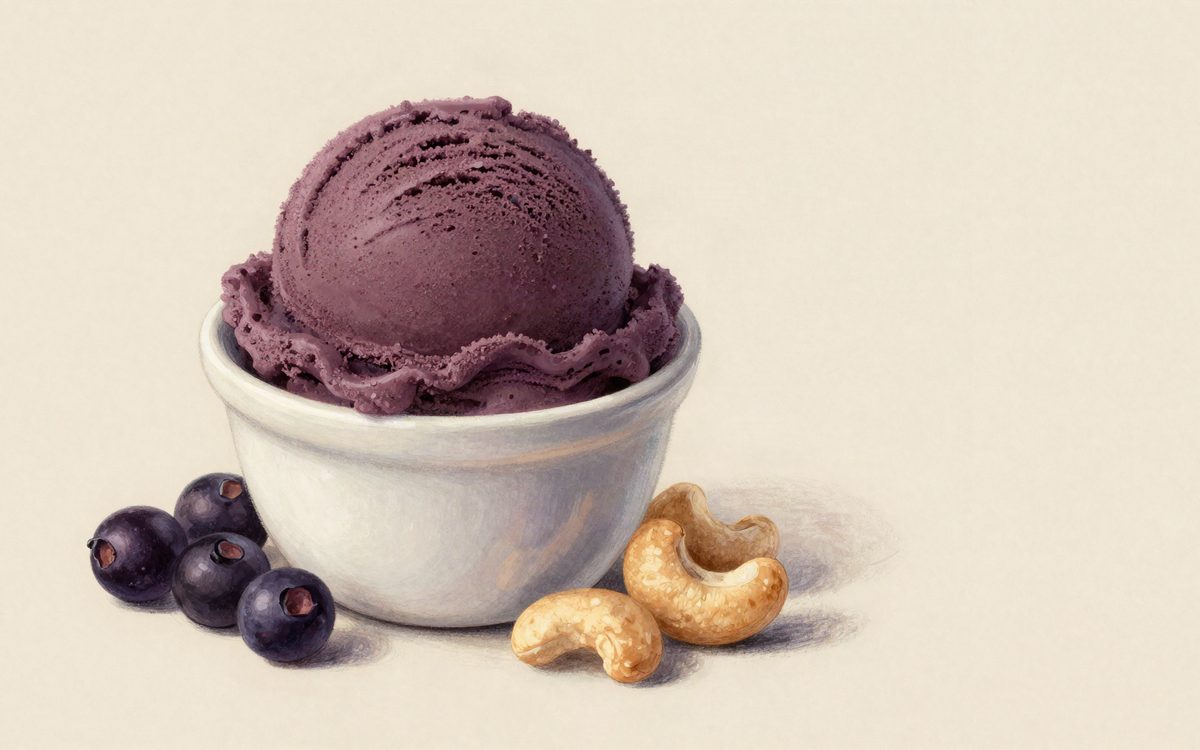
In the Amazon and the Atlantic forest, where the palm grows, this pulp is eaten cold, thick and hardly sweetened at all, and that is the honest starting point here. Chemically it is an odd fruit: roughly 2 percent sugar against 3.9 percent fat, oily rather than juicy. So it goes in heavy, 380 g per kilo, close to the dose of a bowl, without dragging a sugar load in behind it, and every gram of sweetness is put there deliberately. Coconut milk and cashew paste build the fat and the protein a dairy-free base needs, inulin closes the solids without hardening the scrape, and 6 g of lemon juice per kilo holds the purple in place.
All the sweetness is therefore added and it is split for a reason. 120 g of sucrose provides the sweet mass, and 60 g of dextrose pulls PAC to 252.97 without pushing sweetening power past the vegan ceiling of 195. POD lands at 179.24, which keeps it from becoming cloying.
The vegan window asks for 7 to 13 percent fat and there is no cream available. Coconut milk at 217 g plus cashew paste at 95 g lands it at 10.54. The cashew is also the only workable protein source in the mix, at 18 percent protein: this base reads 2.5. On top of that, 13 g of inulin adds pure solids with no PAC contribution, closing total solids at 38.31 without hardening the scoop, and 6 g of lemon juice lowers the pH that keeps the anthocyanin purple.
Ingredients
Makes 1000 g of finished base.
| Ingredient | Grams | Home measure |
|---|---|---|
| Acai Pulp | 380 | |
| Coconut Milk | 217 | 3/4 cup plus 2 tablespoons |
| Sugar (Sucrose) | 120 | 1/2 cup plus 2 tablespoons |
| Cashew Paste 100% | 95 | |
| Water | 90 | 1/3 cup plus 1 tablespoon |
| Dextrose (Glucose) | 60 | 1/4 cup plus 1 tablespoon |
| Soy Milk (Unsweetened) | 15 | |
| Inulin (Vegetable Fiber) | 13 | |
| Lemon Juice | 6 | |
| Stabilizer (Neutral) | 4 |
Loads these exact grams into the free balancer, ready to edit.
Method
Cold pulp fold, fork-broken freeze
- 1Whisk every dry ingredient together first: sugars, milk powder, stabiliser and salt. Dry-blending them stops the stabiliser clumping when it meets liquid.
- 2Warm the liquids to 40 C (104 F), then rain the dry mix in while whisking hard.
- 3Heat to 82 C (180 F) and hold for 2 minutes so the stabiliser hydrates.
- 4Off the heat, whisk in the paste, then blend 60 seconds so the fat emulsifies instead of separating.
- 5Chill in an ice bath to under 5 C (41 F) within 2 hours. Slow cooling is where bacteria and coarse crystals both start.
- 6Age 6 to 12 hours in the fridge under 5 C (41 F). This is when the stabiliser and the milk protein take up water.
- 7Fold the fruit in cold, after ageing. Heating it costs you the fresh aroma and nothing is gained.
- 8Freeze in a shallow metal pan 2 to 3 cm deep, breaking the crystals with a fork every 30 to 40 minutes, 4 to 6 times.
- 9Freeze firm, then temper 10 to 15 minutes in the fridge before scooping.
The balance
All six against the professional range for Vegan Creamy Base.
Two numbers carry this formula: fat 10.54 percent and PAC 252.97. The fat is mid window in 7 to 13 and it is deliberately mixed in origin, because acai fat is mostly oleic and crystallises poorly, so coconut fat has to be there to firm the structure back up. PAC 252.97 sits mid range in 220 to 310 and is mostly the 60 g of dextrose, which is the only way to keep this scoopable while POD stays at 179.24, under the 195 ceiling. Protein 2.5 percent leans on the 95 g of cashew paste, and MSNF reads 0.0 as it must in a vegan base. Water at 61.69 percent is what the 90 g of plain water in the ingredient list is buying: it is the free lever that lets the pulp go in at 380 g and still land inside 58 to 65.
Estimated nutrition: ~206 kcal · Fat 10.5 g · Sugars 19.5 g · Protein 2.5 g (per 100 g of mix, from the balanced composition).
Acai anthocyanin degrades above 80 C and the purple turns brown, so this base is pasteurised without the fruit. Take the white base of coconut milk, cashew paste, sugars and stabiliser to 82 to 85 C for 30 seconds, cool it to 4 C, and only then fold in the thawed pulp under agitation. The pulp sits near pH 5 so there is no curdling risk, but it oxidises fast in contact with air: work quickly and age 6 to 12 hours at 4 C in a container filled to the top. Do not reduce the coconut milk to lighten the recipe. Its lauric fat crystallises well and is the counterweight to the oleic fat of the acai, which does not.
If it goes wrong
The pulp was heated with the base and the anthocyanin degraded above 80 C
Pasteurise the coconut and cashew base alone, cool to 4 C, fold the pulp in cold
Coconut milk was cut back or swapped for a light version, so the lauric fat that firms the structure is missing and only the oleic fat of the acai is left
Keep coconut milk at 217 g and cashew paste at 95 g; fat is meant to read 10.54 percent
The fruit was expected to sweeten it, but acai pulp is only about 2 percent sugar
Weigh the full 120 g of sucrose and 60 g of dextrose; all the sweetness in this recipe is added
Suitable for: Vegan, Vegetarian, Lactose-free, Egg-free
Allergens: soy, tree nuts
- Goff & Hartel, Ice Cream, 7th ed., Springer 2013, caps. 3 (composicao) e 11 (congelamento): https://link.springer.com/book/10.1007/978-1-4614-6096-1
- Embrapa Amazonia Oriental, caracterizacao fisico-quimica da polpa de acai (solidos, lipidios, antocianinas): https://www.embrapa.br/amazonia-oriental
- USDA FoodData Central, composicao de acai, leite de coco e castanha de caju: https://fdc.nal.usda.gov/
- The science behind it: Complete Guide to Vegan Gelato
- Ingredient sheet: Açaí Pulp (10-14%)
Want to change an ingredient and watch the numbers move? Open the free balancer