Vanilla Bean Gelato
Rounded and warm, the seed's smoky floral depth showing up before the sweetness does, with a soft eggy body that finishes clean rather than rich.
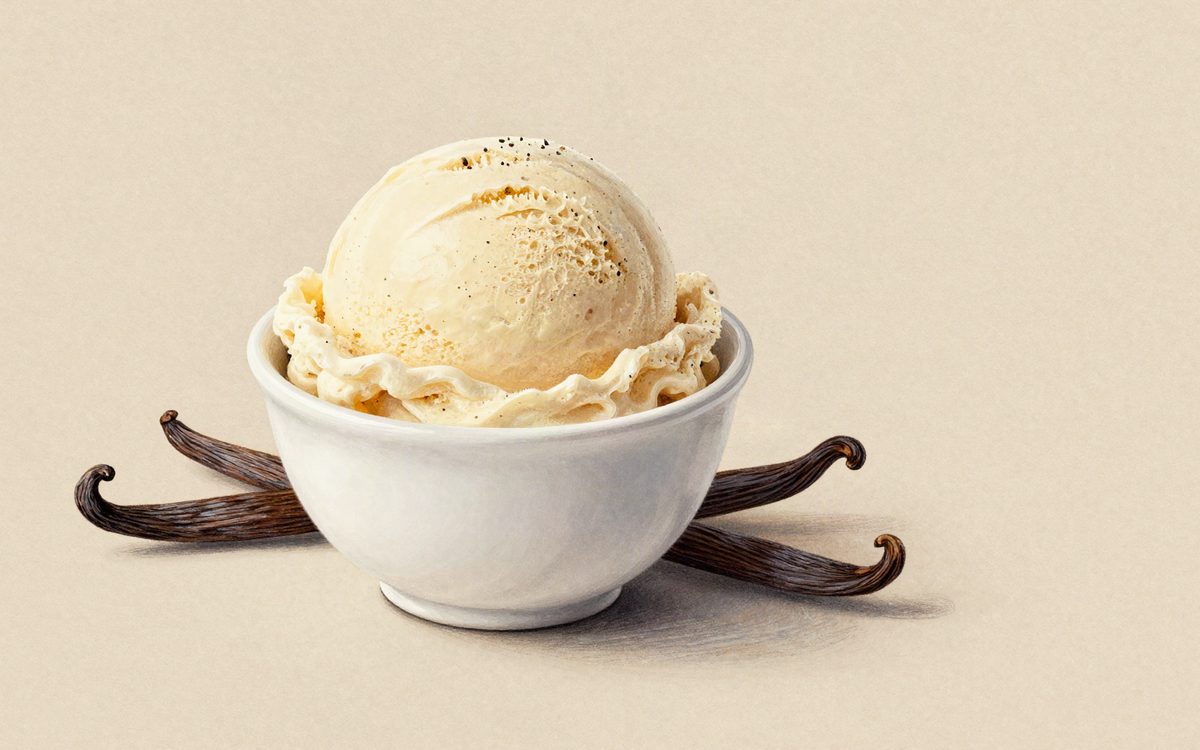
On the label, two things are worth checking: whether the pod is plump and pliable rather than dry and splintering, and whether the bottle says pure extract rather than flavouring. Both go in here for a reason of chemistry, not nostalgia. Vanillin and the couple of hundred secondary compounds in the pod are fat and alcohol soluble, and a hot infusion pulls the non-polar fraction well while leaving the bound compounds behind, which is the fraction the 5 g of pure extract recovers. Nine grams of pod is two to three per kilo, the classic gelateria dose, and it adds almost nothing in solids, so the structure comes from 150 g of cream, 42 g of skim milk powder and 35 g of yolk instead.
9 g of pod per kilo is two to three beans, the gelateria dose rather than the single bean of a home recipe. The pod contributes almost nothing structurally, about 6.5 g of solids, so all the body comes from 574 g of whole milk, 150 g of cream and 42 g of skim milk powder. The 5 g of pure extract next to it is chemistry, not economy: vanillin and the several hundred secondary compounds in the bean are fat and alcohol soluble, and a hot infusion pulls the non-polar ones well but leaves the bound fraction behind. The hydroalcoholic extract covers exactly that fraction.
The yolk at 35 g is the Italian crema tradition and it does measurable work. Lecithin is a natural emulsifier and improves how the fat distributes, and the yolk brings roughly 11 g of fat and 5.6 g of protein, which is how this base closes 4.3 percent protein inside the 3 to 5 window without pushing milk powder higher. That matters, because excess powder brings a cooked-milk taste and a lactose crystal risk. Salt at 1 g lifts the vanilla.
Ingredients
Makes 1000 g of finished base.
| Ingredient | Grams | Home measure |
|---|---|---|
| Whole Milk | 574 | 2 1/3 cups |
| Sugar (Sucrose) | 155 | 3/4 cup plus 1 tablespoon |
| Heavy Cream 35% | 150 | 1/2 cup plus 2 tablespoons |
| Skim Milk Powder | 42 | 1/3 cup plus 2 tablespoons |
| Egg Yolk | 35 | |
| Dextrose (Glucose) | 25 | 2 tablespoons |
| Vanilla Bean | 9 | |
| Vanilla Extract (Pure) | 5 | |
| Carob Seed Flour | 4 | |
| Salt | 1 |
Loads these exact grams into the free balancer, ready to edit.
Method
Tempered custard, fork-broken freeze
- 1Whisk every dry ingredient together first: sugars, milk powder, stabiliser and salt. Dry-blending them stops the stabiliser clumping when it meets liquid.
- 2Warm the liquids to 40 C (104 F), then rain the dry mix in while whisking hard.
- 3Beat the yolks with part of the sugar, then temper: pour the warm base over the yolks in a thin stream, never the other way round.
- 4Bring to 82 to 85 C (180 to 185 F) and stop. Past 87 C the yolk coagulates and no amount of blending brings the flavour back.
- 5Chill in an ice bath to under 5 C (41 F) within 2 hours. Slow cooling is where bacteria and coarse crystals both start.
- 6Age 6 to 12 hours in the fridge under 5 C (41 F). This is when the stabiliser and the milk protein take up water.
- 7Freeze in a shallow metal pan 2 to 3 cm deep, breaking the crystals with a fork every 30 to 40 minutes, 4 to 6 times.
- 8Freeze firm, then temper 10 to 15 minutes in the fridge before scooping.
The balance
All six against the professional range for Milk Gelato.
Protein 4.3 percent and MSNF 9.98 are the pair that explain this formula. Both sit mid window, and they get there with only 42 g of skim milk powder because the yolk is carrying part of the load: lactose ends at 8.79 percent of the water, comfortably below the sandiness line. Fat 8.48 percent comes from 150 g of cream plus the yolk, mid range in 6 to 12, enough for the crema mouthfeel without a greasy finish. PAC 261.34 sits in the middle of 220 to 300, which is what lets 155 g of sucrose and 25 g of dextrose coexist without the base freezing rock hard, and POD 182.1 is high but appropriate for a flavour that has nothing else competing for attention. Total solids 37.89 to 38.14 territory, water 61.86 percent, both mid window.
Estimated nutrition: ~195 kcal · Fat 8.5 g · Sugars 18 g · Protein 4.3 g (per 100 g of mix, from the balanced composition).
Split the pod lengthwise, scrape the seeds, and put seeds and pod into the cold milk. Heat slowly to 65 C and let it infuse 20 to 30 minutes before you take it up to pasteurisation temperature. A cold infusion does not extract, and a direct boil drives off vanillin. Take the pod out before you chill. With yolk in the base the real risk is curdling: never go past 85 C and keep it moving, because yolk proteins start coagulating around 70 to 75 C and form grains that no amount of blending will undo. Without a stirred pasteuriser, work at 82 C for 2 minutes instead of 85 C. The extract goes in only once the base is below 40 C, since the alcohol carries the aromatics out as it evaporates. Age 8 to 12 hours at 4 C: that is when fat partially crystallises and protein hydrates, and in vanilla that step is the difference between smooth and grainy.
If it goes wrong
The base went past 85 C and the yolk protein coagulated
Work at 82 C for 2 minutes with constant stirring if you cannot control temperature precisely
The extract was added while the base was hot, so the alcohol took the aromatics with it
Add the 5 g of extract only below 40 C, after the ice bath
Milk powder was topped up beyond 42 g, pushing lactose past the 8.79 percent of water this formula was solved for
Keep the powder at 42 g and let the yolk carry the protein instead
Suitable for: Vegetarian
Allergens: egg, milk
No ingredient in this recipe contains gluten.
- https://www.cucchiaio.it/ricetta/gelato-alla-vaniglia/
- https://www.gelatoperpassione.it/cose-la-bilanciatura/
- https://www.cucina.li/come-fare-il-gelato-artigianale-ricette-gia-bilanciate/
- The science behind it: Vanilla in Gelato
- Ingredient sheet: Vanilla Bean
Want to change an ingredient and watch the numbers move? Open the free balancer