Triple Chocolate Gelato
Bitterness leads, a milky caramel middle follows, and cocoa butter closes it, drier and less sweet on the finish than any single bar would leave you.
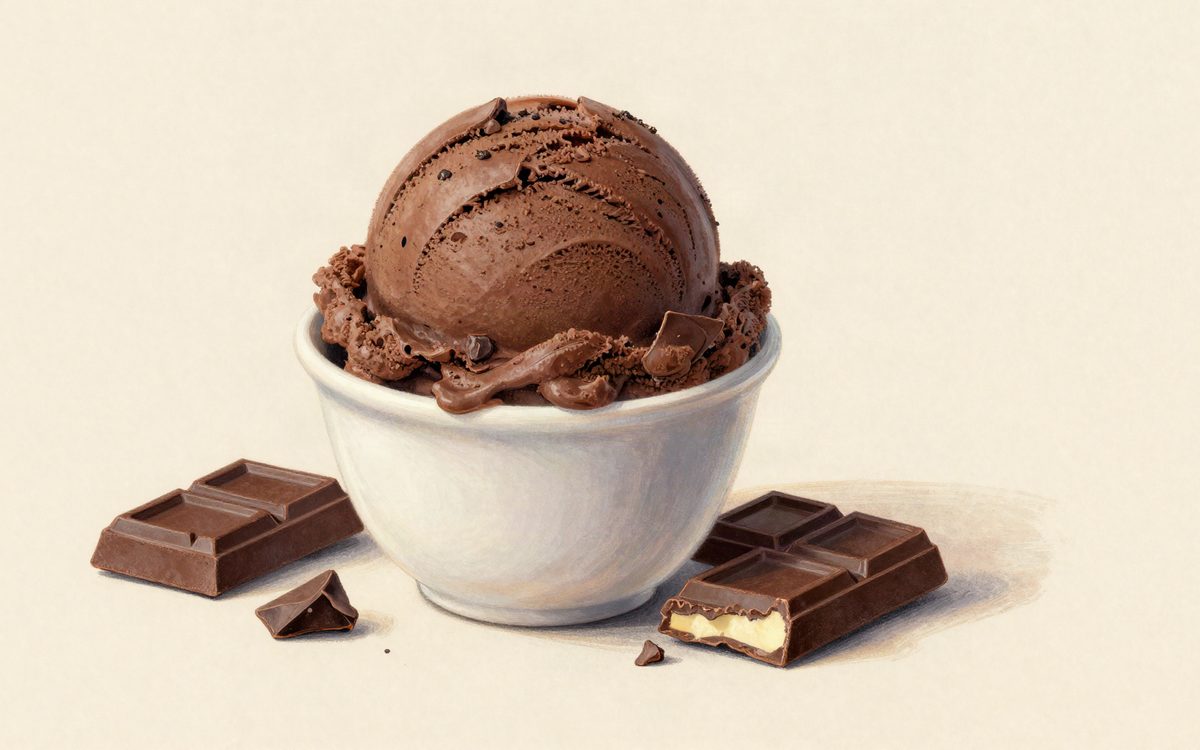
Turn all four packets over before anything reaches the scale. The only fat listed should be cocoa butter, because palm, shea or a generic vegetable fat melts at the wrong temperature and leaves a waxy film no amount of sugar hides. The percentage on the front is a fat and sugar figure as much as a flavour one, which is why the dark, the milk and the white go in at 70, 45 and 35 g instead of equally. And the cocoa powder needs 22 to 24 percent fat printed on the pack, since those 15 g are there to supply cocoa solids the bars cannot: two of the three are mostly sugar and fat, so without the powder you get richness and very little chocolate.
The split is a gradient by intensity. 70 g of 70 percent dark sets the backbone and the colour, 45 g of 40 percent milk chocolate fills the middle of the palate with lactic caramel notes, and 35 g of white comes in last as a layer of cocoa butter and vanilla. The 15 g of 22/24 cocoa powder is there to fix an arithmetic problem in the trio: together the three chocolates bring 150 g of solids but only around 24 g of non-fat cocoa solids, because two of them are mostly sugar and fat. Without the powder you get a fatty gelato that does not taste of cocoa.
Skim milk sits in the list next to 647 g of whole milk for a structural reason. The chocolates alone contribute roughly 46 g of fat per kilo, 6.4 percent of the mass before any dairy, so the formula needs a lever that trades milk fat for water and protein without giving up MSNF. Milk powder is kept short at 12 g for the same reason: the two milk-containing chocolates already carry milk solids of their own, and pushing powder up would drive lactose toward the sandy zone.
Ingredients
Makes 1000 g of finished base.
| Ingredient | Grams | Home measure |
|---|---|---|
| Whole Milk | 647 | 2 2/3 cups |
| Sugar (Sucrose) | 75 | 1/3 cup plus 1 tablespoon |
| Dark Chocolate 70% | 70 | |
| Dextrose (Glucose) | 50 | 1/4 cup |
| Skim Milk | 48 | 3 tablespoons |
| Milk Chocolate 40% | 45 | |
| White Chocolate | 35 | |
| Cocoa Powder 22-24% | 15 | |
| Non-Fat Dry Milk | 12 | 2 tablespoons |
| Stabilizer (Neutral) | 3 |
Loads these exact grams into the free balancer, ready to edit.
Method
Staged melt, fork-broken freeze
- 1Whisk every dry ingredient together first: sugars, milk powder, stabiliser and salt. Dry-blending them stops the stabiliser clumping when it meets liquid.
- 2Warm the liquids to 40 C (104 F), then rain the dry mix in while whisking hard.
- 3Heat to 82 C (180 F) and hold for 2 minutes so the stabiliser hydrates.
- 4Melt the chocolate to 45 C (113 F) and stir it into the hot base off the heat, then blend 60 seconds until glossy.
- 5Chill in an ice bath to under 5 C (41 F) within 2 hours. Slow cooling is where bacteria and coarse crystals both start.
- 6Age 6 to 12 hours in the fridge under 5 C (41 F). This is when the stabiliser and the milk protein take up water.
- 7Freeze in a shallow metal pan 2 to 3 cm deep, breaking the crystals with a fork every 30 to 40 minutes, 4 to 6 times.
- 8Freeze firm, then temper 10 to 15 minutes in the fridge before scooping.
The balance
All six against the professional range for Milk Gelato.
Fat 8.21 percent is the number that explains the rest. With about 46 g per kilo arriving from chocolate, the dairy side has to be lean, which is why whole milk and skim milk share the liquid and cream is absent entirely. PAC 264.96 sits mid window in 220 to 300 and is largely the work of the 50 g of dextrose, which buys freezing-point control without stacking sweetness: POD ends at 170.58, the lowest of the milk gelati in this set, and that is deliberate for a chocolate this dark. MSNF 8.75 sits low in the 8 to 11.5 window, which keeps lactose at 7.73 percent of the water, and protein reads 4.0, mid range in 3 to 5, entirely from dairy and chocolate with no yolk involved.
Estimated nutrition: ~194 kcal · Fat 8.2 g · Sugars 18 g · Protein 4 g (per 100 g of mix, from the balanced composition).
The three chocolates have different melting points and different heat sensitivities, so they do not go in together. Pasteurise the base with the cocoa powder at 85 C, take it off the heat, and add the 70 percent dark first, since it is the most heat tolerant. Add the milk chocolate at around 80 C, and the white last at 75 C or below, because the milk solids in white chocolate scorch first and produce a cooked-milk taste that muddies the whole trio. Blend 20 to 30 seconds after each addition with the blender head kept submerged, so you do not fold hot air into cocoa butter and oxidise it. With that much chocolate fat the cold base is very viscous, so the 12 hour age at 4 C is not optional and the churn runs longer than usual. Do not add egg yolk: yolk protein on top of three chocolates makes the product heavy and flattens the distinction between them. Serve at -11 to -12 C; colder than that the cocoa butter sets hard and the gelato turns waxy in the mouth.
If it goes wrong
Served too cold, so the cocoa butter from 150 g of chocolate is fully crystallised
Temper to -11 to -12 C before scooping, 10 to 15 minutes in the fridge
The white chocolate went in while the base was still above 80 C and its milk solids scorched
Add dark first off the heat, milk chocolate around 80 C, white at 75 C or below
Roughly 46 g of chocolate fat per kilo makes the cold base very viscous
Give it the full 12 hours at 4 C and expect a longer churn, do not thin it with extra milk
Suitable for: Vegetarian, Egg-free
Allergens: milk
- https://adamriff.substack.com/p/3-cioccolati-gelato
- https://villasentieri.com/index.php/recipe/milk-chocolate-gelato-gelato-al-cioccolato-al-latte/
- https://www.dairyfoods.com/articles/90396-working-with-cocoa-in-ice-cream
- https://www.icecreamscience.com/blog/chocolate-ice-cream-recipe
- The science behind it: Couverture Chocolate for Gelato
- Ingredient sheet: Dark Chocolate 70%
Want to change an ingredient and watch the numbers move? Open the free balancer