Torrone Nougat Gelato
Frankly sweet, opening warm and honeyed before toasted almond takes over the middle, with a dense, slow-melting body that keeps the nut going.
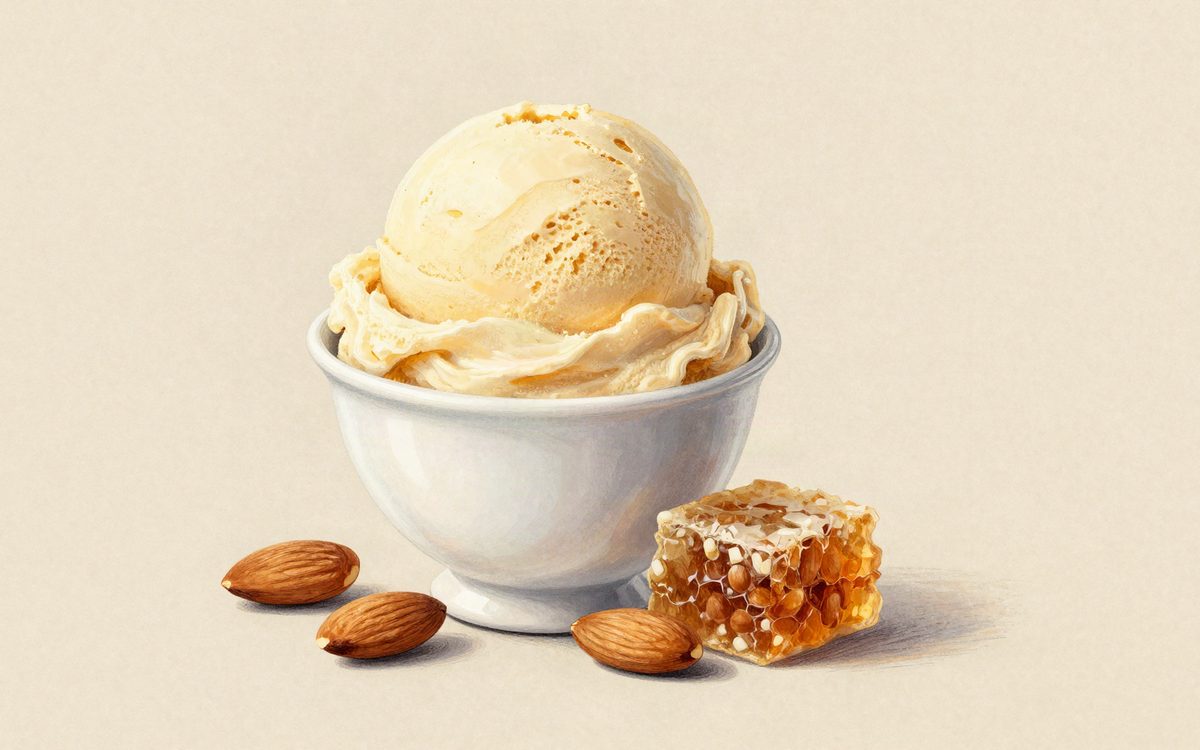
Warmth arrives first, honey warmth rather than plain sugar warmth, and there is no pretending this one is restrained; a beat later the toasted almond takes the middle of the palate and refuses to hand it back. The body is dense and slow to melt, which suits a flavour borrowed from a hard confection, though nothing in the bowl is chewy. Two of the three things that make torrone are on the sheet, almond paste at 65 g and honey at 55 g per kilo, and the whipped egg white belongs to the sweet and stays there. That honey is also why free sucrose stops at 115 g and the POD still reads high.
Honey here is not a substitute sweetener, it is the flavour. With POD 105 and PAC 156 it is both sweeter and more antifreeze than sucrose, so 55 g of it per kilo moves the whole balance. Free sucrose comes down to 115 g, well below the roughly 140 g a straight nut gelato needs, and the final POD still lands at 183.96. That is correct for this flavour: torrone is openly sweet, and a torrone reading 165 would taste like plain almond gelato.
Almond paste sits at 65 g, lower than in a pure almond recipe, because here almond is the floor and not the subject, and because honey already takes part of the sugar budget. Cream at 110 g takes fat to 9.62 percent, which is the number doing the dense, chewy mouthfeel people remember from the bar.
Ingredients
Makes 1000 g of finished base.
| Ingredient | Grams | Home measure |
|---|---|---|
| Whole Milk | 617 | 2 1/2 cups |
| Sugar (Sucrose) | 115 | 1/2 cup plus 1 tablespoon |
| Heavy Cream 35% | 110 | 1/3 cup plus 2 tablespoons |
| Almond Paste (unsweetened) | 65 | |
| Honey | 55 | |
| Non-Fat Dry Milk | 29 | 1/4 cup plus 1 tablespoon |
| Vanilla Extract | 4 | |
| Carob Seed Flour | 4 | |
| Salt | 1 |
Loads these exact grams into the free balancer, ready to edit.
Method
Late honey, shallow pan and fork
- 1Whisk every dry ingredient together first: sugars, milk powder, stabiliser and salt. Dry-blending them stops the stabiliser clumping when it meets liquid.
- 2Warm the liquids to 40 C (104 F), then rain the dry mix in while whisking hard.
- 3Heat to 82 C (180 F) and hold for 2 minutes so the stabiliser hydrates.
- 4Off the heat, whisk in the paste, then blend 60 seconds so the fat emulsifies instead of separating.
- 5Chill in an ice bath to under 5 C (41 F) within 2 hours. Slow cooling is where bacteria and coarse crystals both start.
- 6Age 6 to 12 hours in the fridge under 5 C (41 F). This is when the stabiliser and the milk protein take up water.
- 7Freeze in a shallow metal pan 2 to 3 cm deep, breaking the crystals with a fork every 30 to 40 minutes, 4 to 6 times.
- 8Freeze firm, then temper 10 to 15 minutes in the fridge before scooping.
The balance
All six against the professional range for Milk Gelato.
The two indicators to watch are POD 183.96 and PAC 258.68. POD sits high in the 140 to 200 window on purpose, because honey carries the sweetness signature of the flavour; PAC sits mid range in 220 to 300, which is what keeps a base this sweet still scoopable at serving temperature, -11 to -14 C, instead of soupy. Fat at 9.62 percent is comfortably inside 6 to 12 and comes mostly from the 110 g of cream plus the almond paste, so the body does not depend on milk powder: MSNF stays at 8.94, low in the 8 to 11.5 window, and lactose ends at 7.84 percent of the water, the lowest reading of the milk gelati in this set. Total solids 37.82 sit low in the window and water 62.18 percent high in it, which is where the 617 g of whole milk puts them.
Estimated nutrition: ~199 kcal · Fat 9.6 g · Sugars 16.3 g · Protein 4.7 g (per 100 g of mix, from the balanced composition).
What is specific to torrone is that the honey cannot be pasteurised with the base. Above 60 C it loses the floral volatiles that make it read as honey, and in a hot dairy medium held for minutes the free fructose runs Maillard with milk protein and brings a caramel note that does not belong to this flavour. Pasteurise the base at 85 C, cool it below 40 C, and only then dissolve the honey and the almond paste, blending 60 seconds so the almond fat emulsifies instead of separating. If you want crunchy torrone pieces, they go in as a variegato after churning and they stay outside the balanced 1000 g, because their sugar was never counted in the PAC.
If it goes wrong
The honey went in before or during pasteurisation, so its fructose reacted with milk protein and its floral volatiles were driven off above 60 C
Hold all 55 g of honey back until the base is under 40 C, then stir it in
Honey was added on top of a full sucrose dose instead of replacing part of it, pushing PAC past the 258.68 the formula was solved for
Weigh honey at 55 g and sucrose at 115 g exactly; those two numbers are linked
The paste was stirred into the base without blending, so its fat never emulsified
Blend 60 seconds with an immersion blender after the paste goes in, off the heat
Suitable for: Vegetarian, Egg-free
Allergens: milk, tree nuts
No ingredient in this recipe contains gluten.
- https://tasteatlas.com/gelato-al-torrone
- https://rocambolesc.com/usa/en/500-ml-tubs/702-torro.html
- https://www.nonnabox.com/homemade-torrone/
- The science behind it: Almond Paste in Gelato
- Ingredient sheet: Almond Paste (unsweetened)
Want to change an ingredient and watch the numbers move? Open the free balancer