Torroncino Gelato, Italian Nougat
Sweet-shop aromas land first, honey and toasted nut over a dense milk base, and the finish runs long and faintly salted instead of turning sugary.
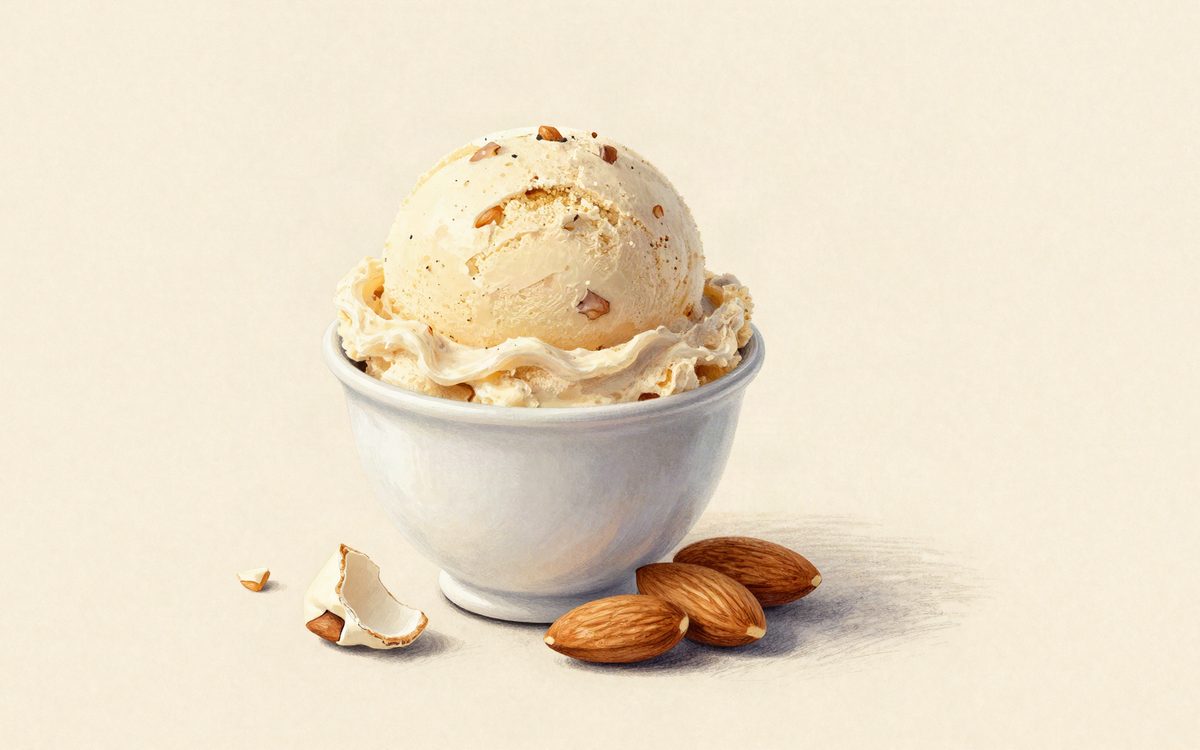
Anything that arrives already 52 percent sugar and 27 percent fat rewrites the lines beneath it. Ground torrone at 110 g per kilo injects roughly 57 g of sugar and 30 g of fat before another ingredient is weighed, which is why free sucrose sits at 65 g rather than the usual 90: at a normal dose the sugars would break the ceiling, and as balanced they close at 18.67 percent. Its protein pulls the milk powder line down for the same reason. Acacia honey at 15 g is not there to sweeten but because it is the most neutral of the honeys, so the nougat signature comes back without a wild honey taste laid over toasted almond and caramelised sugar.
The second consequence is protein. Torrone brings about 12 g of protein per kilo, and protein closes at 4.76 percent against a 5 ceiling, so milk powder had to stay down at 24 g. Cream, at 2.1 percent protein, is the low protein way to buy fat and solids, which is why 60 g of it appear alongside 647 g of whole milk.
The 15 g of acacia honey are not there to sweeten either. Italian torrone is made with honey and egg white, so honey is part of the signature, and acacia specifically is the most neutral of the honeys, high in fructose and low in aroma of its own. It restores the signature without turning the flavour into wildflower honey gelato.
The 20 g of almond paste are a correction for the raw material. Commercial torrone varies in how much almond it carries, and without that reinforcement the gelato reads as sweet marshmallow rather than as torroncino.
Ingredients
Makes 1000 g of finished base.
| Ingredient | Grams | Home measure |
|---|---|---|
| Whole Milk | 647 | 2 2/3 cups |
| Nougat (Torrone) | 110 | |
| Sugar (Sucrose) | 65 | 1/3 cup |
| Heavy Cream 35% | 60 | 1/4 cup |
| Glucose Powder | 35 | 3 tablespoons |
| Non-Fat Dry Milk | 24 | 1/4 cup |
| Almond Paste (unsweetened) | 20 | |
| Dextrose (Glucose) | 20 | 1 1/2 tablespoons |
| Acacia Honey | 15 | |
| Stabilizer (Neutral) | 3 | |
| Salt | 1 |
Loads these exact grams into the free balancer, ready to edit.
Method
Ground nougat dissolved hot at 65 C, almond paste in cold, three tray passes
- 1Whisk every dry ingredient together first: sugars, milk powder, stabiliser and salt. Dry-blending them stops the stabiliser clumping when it meets liquid.
- 2Warm the liquids to 40 C (104 F), then rain the dry mix in while whisking hard.
- 3Heat to 82 C (180 F) and hold for 2 minutes so the stabiliser hydrates.
- 4Off the heat, whisk in the paste, then blend 60 seconds so the fat emulsifies instead of separating.
- 5Chill in an ice bath to under 5 C (41 F) within 2 hours. Slow cooling is where bacteria and coarse crystals both start.
- 6Age 6 to 12 hours in the fridge under 5 C (41 F). This is when the stabiliser and the milk protein take up water.
- 7Freeze in a shallow metal pan 2 to 3 cm deep, breaking the crystals with a fork every 30 to 40 minutes, 4 to 6 times.
- 8Freeze firm, then temper 10 to 15 minutes in the fridge before scooping.
The balance
All six against the professional range for Milk Gelato.
Two ceilings shape this sheet. Protein at 4.76 percent against a 3 to 5 band is the tightest figure of this batch, and it is what holds milk powder to 24 g: the nougat itself contributes around 12 g of protein per kilo, so there is very little left to spend. Sugars at 18.67 percent against a 16 to 22 band is the other: 110 g of a 52 percent sugar ingredient bring roughly 57 g on their own, which is why sucrose stops at 65 g instead of the 90 or so a plain milk base would take. Fat closes at 8.46 percent against 6 to 12, with about 30 g of it coming from the nougat, so 60 g of cream is enough. Solids read 38.27 against 36 to 42, POD 170.92 against 140 to 200, PAC 264.92 against 220 to 300, MSNF 8.46 against an 8 floor and water 61.73 against 58 to 64. Lactose is 4.61 percent of the mix and 7.47 percent of the water, and the sandiness check passes.
Estimated nutrition: ~195 kcal · Fat 8.5 g · Sugars 18.7 g · Protein 4.8 g (per 100 g of mix, from the balanced composition).
The torrone has to be ground fine and it goes in hot, which is the opposite of every nut paste rule. Its matrix is cooked sugar with egg white, and it needs heat to dissolve. Left as fragments it sets rock hard at minus 18 C and becomes a dental hazard. Grind it in a processor to a coarse powder and add it between 60 and 70 C, blending until it dissolves. The 20 g of almond paste, on the other hand, go in below 60 C to protect its volatiles, and the honey goes in with the sugars in the cold phase, since honey held above 60 C loses its aromatic esters and reverts to plain fructose. One storage note that surprises people: torrone is hygroscopic and keeps pulling water out of the mix during ageing, so the base visibly thickens between pasteurisation and churning. That is expected and needs no correction. If you want visible nougat pieces, add a separate portion in cubes at the end of churning, outside this balance, and count on them softening within 24 hours.
If it goes wrong
The torrone was chopped rather than ground, or added cold, so its cooked sugar matrix never dissolved.
Grind the 110 g to a coarse powder and add it at 60 to 70 C, blending until it fully dissolves into the base.
Sucrose was used at a normal gelato dose on top of the sugar the nougat already carries.
Keep sucrose at 65 g. The nougat brings about 57 g of sugar per kilo on its own, and sugars close at 18.67 percent against a 22 ceiling.
The 20 g of almond paste were skipped, and the torrone used was low in almond.
Keep the almond paste and add it below 60 C. It is the reinforcement that makes the flavour read as torroncino rather than as generic nougat.
Suitable for: Vegetarian
Allergens: egg, milk, tree nuts
- https://impastaesorridi.it/gelato-torroncino/
- https://www.cookist.it/torrone-gelato/
- https://blog.giallozafferano.it/cucinaprediletta/gelato-al-torrone/
- https://magazine.artigianoinfiera.it/la-ricetta-il-gelato-al-torrone/
- The science behind it: Starch vs Fat Nut Pastes
- Ingredient sheet: Nougat (Torrone)
Want to change an ingredient and watch the numbers move? Open the free balancer