Tiramisu Gelato
What lands first is bitter coffee and cocoa, then sweet cream, with softened biscuit thickening the body and an egg-rich weight that stays put.
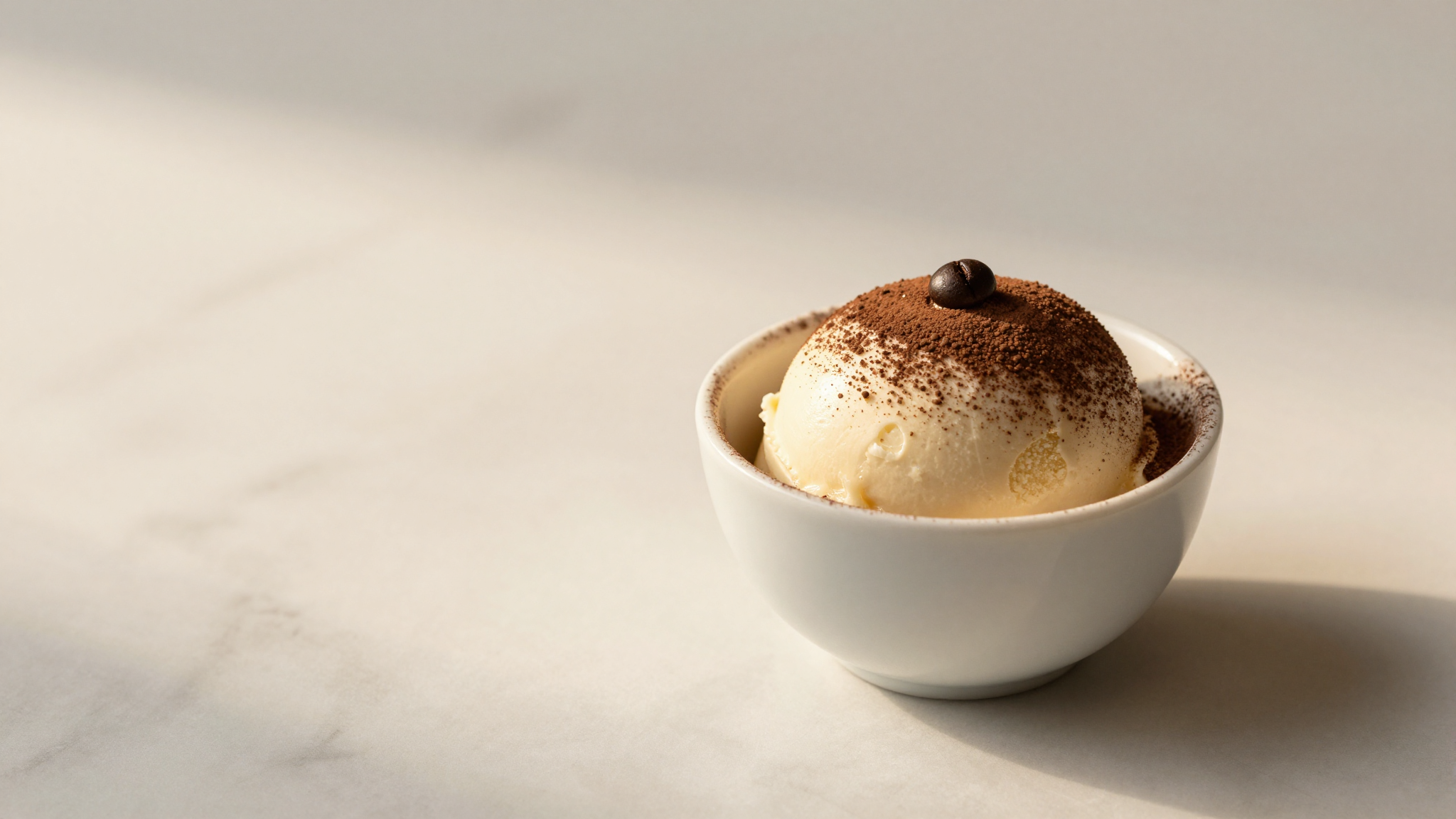
It is the mascarpone and the coffee that make this a Veneto dessert rather than a coffee gelato with biscuit stirred through. Both go in as themselves: mascarpone at 120 g/kg and 44% fat, which supplies most of the fat in the tub on its own, and concentrated espresso at 60 g/kg instead of instant coffee, because the soluble version brings bitterness without the roasted volatiles that make the flavour recognisable. Egg yolk enters at half the dose a custard base would take, enough to emulsify and to leave the zabaione memory, and the mascarpone never goes above 60 C so it cannot split.
Egg yolk sits at 40 g, about half what a crema would take. In tiramisu the yolk is a binder and a memory of zabaione, not the lead, and 40 g give enough lecithin to emulsify the mascarpone fat without pushing protein, which closes at 4.51 percent against a 5 ceiling.
The coffee is 60 g of concentrated espresso rather than instant, because instant delivers the bitterness without the roasted volatiles, and those 60 g bring only about 54 g of water, which the base absorbs. The 35 g of ladyfinger biscuit dissolved into the mix supply the starch and the vanilla and egg note the palate reads as savoiardo, plus around 9.1 g of sugar. Cocoa powder appears at just 6 g: it is the dusting on top of the dessert, and any more shifts the flavour to chocolate and buries the coffee.
Because the fixed ingredients already deliver a large share of the fat and the milk solids, the milk lines are what the solver used to steer the rest: 350 g of whole milk plus 189 g of skim, which lets water land at 61.97 percent in a 58 to 64 band and MSNF at 8.58 percent without adding another gram of fat.
Ingredients
Makes 1000 g of finished base.
| Ingredient | Grams | Home measure |
|---|---|---|
| Whole Milk | 350 | 1 1/2 cups |
| Skim Milk | 189 | 3/4 cup |
| Sugar (Sucrose) | 125 | 1/2 cup plus 2 tablespoons |
| Mascarpone | 120 | |
| Espresso (Rich) | 60 | |
| Egg Yolk | 40 | |
| Dextrose (Glucose) | 40 | 3 1/2 tablespoons |
| Ladyfinger Biscuit | 35 | |
| Non-Fat Dry Milk | 27 | 1/4 cup plus 1 tablespoon |
| Cocoa Powder 22-24% | 6 | |
| Glucose Powder | 5 | 1 1/4 teaspoons |
| Stabilizer (Neutral) | 2 | |
| Salt | 1 |
Loads these exact grams into the free balancer, ready to edit.
Method
Custard to 85 C, mascarpone folded in at 60 C, tray with three passes
- 1Whisk every dry ingredient together first: sugars, milk powder, stabiliser and salt. Dry-blending them stops the stabiliser clumping when it meets liquid.
- 2Warm the liquids to 40 C (104 F), then rain the dry mix in while whisking hard.
- 3Beat the yolks with part of the sugar, then temper: pour the warm base over the yolks in a thin stream, never the other way round.
- 4Bring to 82 to 85 C (180 to 185 F) and stop. Past 87 C the yolk coagulates and no amount of blending brings the flavour back.
- 5Chill in an ice bath to under 5 C (41 F) within 2 hours. Slow cooling is where bacteria and coarse crystals both start.
- 6Age 6 to 12 hours in the fridge under 5 C (41 F). This is when the stabiliser and the milk protein take up water.
- 7Freeze in a shallow metal pan 2 to 3 cm deep, breaking the crystals with a fork every 30 to 40 minutes, 4 to 6 times.
- 8Freeze firm, then temper 10 to 15 minutes in the fridge before scooping.
The balance
All six against the professional range for Milk Gelato.
Fat at 8.31 percent against a 6 to 12 band is what fixes the mascarpone dose. At 44 percent fat, 120 g of mascarpone bring roughly 52.8 g of the total, so there is no cream in the sheet and no room for a full crema dose of yolk. Protein at 4.51 percent against a 3 to 5 band is the other constraint: yolk, milk powder and skim milk all push it, which is why the yolk stops at 40 g. MSNF closes at 8.58 percent just above its 8 floor, solids at 38.03 against 36 to 42, sugars at 17.56 against 16 to 22, POD at 168.95 against 140 to 200, PAC at 258.33 against 220 to 300 and water at 61.97 against 58 to 64. Lactose is 4.68 percent of the mix and 7.55 percent of the water, and the sandiness check passes.
Estimated nutrition: ~194 kcal · Fat 8.3 g · Sugars 17.6 g · Protein 4.5 g (per 100 g of mix, from the balanced composition).
Order of addition decides this one, because three ingredients have different thermal limits. First, the milk, sugars, milk powder and stabiliser go to 40 C. The ground biscuit and the 6 g of cocoa go in with the dry ingredients, before 85 C, because the biscuit starch needs to gelatinise or the texture turns rough. Second, temper the yolk in and take the mix to 82 to 85 C, no further, or the yolk coagulates. Third, cool to 55 to 60 C and only then add the mascarpone. Mascarpone is an acid set cream: at 85 C it breaks and releases whey, and the gelato comes out grainy in a way no blender recovers. That is the main curdling risk of this flavour. Fourth, the espresso goes in after pasteurisation, cold or lukewarm, since its volatiles are the first thing to boil off and boiled coffee is only bitter. Age 8 to 12 hours at 4 C. A dusting of cocoa over the tub and a piece of savoiardo folded in at the end of churning are outside the balance, and the biscuit piece softens within 24 hours, so that is a same day production choice.
If it goes wrong
The mascarpone was added before the base cooled, or the whole mix was taken to 85 C with the mascarpone in it.
Pasteurise the custard alone to 82 to 85 C, cool to 55 to 60 C, then stir the 120 g of mascarpone in. It is an acid set cream and it breaks under heat.
Instant coffee was used, or the espresso was heated with the base.
Use 60 g of concentrated espresso and add it after pasteurisation, cold or lukewarm. Those 60 g carry only about 54 g of water, which the base absorbs without upsetting the 61.97 percent water figure.
The cocoa was increased beyond the 6 g in the formula.
Keep cocoa at 6 g per kilo. It stands for the dusting on the dessert, not for a chocolate line, and more of it buries both the coffee and the mascarpone.
Suitable for: Vegetarian
Allergens: egg, gluten, milk
- https://www.recipesfromitaly.com/authentic-italian-gelato-recipe/
- https://www.greatitalianchefs.com/recipes/crema-gelato-recipe
- https://www.icecreamnation.org/2021/03/gelato-di-crema-and-on-gelato-in-general/
- https://www.dreamscoops.com/ice-cream-science/ice-cream-calculator/
- The science behind it: Mascarpone in Gelato
- Ingredient sheet: Mascarpone
- The story of this recipe: Tiramisu Gelato
Want to change an ingredient and watch the numbers move? Open the free balancer