Tangerine Sorbet
Perfume comes before sweetness, with a lemon edge just behind it to keep that sweetness from cloying, and the aroma survives the cold because the zest carries it.
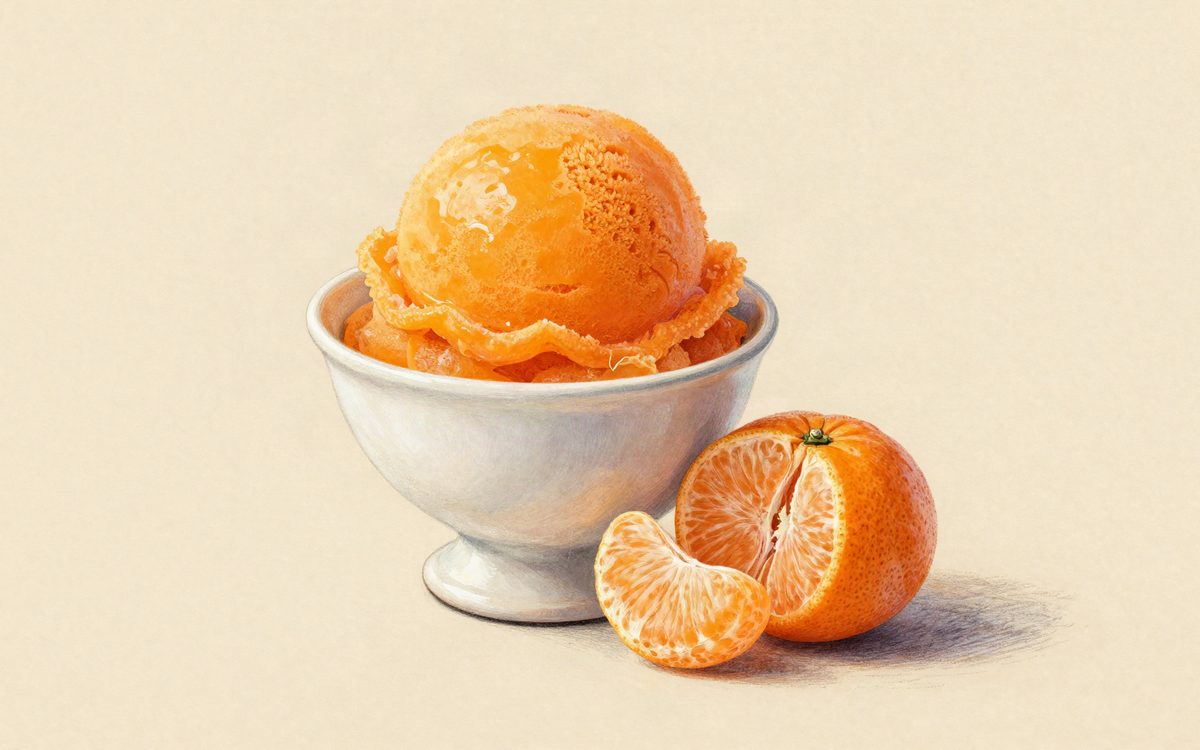
Aroma is what fails here, long before texture does. Citrus perfume lives in the peel oil, so a sorbet built on juice alone reads flat once it is properly cold, and this fruit compounds the problem by being the sweetest and least acidic of the common citrus: its brix to acid ratio typically runs above 14, against roughly 8 to 12 for orange. Juice on its own therefore lands sweet and slack. Two corrections answer that. 15 g of lemon juice takes the mix to about pH 3.3 to 3.5 and gives back the cut the fruit lacks, and 4 g of zest puts the essential oil back on top of 530 g of fruit.
The fruit sits at 530 g per kilo. That is high because tangerine is about 85.2 percent water and effectively acts as the liquid of the formula.
The 4 g of zest matter more than their weight suggests. Tangerine peel oil is rich in methyl N-methylanthranilate, the compound responsible for the unmistakable tangerine note, and it is simply not present in the juice. Leave the zest out and you get a generic orange sorbet.
With only 5.6 points of sugar and 62 of POD coming from the fruit, the sugar architecture is classic and sucrose led: 110 g of sucrose, 70 g of dextrose and 53 g of maltodextrin. POD closes at 222.56, the strongest sweetening power in this batch, which is the price of a fruit that arrives with so little of its own.
Ingredients
Makes 1000 g of finished base.
| Ingredient | Grams | Home measure |
|---|---|---|
| Tangerine | 530 | |
| Water | 214 | 3/4 cup plus 2 tablespoons |
| Sugar (Sucrose) | 110 | 1/2 cup plus 1 tablespoon |
| Dextrose (Glucose) | 70 | 1/3 cup plus 1 tablespoon |
| Maltodextrin | 53 | |
| Lemon Juice | 15 | |
| Orange Zest | 4 | |
| Carob Seed Flour | 3 | |
| Guar Gum | 1 |
Loads these exact grams into the free balancer, ready to edit.
Method
Zest infused syrup at 85 C, juice added cold, four short tray passes
- 1Whisk every dry ingredient together first: sugars, milk powder, stabiliser and salt. Dry-blending them stops the stabiliser clumping when it meets liquid.
- 2Warm the liquids to 40 C (104 F), then rain the dry mix in while whisking hard.
- 3Heat to 82 C (180 F) and hold for 2 minutes so the stabiliser hydrates.
- 4Chill in an ice bath to under 5 C (41 F) within 2 hours. Slow cooling is where bacteria and coarse crystals both start.
- 5Age 6 to 12 hours in the fridge under 5 C (41 F). This is when the stabiliser and the milk protein take up water.
- 6Fold the fruit in cold, after ageing. Heating it costs you the fresh aroma and nothing is gained.
- 7Freeze in a shallow metal pan 2 to 3 cm deep, breaking the crystals with a fork every 30 to 40 minutes, 4 to 6 times.
- 8Freeze firm, then temper 10 to 15 minutes in the fridge before scooping.
The balance
All six against the professional range for Sorbetto.
POD at 222.56 against a 200 to 270 band is the number behind the lemon: tangerine is already the sweet end of citrus, and the 15 g of lemon juice is what keeps that much sweetening power palatable. The rest falls into place: solids 30.83 against 28 to 34, sugars 28.08 against 25 to 31, PAC 321.15 against 280 to 340, fat 0.17 and protein 0.46, each against a 1 ceiling, and water 69.17 against 66 to 72. No MSNF, so lactose is zero and the sandiness check passes.
Estimated nutrition: ~124 kcal · Fat 0.2 g · Sugars 28.1 g · Protein 0.5 g (per 100 g of mix, from the balanced composition).
The membranes and the white pith of tangerine segments are far more bitter than those of orange and they come loose easily, so strain the juice through a fine sieve and do not blitz whole segments. Tangerine also has seeds, which release limonin within seconds of being broken, so remove them first. All the heat stays in the syrup: 85 C with the zest infusing for 20 minutes, then strain and cool to 4 C. Tangerine juice and lemon juice go in cold at the end. Keep the age short, up to 4 hours, because of the same delayed limonin bitterness that affects all citrus. If your fruit is very ripe, take the lemon up to 20 g before touching the sugar: the problem is too little acid, not too much sweetness.
If it goes wrong
The lemon juice was skipped, or the tangerines were very ripe and the acid was not adjusted.
Keep the 15 g of lemon juice, and take it to 20 g with very ripe fruit. Do not cut sugar to compensate: POD at 222.56 is already the highest of this batch and reducing sugar will make it icy.
Seeds were broken during juicing or the segments were blitzed with membrane and pith, releasing limonin.
Remove seeds before juicing, strain through a fine sieve and keep the age short, up to 4 hours.
The zest was left out, or it was added to the cold juice instead of infused in the hot syrup.
Infuse the 4 g of zest in the syrup at 85 C for 20 minutes, then strain. The methyl N-methylanthranilate that reads as tangerine lives in the peel oil, not in the juice.
Suitable for: Vegan, Vegetarian, Lactose-free, Egg-free
No ingredient in this recipe contains gluten.
- USDA FoodData Central, Tangerines (mandarin oranges), raw (agua cerca de 85,2 g/100 g, acucares totais 10,6 g/100 g, proteina 0,81 g/100 g)
- Recipes from Italy, Homemade Orange Sorbet Recipe with Fresh Oranges (https://www.recipesfromitaly.com/orange-sorbet-recipe/), metodo aplicavel a citricos de mesa
- Luca Caviezel, Scienza e Tecnologia del Gelato Artigianale, sorbetti di agrumi e correcao de acidez
- Underbelly, Sample Sorbet Recipe (https://under-belly.org/sample-sorbet-recipe/)
- The science behind it: Supreming Citrus for Sorbet
- Ingredient sheet: Tangerine
Want to change an ingredient and watch the numbers move? Open the free balancer