Tahini Sesame Gelato
Sweetness arrives late, after a nutty and faintly savoury opening, and honey rounds off a toasted bitterness that stops just short of being too much.
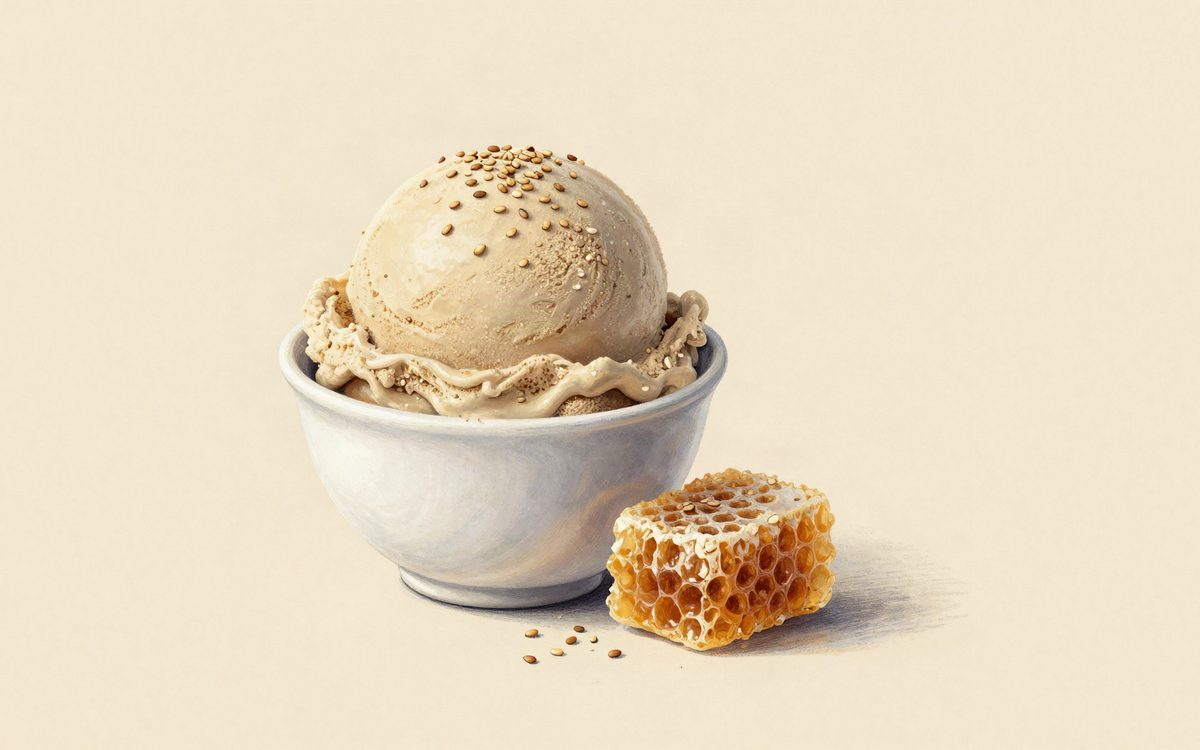
Levantine kitchens keep sesame paste and honey within reach of each other, and that pairing does structural work in this recipe rather than sitting in it as a reference. Sesame carries lignans, sesamin and sesamolin, plus phenolics from the hull, and past a certain dose the bitterness settles in and will not leave. So the paste is capped at 70 g per kilo, the smallest on any milk base here, well under the roughly 115 g the numbers alone would allow. Honey at 25 g and salt at 2 g come at that bitterness from two directions, and MSNF climbs to 9.3 percent, the highest in this group, for the same reason.
The 25 g of honey follow directly from that decision. Tahini and honey is the classic pairing of the Levant precisely because a sweetness with a floral edge covers phenolic bitterness better than plain sucrose, and the honey contributes 39 points of PAC without spending much on solids. The 2 g of salt work the same angle, suppressing bitterness by ionic antagonism rather than adding flavour.
MSNF closes at 9.3 percent in an 8 to 11.5 band, the highest figure of this group of recipes, and that is also a bitterness decision: milk protein binds phenolics and tannins, so pushing 32 g of milk powder into the formula rounds the sesame off. Around it, sugars sit at 16.93 percent against a 16 to 22 band and PAC at 262.47 against 220 to 300, with 652 g of whole milk and just 65 g of cream doing the dairy work.
Ingredients
Makes 1000 g of finished base.
| Ingredient | Grams | Home measure |
|---|---|---|
| Whole Milk | 652 | 2 3/4 cups |
| Sugar (Sucrose) | 135 | 2/3 cup |
| Tahini (Sesame Paste) | 70 | |
| Heavy Cream 35% | 65 | 1/4 cup |
| Non-Fat Dry Milk | 32 | 1/3 cup |
| Honey | 25 | |
| Dextrose (Glucose) | 15 | 1 1/2 tablespoons |
| Carob Seed Flour | 4 | |
| Salt | 2 |
Loads these exact grams into the free balancer, ready to edit.
Method
Base pasteurised alone, tahini and honey blended in below 40 C, three tray passes
- 1Whisk every dry ingredient together first: sugars, milk powder, stabiliser and salt. Dry-blending them stops the stabiliser clumping when it meets liquid.
- 2Warm the liquids to 40 C (104 F), then rain the dry mix in while whisking hard.
- 3Heat to 82 C (180 F) and hold for 2 minutes so the stabiliser hydrates.
- 4Off the heat, whisk in the paste, then blend 60 seconds so the fat emulsifies instead of separating.
- 5Chill in an ice bath to under 5 C (41 F) within 2 hours. Slow cooling is where bacteria and coarse crystals both start.
- 6Age 6 to 12 hours in the fridge under 5 C (41 F). This is when the stabiliser and the milk protein take up water.
- 7Freeze in a shallow metal pan 2 to 3 cm deep, breaking the crystals with a fork every 30 to 40 minutes, 4 to 6 times.
- 8Freeze firm, then temper 10 to 15 minutes in the fridge before scooping.
The balance
All six against the professional range for Milk Gelato.
MSNF at 9.3 percent against 8 to 11.5 is the deliberate number here. It is high for a paste gelato, and it is high on purpose: milk protein binds the phenolics that make sesame bitter, so 32 g of milk powder buys palatability, not just body. Protein closes at 4.7 percent against a 3 to 5 band, which is the reason the paste dose cannot simply be doubled even if bitterness were not an issue. Fat lands at 8.44 percent against 6 to 12, most of it from the 70 g of tahini plus 65 g of cream. The rest reads solids 38.14 against 36 to 42, sugars 16.93 against 16 to 22, POD 179.17 against 140 to 200, PAC 262.47 against 220 to 300 and water 61.86 against 58 to 64. Lactose is 5.07 percent of the mix and 8.19 percent of the water, and the sandiness check passes.
Estimated nutrition: ~195 kcal · Fat 8.4 g · Sugars 16.9 g · Protein 4.7 g (per 100 g of mix, from the balanced composition).
With tahini the raw material moves the usable dose more than any calculation does. Hulled sesame, medium roast, takes the 70 g per kilo comfortably. Whole seed tahini and black tahini are noticeably more bitter and should drop to 50 to 55 g, which then means rebalancing fat with cream. Tahini separates oil aggressively in the jar, so stir it to uniform before weighing. Add it to a base that is already cooled, below 40 C: heating tahini in a watery medium sharpens the bitterness rather than blending it away. The 25 g of honey go in cold for the same reason, to keep its aromatic esters intact. Sesame is a declarable allergen in many markets, so label it.
If it goes wrong
Either the tahini was whole seed or black rather than hulled, or it was added while the base was still hot.
Drop the dose to 50 to 55 g for whole seed or black tahini and make up the fat with cream. In all cases add the paste below 40 C.
The tahini was weighed out of a separated jar, so the real fat load of the batch went above the 8.44 percent target.
Stir the jar back to uniform before weighing the 70 g, and blend the paste into the cold base with a stick blender rather than folding it in by hand.
The honey was cut back or replaced with sucrose, so nothing is lifting the sesame or covering its bitter edge.
Keep the 25 g of honey and the 2 g of salt. They carry 39 points of PAC and the masking effect that lets 70 g of paste read as flavour rather than as bitterness.
Suitable for: Vegetarian, Egg-free
Allergens: milk, sesame
No ingredient in this recipe contains gluten.
- https://www.greatbritishchefs.com/recipes/matcha-tahini-gelato-sesame-brittle-caramel-drizzle-recipe
- https://bistrobadia.de/en/tahini-ice-cream-recipe/
- https://en.wikipedia.org/wiki/Tahini
- The science behind it: Tahini in Gelato
- Ingredient sheet: Tahini (Sesame Paste)
Want to change an ingredient and watch the numbers move? Open the free balancer