Sunflower Seed Butter Gelato
Toasted and savoury before it is sweet, with a honeyed edge lifting the bitterness and a body that stays soft rather than claggy on the palate.
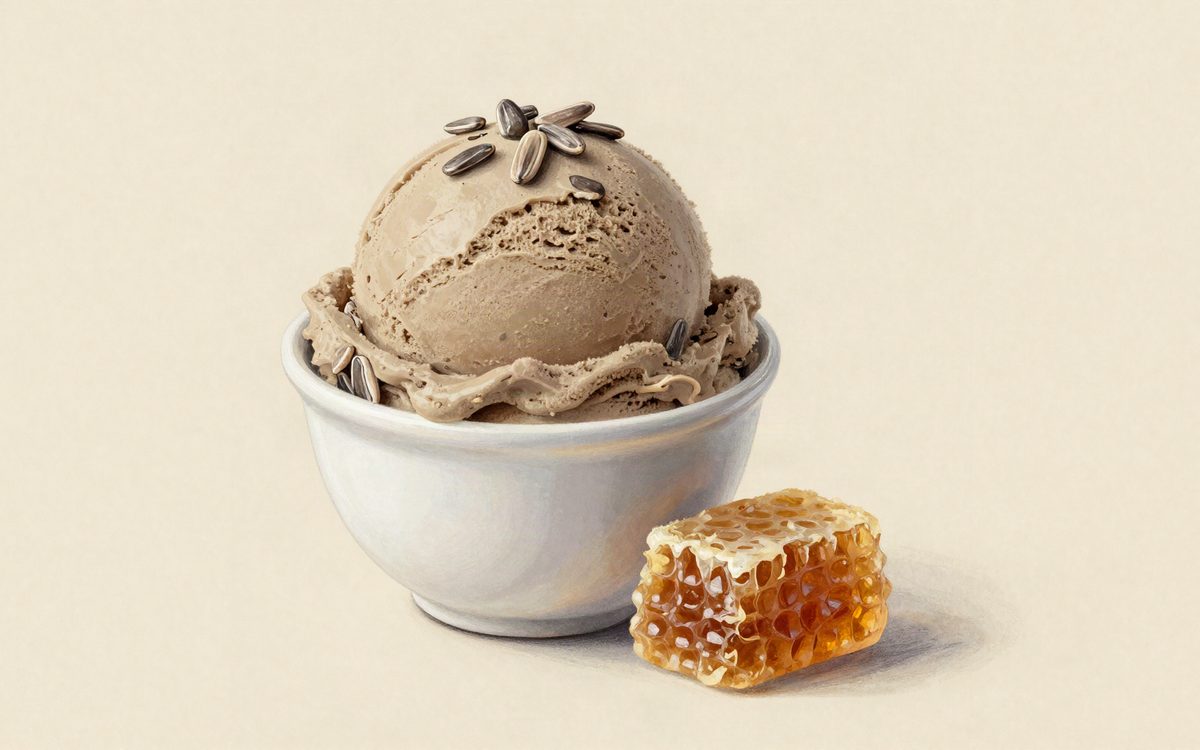
Because seed paste is leaner in protein than any nut paste you could put in its place, roughly 17.3 percent against 24.4 for peanut and 21 for almond, the protein budget never gets tight and the full 80 g per kilo fits without pushing MSNF towards its floor. The seed also brings 55 percent fat of its own, so cream drops back to a fine adjustment and whole milk does the volume. What makes it worth eating is the honey at 15 g: sunflower carries a phenolic bitterness that sucrose cannot mask, and the honey covers it while leaving a warm, toasted finish.
The paste is also 55.2 percent fat, so those 80 g put roughly 44 g of fat into the kilo before any dairy is counted. Total fat lands at 8.64 percent in a 6 to 12 band, which is why heavy cream appears at only 55 g: it is a trim, not a structural line. The 648 g of whole milk does the volume, and 26 g of milk powder lifts MSNF to 8.63 percent, just above the 8 floor.
The 15 g of honey is not sweetening. Sunflower carries a residual phenolic bitterness, and chlorogenic acid accounts for something like 50 to 70 percent of the total phenols in the paste. Honey masks that better than sucrose does, and it comes with POD 105 and PAC 156, so it sweetens harder and depresses the freezing point more per gram than table sugar. Fifteen grams is a masking dose: past about 30 g per kilo you are eating honey gelato. The 2 g of salt is there for the same reason.
One thing this recipe cannot do is borrow from the nut shelf. The whole point of the flavour is that it is nut free, so there is no hazelnut paste to round the edges and no milk chocolate with a tree nut trace. The seed has to stand on its own.
Ingredients
Makes 1000 g of finished base.
| Ingredient | Grams | Home measure |
|---|---|---|
| Whole Milk | 648 | 2 2/3 cups |
| Sugar (Sucrose) | 105 | 1/2 cup plus 1 tablespoon |
| Sunflower Seed Butter | 80 | |
| Heavy Cream 35% | 55 | 3 1/2 tablespoons |
| Glucose Syrup DE42 | 45 | 2 tablespoons |
| Non-Fat Dry Milk | 26 | 1/4 cup plus 1 tablespoon |
| Dextrose (Glucose) | 20 | 1 1/2 tablespoons |
| Honey | 15 | |
| Stabilizer (Neutral) | 4 | |
| Salt | 2 |
Loads these exact grams into the free balancer, ready to edit.
Method
White base pasteurised alone, paste emulsified at 55 C, three tray passes
- 1Whisk every dry ingredient together first: sugars, milk powder, stabiliser and salt. Dry-blending them stops the stabiliser clumping when it meets liquid.
- 2Warm the liquids to 40 C (104 F), then rain the dry mix in while whisking hard.
- 3Heat to 82 C (180 F) and hold for 2 minutes so the stabiliser hydrates.
- 4Chill in an ice bath to under 5 C (41 F) within 2 hours. Slow cooling is where bacteria and coarse crystals both start.
- 5Age 6 to 12 hours in the fridge under 5 C (41 F). This is when the stabiliser and the milk protein take up water.
- 6Freeze in a shallow metal pan 2 to 3 cm deep, breaking the crystals with a fork every 30 to 40 minutes, 4 to 6 times.
- 7Freeze firm, then temper 10 to 15 minutes in the fridge before scooping.
The balance
All six against the professional range for Milk Gelato.
Protein at 4.58 percent against a 3 to 5 band is the number that lets this recipe exist at full dose. A paste at 17.3 percent protein leaves headroom that peanut or pistachio would have consumed, so 80 g fits without squeezing MSNF, which closes at 8.63 percent just above its 8 floor. Fat at 8.64 percent against 6 to 12 explains the ingredient list from the other side: the paste alone brings about 44 g per kilo, so 55 g of cream is all the correction needed on top of 648 g of whole milk. The rest sits comfortably: solids 38.51 against 36 to 42, sugars 17.98 against 16 to 22, POD 167.44 against 140 to 200, PAC 258.85 against 220 to 300, water 61.49 against 58 to 64. Lactose comes to 4.7 percent of the mix and 7.65 percent of the water, and the sandiness check passes.
Estimated nutrition: ~197 kcal · Fat 8.6 g · Sugars 18 g · Protein 4.6 g (per 100 g of mix, from the balanced composition).
The specific risk here is colour, not spoilage. Sunflower seed butter turns green in an alkaline environment: chlorogenic acid oxidises to an o-quinone, which reacts with amino acids and protein side chains and forms trihydroxy benzacridine derivatives. The yellow to blue green shift happens between roughly pH 5 and pH 9, and moisture accelerates it. A base with 4.58 percent protein and 61.49 percent water is a fine stage for that reaction, so never add bicarbonate, Dutch process cocoa or any pH corrector, do not combine with egg white or alkalised milk powder, and keep the base at the natural pH of milk, around 6.6 to 6.8. Thermally: pasteurise the dairy base at 82 to 85 C without the paste, cool to 50 to 55 C, then emulsify the sunflower butter and the honey with a stick blender. Honey above 65 C loses its volatiles and browns against the lactose. Age 6 to 12 hours at 4 C. Last practical point: this paste separates hard, since it has none of the stabilisers commercial peanut butters carry. Stir the jar to uniform before weighing, or the real fat of the batch swings and the balance stops meaning anything.
If it goes wrong
Something alkaline went in, or the base was corrected upward in pH. Chlorogenic acid oxidises and reacts with protein above roughly pH 5.
Discard the alkaline ingredient from the recipe entirely. No bicarbonate, no Dutch cocoa, no alkalised milk powder. Keep the base at the natural pH of milk, 6.6 to 6.8.
The honey or the salt was cut, so nothing is masking the phenolic bitterness of the seed.
Keep the 15 g of honey and the 2 g of salt. Both are there for bitterness suppression, not for flavour, and neither can be replaced by extra sucrose.
The paste was weighed straight from a separated jar, so the actual fat contribution varied between batches.
Stir the jar back to uniform before weighing the 80 g. The paste is 55.2 percent fat, so a separated scoop can move total fat well off the 8.64 percent target.
Suitable for: Vegetarian, Egg-free
Allergens: milk
- Liang, Were et al. — Chlorogenic acid oxidation-induced greening of sunflower butter cookies as a function of different sweeteners and storage conditions, Food Chemistry (PubMed 28958510): https://pubmed.ncbi.nlm.nih.gov/28958510/
- Chlorogenic acid induced colored reactions and their effect on carbonyls, phenolic content, and antioxidant capacity in sunflower butter cookies, LWT — Food Science and Technology: https://www.sciencedirect.com/science/article/abs/pii/S0023643817306394
- Nordic Food Lab — Green sunflower seeds (mecanismo do esverdeamento: acido clorogenico + proteina em meio alcalino): https://nordicfoodlab.org/blog/2015/09/green-sunflower-seeds/
- The Gelato Alcreamist — How to create your own gelato recipe at home (faixas de acucares e gordura do gelato de leite): https://www.alcremista.com/en/diary/tips-tricks/158-how-to-create-your-own-gelato-recipe.html
- The science behind it: Starch vs Fat Nut Pastes
- Ingredient sheet: Sunflower Seed Butter
Want to change an ingredient and watch the numbers move? Open the free balancer