Strawberry Variegato (Ripple Sauce)
Glossy and bright red, it stays soft enough to streak through frozen gelato, sweet at first touch and then sharp with fresh berry and lemon at the finish.
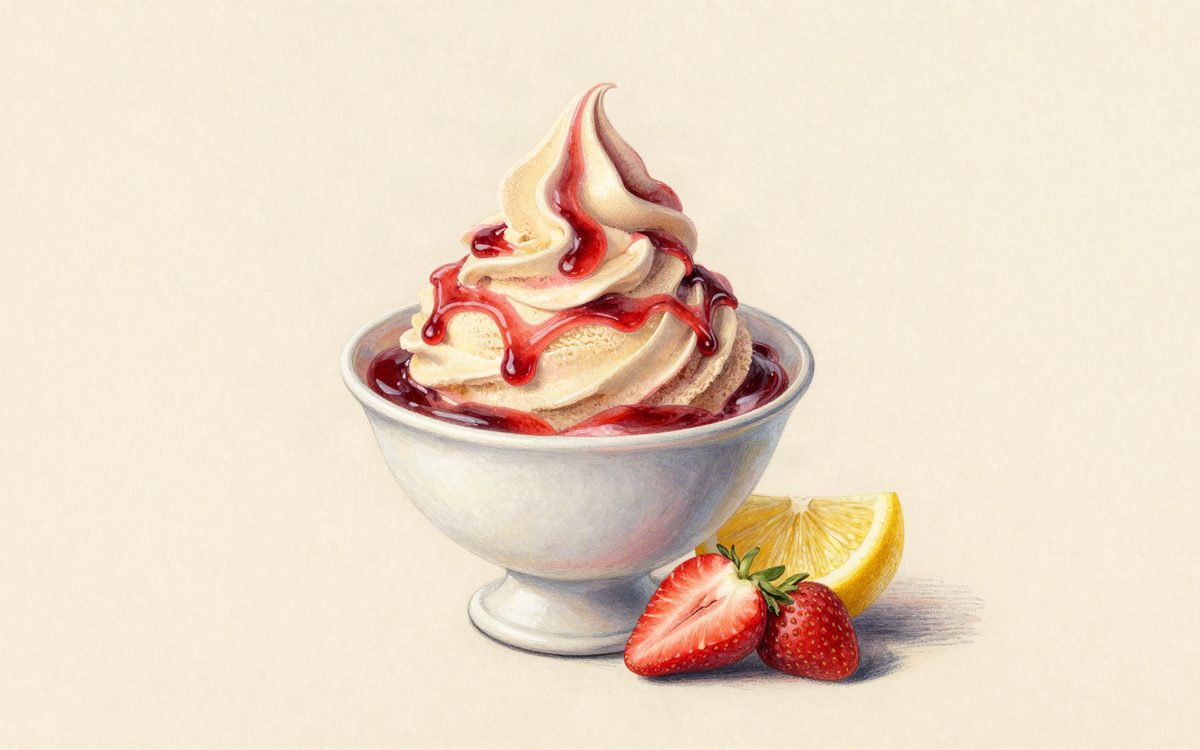
Stirred into gelato, most homemade fruit sauces give themselves away the next day: the ripple sets into icy red streaks that crunch against the spoon. That is water freezing, and the only cure is enough dissolved sugar that the water in the sauce cannot turn to ice at -18 C. Here the job is split between 337 g of sucrose for body and sweetness and 285 g of dextrose, which lowers the freezing point much harder per gram. The 300 g of strawberries and 15 g of lemon juice keep the fruit in front, and 3 g of pectin gives the sauce enough hold to stay in ribbons.
A ripple sauce is judged on its own targets, not on the eight indicators of a mix. PAC per 100 g of water lands at 275.81 inside a 250 to 350 band, which is what keeps the ripple from freezing hard, and the Brix of the water phase reads 67.01 against 62 to 72. Water sits at 32.48 percent and total solids at 67.52, both inside their bands, with sugars at 65.97 percent.
Every number assumes the sauce ends at the weight it started. Cooking only drives off water, and a pan that loses some would push PAC per water and Brix up without the page showing it, so the method weighs the pan and puts the evaporated water back. Use it at 10 to 20 percent of the finished gelato.
Ingredients
Makes 1000 g of finished base.
| Ingredient | Grams | Home measure |
|---|---|---|
| Sugar (Sucrose) | 337 | 1 3/4 cups |
| Strawberry | 300 | |
| Dextrose (Glucose) | 285 | 1 1/2 cups |
| Glucose Syrup DE42 | 60 | 3 tablespoons |
| Lemon Juice | 15 | |
| Pectin HM | 3 |
Loads these exact grams into the free balancer, ready to edit.
Method
Cooked just to dissolve, evaporated water weighed back in, cooled, rippled in at 10 to 20%
- 1Weigh the empty pan first and write the number down. The balance assumes the sauce ends at the same weight it started.
- 2Whisk the pectin into part of the sucrose before it meets any liquid: on its own it forms lumps that never dissolve.
- 3Trim the fruit and blend it to a coarse purée with the lemon juice.
- 4Heat the purée with the syrups to 85 C (185 F), rain in the sugars while whisking, and simmer gently for 2 minutes until every crystal has dissolved.
- 5Weigh the pan again and whisk in hot water until the sauce is back to its starting weight. Cooking only drives off water, so this puts the Brix back where the balance put it.
- 6Cool it covered, then keep it in the fridge at 4 C (39 F). It thickens as it cools.
- 7Ripple it through the gelato as it comes out of the machine or the tray, in thin layers and without stirring it in, at 10 to 20% of the finished weight.
The balance
The sauce against the variegato ranges: PAC per 100 g of water and Brix take the place of the mix indicators.
PAC per 100 g of water is the number this sauce is built on: 275.81, inside the 250 to 350 band that keeps a ripple soft at -18 C without pulling water out of the gelato around it. Sucrose cannot do that on its own: swap the 285 g of dextrose for sucrose and PAC per water falls to 229.91, under the 250 floor, even though the Brix rises to 69.62. Glucose syrup at 60 g adds body and slows crystallisation, and the Brix of the water phase closes at 67.01, inside 62 to 72. Water is 32.48 percent and total solids 67.52 percent, both inside their bands, with fat at 0.09 and nothing dairy in the pan.
Estimated nutrition: ~271 kcal · Fat 0.1 g · Sugars 66 g · Protein 0.2 g (per 100 g of mix, from the balanced composition).
Weigh the empty pan before anything goes in. Whisk the 3 g of pectin into part of the sucrose first, because pectin dropped straight into hot fruit forms lumps that never dissolve. Heat the strawberries, lemon juice and glucose syrup to 85 C, rain in the sugars while whisking and hold a gentle simmer for 2 minutes. Then weigh again and whisk in hot water until the pan is back to its starting weight: the balance assumes no water was lost. Cool it covered and keep it at 4 C. Ripple it in while the gelato is still soft from the machine or the tray, in thin layers, and do not stir.
If it goes wrong
More fruit than the sheet, or sucrose in place of the dextrose. With 50 g more strawberries and 50 g less sucrose, PAC per water falls to 229.62 and water climbs to 37.03 percent, both outside their bands.
Keep 300 g of strawberries and 285 g of dextrose, and weigh the pan back to its starting weight after cooking.
Too much water boiled off and was never put back, so the Brix climbed past the band and the sugar started to crystallise.
Weigh the pan after cooking every time and whisk the lost water back in while the sauce is still hot.
The pectin was left out, or the sauce went in warm.
Keep the 3 g of pectin, chill the sauce to fridge temperature and layer it into gelato that has just come out of the machine.
Suitable for: Vegan, Vegetarian, Lactose-free, Egg-free
No ingredient in this recipe contains gluten.
- https://www.frulact.com/ice-cream-variegate/
- https://patents.google.com/patent/US20100159081A1/en
- https://www.uoguelph.ca/foodscience/sites/uoguelph.ca.foodscience/files/public/FreezingCurveCalculation.pdf
- https://www.dairyscience.info/index.php/ice-cream/228-ice-cream-hardness.html
Want to change an ingredient and watch the numbers move? Open the free balancer