Strawberry Milk Gelato
Fruit reads fresh and faintly tart rather than jammy, and the body stays soft and creamy on the spoon instead of setting hard into pink ice.
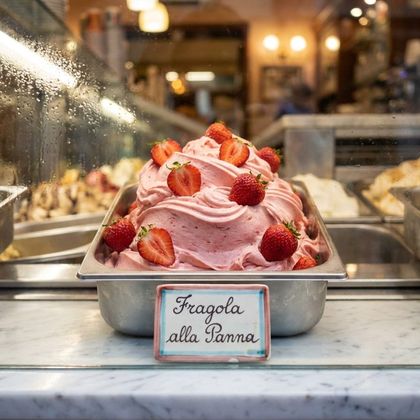
Blend 300 g of fruit into a kilo of mix with nothing to compensate, and the freezer hands back a pink brick that scrapes instead of scooping. Fruit that is only about 9% solids arrives as 27 g of solids and 273 g of free water, and free water is precisely what grows into crystals overnight. Three answers sit in this sheet: 54 g of non-fat dry milk to put back the solids and the body the water diluted, dextrose to drop the freezing point without adding more sweetness, and glucose powder to thicken the unfrozen phase so the crystals that do form stay too small to feel on the tongue.
The answer to 273 g of water is 54 g of non-fat dry milk and 60 g of glucose powder. The milk powder gives MSNF back, closing at 8.77 percent in a 5 to 9.5 range. The glucose powder buys dry extract at POD 44, so it adds body without adding sweetness.
Dextrose is held to just 15 g for the same reason. It is the strongest freezing point depressant of the three sugars here at PAC 173 against sucrose's 100, but it also spends sweetness and sugar budget, and PAC is already comfortable at 259.53. Sucrose takes 110 g and does the actual sweetening. Fat comes from 130 g of cream and nothing else, closing at 5.81 percent, and there is no yolk anywhere: egg fat and egg flavour both sit on top of the fresh aroma that is the entire point of a strawberry gelato.
Ingredients
Makes 1000 g of finished base.
| Ingredient | Grams | Home measure |
|---|---|---|
| Whole Milk | 319 | 1 1/3 cups |
| Strawberry | 300 | |
| Heavy Cream 35% | 130 | 1/2 cup plus 1 tablespoon |
| Sugar (Sucrose) | 110 | 1/2 cup plus 1 tablespoon |
| Glucose Powder | 60 | 1/4 cup plus 1 tablespoon |
| Non-Fat Dry Milk | 54 | 1/2 cup plus 1 tablespoon |
| Dextrose (Glucose) | 15 | 1 1/2 tablespoons |
| Lemon Juice | 8 | |
| Stabilizer (Neutral) | 3 | |
| Salt | 1 |
Loads these exact grams into the free balancer, ready to edit.
Method
White base pasteurised and aged cold, macerated raw puree folded in at the end
- 1Whisk every dry ingredient together first: sugars, milk powder, stabiliser and salt. Dry-blending them stops the stabiliser clumping when it meets liquid.
- 2Warm the liquids to 40 C (104 F), then rain the dry mix in while whisking hard.
- 3Heat to 82 C (180 F) and hold for 2 minutes so the stabiliser hydrates.
- 4Chill in an ice bath to under 5 C (41 F) within 2 hours. Slow cooling is where bacteria and coarse crystals both start.
- 5Age 6 to 12 hours in the fridge under 5 C (41 F). This is when the stabiliser and the milk protein take up water.
- 6Fold the fruit in cold, after ageing. Heating it costs you the fresh aroma and nothing is gained.
- 7Freeze in a shallow metal pan 2 to 3 cm deep, breaking the crystals with a fork every 30 to 40 minutes, 4 to 6 times.
- 8Freeze firm, then temper 10 to 15 minutes in the fridge before scooping.
The balance
All six against the professional range for Milk Gelato with Fruit.
This sheet is a water management problem and two numbers show it. Solids close at 35.72 percent against a 32 percent floor, with water at 64.28 percent inside a 60 to 68 range, which is what 300 g of a 9 percent solids fruit does to a kilo. MSNF at 8.77 percent in the 5 to 9.5 band for a milk gelato with fruit is the recovery: 54 g of non-fat dry milk is an unusually high dose for a gelato and it is there because the fruit diluted the dairy, not because the recipe wanted extra milk flavour. Sugars land at 19.59 percent in a 17 to 25 window, and POD 171.7 against a 230 ceiling shows the sweetness is not being pushed. Fat at 5.81 percent sits mid band in 3.5 to 8 and comes entirely from 130 g of cream, while protein reads 3.48 in a 2 to 4.5 range. Lactose is 4.78 percent of the mass and 7.44 percent of the water, so despite the heavy milk powder dose, crystallised lactose is not the thing that will make this one grainy.
Estimated nutrition: ~172 kcal · Fat 5.8 g · Sugars 19.6 g · Protein 3.5 g (per 100 g of mix, from the balanced composition).
Strawberry runs at a pH near 3.3 and milk casein does not tolerate that with heat. Pasteurise the white base on its own at 85 C, chill it to 4 C, age it 6 to 12 hours, and only then add the raw cold puree, immediately before freezing. Do not cook the fruit at any point: heat destroys furaneol and mesifurane, which are the two molecules that make strawberry smell like strawberry rather than like jam, and it darkens the anthocyanins so the colour drifts from pink to brick. One step is worth the extra half hour: macerate the fruit with a small part of the sugar for 30 minutes before blending. It draws the juice out and dissolves the pigment evenly, which gives a uniform pink instead of a blotchy one. Serve at -12 C. The fruit acid lowers the freezing point further than the sheet accounts for, so this base eats softer than PAC 259.53 suggests on paper.
If it goes wrong
The puree met a warm base. At pH 3.3 the fruit acid destabilises milk casein, and warmth is all it needs to flocculate.
Chill the pasteurised base to 4 C and age it before the fruit goes anywhere near it. Cold puree into cold base, never the reverse.
The fruit was heated with the base. Furaneol and mesifurane cook off and the anthocyanins brown.
Pasteurise the dairy alone, then fold in 300 g of raw puree cold, after ageing and just before freezing.
The fruit went straight into the blender. The pigment is concentrated in the juice, and without maceration it never distributes evenly through the 1 kg batch.
Macerate the strawberries with a small part of the 110 g of sucrose for 30 minutes, then blend and fold in.
Suitable for: Vegetarian, Egg-free
Allergens: milk
- Goff, H. D.; Hartel, R. W. Ice Cream, 7a ed. Springer, 2013 (cap. 3, papel dos diferentes acucares na curva de congelamento)
- Corvitto, A. Los secretos del helado: el helado sin secretos. Vilbo, 2004 (balanceamento de gelato de leite com fruta por POD e PAC)
- Caviezel, L. Il gelato artigianale. Chiriotti Editori (percentuais de fruta no gelato alla frutta com leite)
- USDA FoodData Central, morango cru: https://fdc.nal.usda.gov/
- The science behind it: Why Acidic Fruit Curdles Dairy Gelato, and How to Stop It
- Ingredient sheet: Strawberry
Want to change an ingredient and watch the numbers move? Open the free balancer