Salted Peanut Caramel Gelato
Three flavours land in order, roasted nut then caramel then salt, and the salt is what stops the sweetness from going flat halfway through.
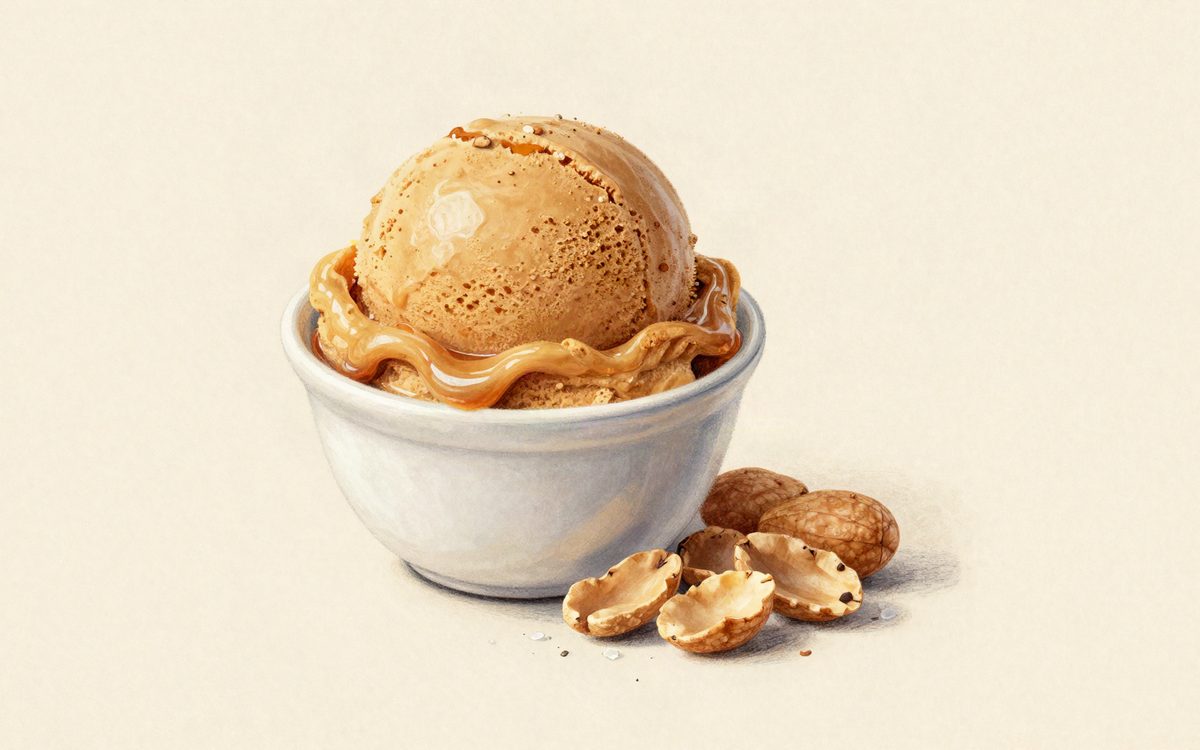
What you buy in a jar cannot be fixed later in the machine. The peanut paste should be nothing but roasted peanut: no added sugar, no hydrogenated fat, no salt, because salt is dosed separately here and a salted paste takes that control away. The dulce de leche wants the same scrutiny, milk and sugar and little else, since the cheap tins lean on starch and read gummy once frozen. Both arrive carrying sugar and fat, and both are loud. Peanut is the most assertive nut on the shelf and does not need a full dose to lead, so it stops at 60 g against the 80 to 100 g a plain nut gelato would take, and the salt sits at 3 g, the line between salted caramel and caramel.
Dulce de leche is doing more work than it looks. Those 70 g bring roughly 34 g of sugar, 4.9 g of fat and 9.5 g of MSNF in a single ingredient, plus the Maillard notes and the colour that make it read as caramel rather than as sweetened milk. That is why non-fat dry milk is only 15 g here: MSNF has an 11.5 percent ceiling and closes at 8.43, and most of the way there was already paid for.
The salt is the technical heart of the recipe. Three grams per kilo is the dose the salted caramel literature settles on, around 0.3 percent of the mass, and it is what separates salted caramel from plain caramel. It is also a balancing ingredient: at PAC 585 those 3 g shift PAC by about 17.6 points, out of the 263.74 the sheet reads. Which means a 1 g weighing error moves PAC by nearly 6 points on its own. On this recipe the salt goes on a 0.1 g scale, not in a pinch.
Ingredients
Makes 1000 g of finished base.
| Ingredient | Grams | Home measure |
|---|---|---|
| Whole Milk | 623 | 2 2/3 cups |
| Sugar (Sucrose) | 115 | 1/2 cup plus 1 tablespoon |
| Heavy Cream 35% | 80 | 1/3 cup |
| Dulce de Leche (Can) | 70 | |
| Peanut Paste 100% | 60 | |
| Dextrose (Glucose) | 30 | 2 1/2 tablespoons |
| Non-Fat Dry Milk | 15 | 2 1/2 tablespoons |
| Carob Seed Flour | 4 | |
| Salt | 3 |
Loads these exact grams into the free balancer, ready to edit.
Method
Dulce dissolved into warm milk, peanut paste at 60 C, tray frozen and forked
- 1Whisk every dry ingredient together first: sugars, milk powder, stabiliser and salt. Dry-blending them stops the stabiliser clumping when it meets liquid.
- 2Warm the liquids to 40 C (104 F), then rain the dry mix in while whisking hard.
- 3Heat to 82 C (180 F) and hold for 2 minutes so the stabiliser hydrates.
- 4Off the heat, whisk in the paste, then blend 60 seconds so the fat emulsifies instead of separating.
- 5Chill in an ice bath to under 5 C (41 F) within 2 hours. Slow cooling is where bacteria and coarse crystals both start.
- 6Age 6 to 12 hours in the fridge under 5 C (41 F). This is when the stabiliser and the milk protein take up water.
- 7Freeze in a shallow metal pan 2 to 3 cm deep, breaking the crystals with a fork every 30 to 40 minutes, 4 to 6 times.
- 8Freeze firm, then temper 10 to 15 minutes in the fridge before scooping.
The balance
All six against the professional range for Milk Gelato.
Protein is the tightest number on the sheet at 4.78 percent against a 5 percent ceiling, and it is the sum of three sources that all arrived together: milk protein from 623 g of whole milk, the MSNF the dulce de leche carried in, and peanut protein from the 60 g of paste. That ceiling is the real reason the peanut stops at 60 g rather than the 80 to 100 g a plain peanut gelato would use. PAC is the second number to read, at 263.74 in a 220 to 300 band, with roughly 17.6 of those points coming from salt alone. Fat lands at 8.47 percent in a 6 to 12 range, which is why the cream is only 80 g: the peanut paste and the dulce brought fat before the cream ever got a vote. Sugars close at 17.95 percent with just 115 g of added sucrose, because the dulce de leche had already put about 34 g of sugar in.
Estimated nutrition: ~195 kcal · Fat 8.5 g · Sugars 18 g · Protein 4.8 g (per 100 g of mix, from the balanced composition).
The order matters more here than in most gelati, because three ingredients each want a different temperature. Salt goes in first, fine, dissolved into the cold liquid phase. Dulce de leche goes in during the heating, dissolved into milk that is already warm and with the whisk moving, because it settles on the bottom of the pot and scorches if you let it. Peanut paste goes in last, during cooling, at 60 to 65 C, then blend 60 seconds so the fat emulsifies instead of separating out later. Pasteurise at 85 C for 30 seconds and do not push past it: dulce de leche is a finished Maillard product and it keeps browning, so an extra few degrees reads as burnt rather than as deeper caramel. Age 8 hours at 4 C. There is no acid anywhere on this list, so nothing here can curdle, which makes this an unusually forgiving base once the temperatures are respected. Worth flagging on the label: peanut and milk in the same recipe is a two allergen product and needs a separated line if you are making it alongside anything else.
If it goes wrong
The dulce de leche was taken past 85 C, or it sat undissolved on the bottom of the pot. It is already a browned product and it keeps going.
Dissolve the 70 g into warm milk with the whisk moving, hold at 85 C for 30 seconds only, then pull it off the heat and start cooling.
Salt overdosed. At PAC 585 one extra gram adds close to 6 points on top of a sheet already at 263.74.
Weigh the 3 g on a 0.1 g scale. If it tastes under-salted, drop sucrose from 115 g before you touch the salt.
The paste went into a hot pot. Peanut paste dropped into liquid above about 70 C separates instead of emulsifying, and the aroma goes with the heat.
Add the 60 g of paste during cooling at 60 to 65 C and blend for a full 60 seconds before the ice bath.
Suitable for: Vegetarian, Egg-free
Allergens: milk, peanuts
- https://www.icecreamscience.com/blog/how-to-make-homemade-salted-caramel-ice-cream
- https://www.grahamsfamilydairy.com/news-events/blog/why-salted-caramel-ice-cream-works-so-well/
- https://www.davidlebovitz.com/salted-butter-c/
- https://www.gelq.it/en/7-nuts-ice-cream-pastes
- The science behind it: Starch vs Fat Nut Pastes
- Ingredient sheet: Peanut Paste 100%
Want to change an ingredient and watch the numbers move? Open the free balancer