Salted Dark Chocolate Gelato
A saline edge runs under the cocoa from the first spoonful, rounding the bitterness, sharpening the sweetness and leaving a long, dry finish behind it.
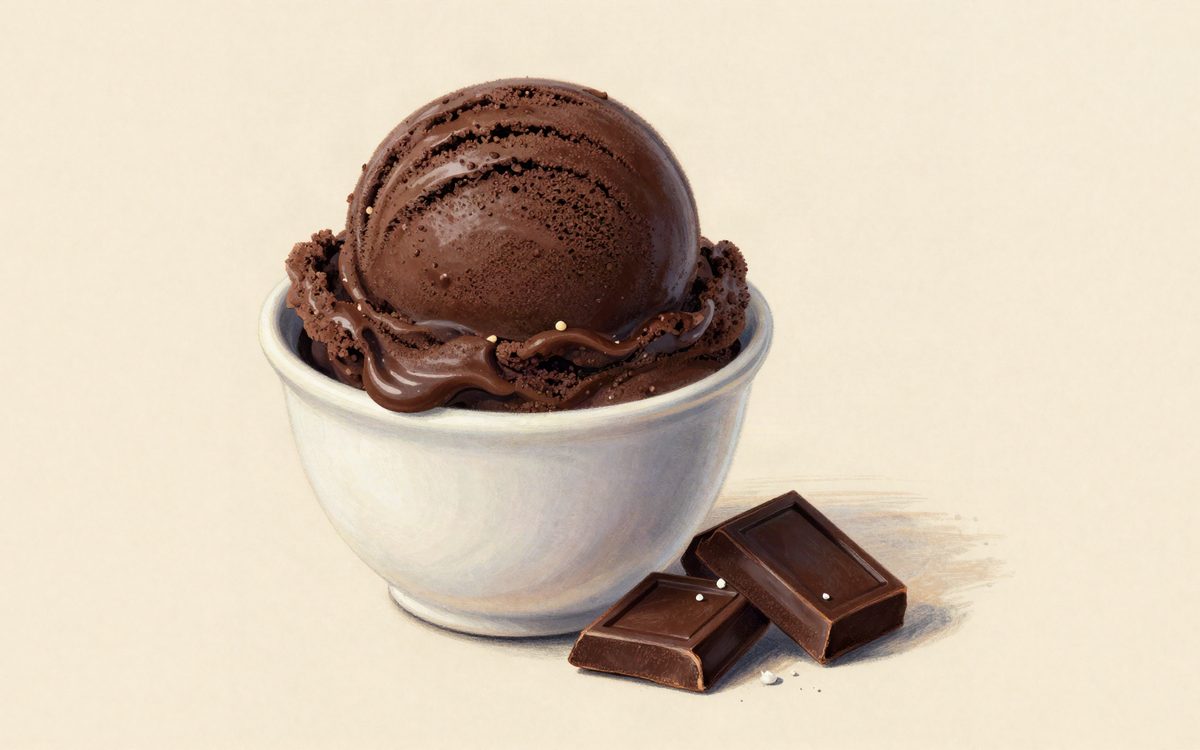
Turn the bar over before you buy it. The list should read cocoa mass, cocoa butter and sugar, with nothing else worth arguing about, since anything using vegetable fat in place of cocoa butter sets waxy in the tub and dulls the finish. The powder deserves the same look: 22 to 24 percent fat, cocoa only. And buy fine salt rather than flakes, because it has to dissolve into the mix instead of sitting in it. With 110 g of the bar plus 25 g of powder per kilo carrying the flavour, 3 g of salt then does two jobs at once, lifting the sweetness while contributing a PAC of 585, roughly the freezing work of 17.5 g of sucrose.
The reason it cannot go much higher is arithmetic, not taste. Salt has a PAC of 585 against sucrose's 100, so 3 g of it does the same work on the freezing point that about 17.5 g of sucrose would do. That is why sucrose stops at 105 g and total sugars close at 17.02 percent, low in a 16 to 22 band, while PAC still reaches 263.01. Add another gram of salt without pulling sugar back and the mix goes soft in the tub.
The cocoa comes from two places on purpose: 110 g of 70 percent chocolate and 25 g of 22 to 24 percent cocoa powder. The bar brings cocoa butter and emulsion, the powder brings the non-fat cocoa solids that actually carry flavour and colour. There is no cream on the list at all, and fat still closes at 7.21 percent, supplied by the chocolate and by 695 g of whole milk. The base is milk rather than water because casein rounds off the tannin in a 70 percent bar. On water the same cocoa reads harsh and astringent.
Ingredients
Makes 1000 g of finished base.
| Ingredient | Grams | Home measure |
|---|---|---|
| Whole Milk | 695 | 3 cups |
| Dark Chocolate 70% | 110 | |
| Sugar (Sucrose) | 105 | 1/2 cup plus 1 tablespoon |
| Dextrose (Glucose) | 35 | 3 tablespoons |
| Cocoa Powder 22-24% | 25 | |
| Non-Fat Dry Milk | 24 | 1/4 cup |
| Salt | 3 | |
| Stabilizer (Neutral) | 3 |
Loads these exact grams into the free balancer, ready to edit.
Method
Cocoa hydrated at 85 C, chocolate melted in off the heat, tray frozen and forked
- 1Whisk every dry ingredient together first: sugars, milk powder, stabiliser and salt. Dry-blending them stops the stabiliser clumping when it meets liquid.
- 2Warm the liquids to 40 C (104 F), then rain the dry mix in while whisking hard.
- 3Heat to 82 C (180 F) and hold for 2 minutes so the stabiliser hydrates.
- 4Melt the chocolate to 45 C (113 F) and stir it into the hot base off the heat, then blend 60 seconds until glossy.
- 5Chill in an ice bath to under 5 C (41 F) within 2 hours. Slow cooling is where bacteria and coarse crystals both start.
- 6Age 6 to 12 hours in the fridge under 5 C (41 F). This is when the stabiliser and the milk protein take up water.
- 7Freeze in a shallow metal pan 2 to 3 cm deep, breaking the crystals with a fork every 30 to 40 minutes, 4 to 6 times.
- 8Freeze firm, then temper 10 to 15 minutes in the fridge before scooping.
The balance
All six against the professional range for Milk Gelato.
Salt drives two of the eight numbers here. Sugars at 17.02 percent sit in the lower half of a 16 to 22 range, which for a chocolate gelato looks restrained until you account for the salt: at PAC 585 those 3 g are worth roughly 17.5 g of sucrose on the freezing curve, and PAC still lands at 263.01. The other number worth reading is fat at 7.21 percent with no cream anywhere on the ingredient list. All of it comes from the 110 g of 70 percent bar and the 695 g of whole milk, which is why the sheet can afford 135 g of combined cocoa without breaking the 12 percent fat ceiling. MSNF at 8.56 percent sits close to its 8 percent floor because there is only 24 g of non-fat dry milk propping it up, and that in turn keeps lactose at 4.66 percent of the mass and 7.6 percent of the water, well clear of sandiness.
Estimated nutrition: ~191 kcal · Fat 7.2 g · Sugars 17 g · Protein 4.4 g (per 100 g of mix, from the balanced composition).
Use fine salt dissolved into the cold liquid phase. Flake salt scattered into a finished base does not dissolve at -12 C and the eater finds isolated salty points. Cocoa powder needs moist heat to hydrate, so disperse the 25 g dry with a third of the sugar, add it to cold milk, take the pot to 85 C and hold 2 to 3 minutes there before melting the 70 percent bar in off the heat. Alkalised cocoa at 22 to 24 percent has a pH of 7.0 to 7.5, which stabilises the casein and makes this base far more heat tolerant than any fruit version. Ageing 8 to 12 hours at 4 C is mandatory: cocoa starch and fibre keep taking up water through the rest, and freezing early gives a grainy texture that is not lactose but unhydrated cocoa particles. One calibration rule: if the salt seems to vanish at serving temperature, do not add salt, raise the serving temperature. Cold suppresses salt perception badly, so judge the base melted at around 10 C, where it should taste slightly too salty.
If it goes wrong
The cocoa powder never hydrated. Cocoa starch and fibre need moist heat and then time, and this base was frozen too soon after cooking.
Hold the mix at 85 C for a full 2 to 3 minutes after the cocoa goes in, then age 8 to 12 hours at 4 C before freezing.
Coarse or flake salt. Large crystals do not dissolve in a mix that is already at freezing temperature, so the 3 g stays in a handful of spots instead of spreading through the kilo.
Weigh fine salt and dissolve it in the cold liquid phase, before any heat, so it is in solution from the start.
Salt was overdosed. At PAC 585 every extra gram adds close to 6 points on top of the 263.01 the sheet already carries.
Weigh the salt on a 0.1 g scale. If you want it saltier, pull sucrose back from 105 g rather than adding salt on top.
Suitable for: Vegetarian, Egg-free
Allergens: milk
- https://www.icecreamscience.com/blog/chocolate-ice-cream-recipe
- https://foodnouveau.com/dark-chocolate-gelato/
- https://www.dairyfoods.com/articles/90396-working-with-cocoa-in-ice-cream
- https://www.foodnetwork.com/recipes/ina-garten/deeply-chocolate-gelato-recipe-1945398
- The science behind it: Couverture Chocolate for Gelato
- Ingredient sheet: Dark Chocolate 70%
Want to change an ingredient and watch the numbers move? Open the free balancer