Saffron Gelato
Honeyed and faintly medicinal, more perfume than sugar, riding on a yolk-thickened body that turns the whole scoop gold and keeps the scent going after the swallow.
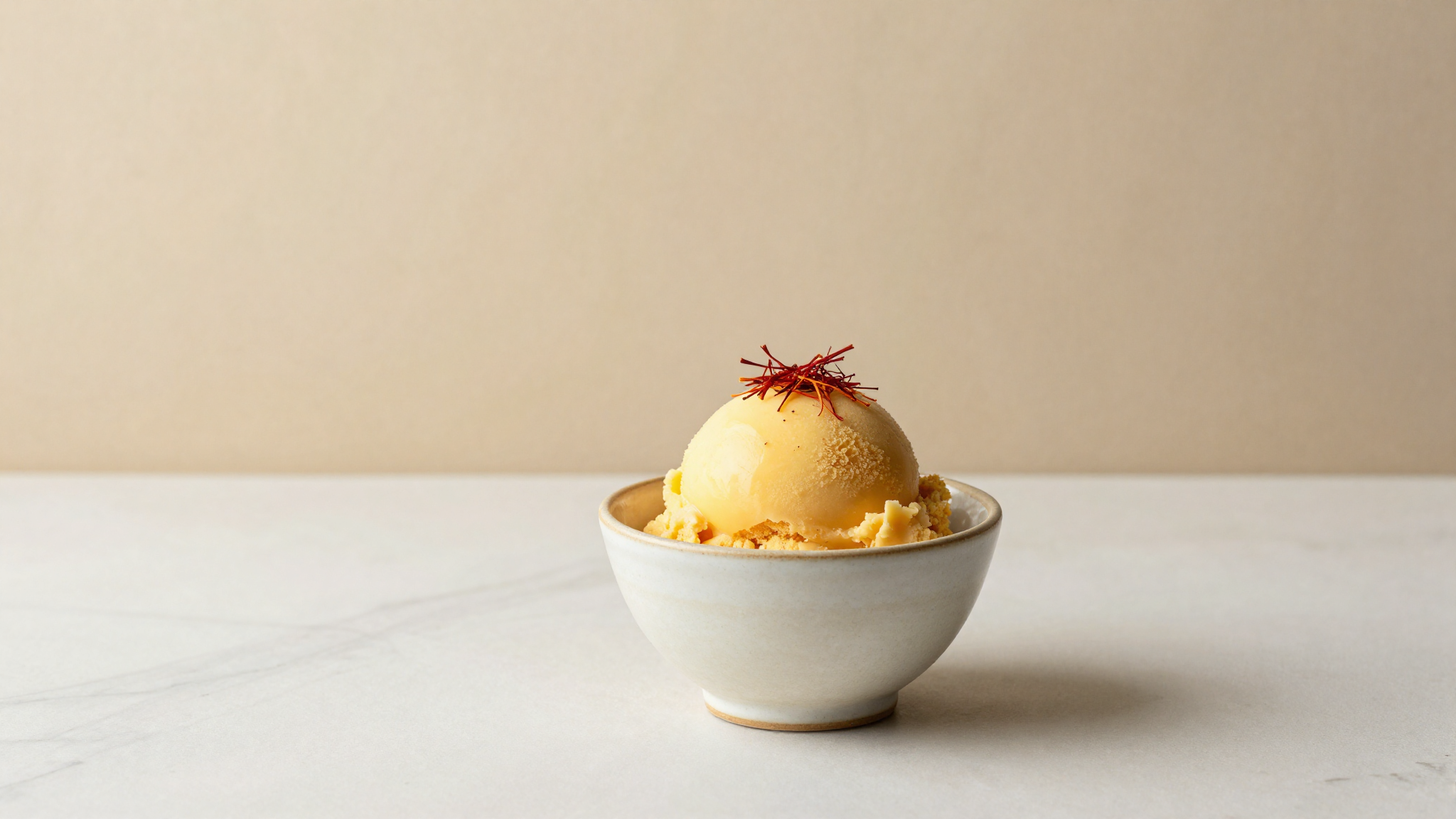
Across the Indian subcontinent the threads go into milk before they go anywhere else, steeped until the colour bleeds out and the aroma moves into the fat, and that is the technique this sheet is built around. The spice itself is arithmetically invisible: a working dose sits between 0.5 and 1.5 g per kilo, under 0.15 percent of the mass, and none of the eight indicators move. Everything else is the carrier, which is where the care goes. Whole milk at 576 g, cream at 140 g, skim milk powder at 40 g and 45 g of egg yolk, roughly two and a half yolks, give the perfume something fatty to hold on to and the colour a warm background to sit against.
Yolk at 45 g per kilo is roughly two and a half yolks. Domestic saffron recipes routinely ask for six yolks per litre, and that lands protein well past the 5 percent ceiling. This one closes at 4.33. Yolk earns its place twice over here: lecithin does the emulsifying, and the yolk's own yellow gives crocin something to sit on, because crocin delivers colour and no body at all. That is also why carob seed flour is down to 3 g. With yolk in the mix it has very little left to do.
The sugar side is a straight custard build: 125 g sucrose, 30 g dextrose, 40 g glucose powder, closing at 19.03 percent sugars and POD 170.31 against a 200 ceiling. PAC reads 264.63 in a 220 to 300 band, solids 38.35 and fat 8.4, all comfortably mid range. Nothing is pinned, which is the point: when the flavour ingredient contributes no structure, the base has to be right on its own.
Ingredients
Makes 1000 g of finished base.
| Ingredient | Grams | Home measure |
|---|---|---|
| Whole Milk | 576 | 2 1/3 cups |
| Heavy Cream 35% | 140 | 1/2 cup plus 2 tablespoons |
| Sugar (Sucrose) | 125 | 1/2 cup plus 2 tablespoons |
| Egg Yolk | 45 | |
| Skim Milk Powder | 40 | 1/3 cup plus 2 tablespoons |
| Glucose Powder | 40 | 3 1/2 tablespoons |
| Dextrose (Glucose) | 30 | 2 1/2 tablespoons |
| Carob Seed Flour | 3 | |
| Salt | 1 |
Loads these exact grams into the free balancer, ready to edit.
Method
Threads infused at 50 C, base aged 12 hours, tray frozen and forked
- 1Whisk every dry ingredient together first: sugars, milk powder, stabiliser and salt. Dry-blending them stops the stabiliser clumping when it meets liquid.
- 2Warm the liquids to 40 C (104 F), then rain the dry mix in while whisking hard.
- 3Beat the yolks with part of the sugar, then temper: pour the warm base over the yolks in a thin stream, never the other way round.
- 4Bring to 82 to 85 C (180 to 185 F) and stop. Past 87 C the yolk coagulates and no amount of blending brings the flavour back.
- 5Chill in an ice bath to under 5 C (41 F) within 2 hours. Slow cooling is where bacteria and coarse crystals both start.
- 6Age 6 to 12 hours in the fridge under 5 C (41 F). This is when the stabiliser and the milk protein take up water.
- 7Freeze in a shallow metal pan 2 to 3 cm deep, breaking the crystals with a fork every 30 to 40 minutes, 4 to 6 times.
- 8Freeze firm, then temper 10 to 15 minutes in the fridge before scooping.
The balance
All six against the professional range for Milk Gelato.
Two numbers explain the shape of this sheet. Protein at 4.33 percent in a 3 to 5 band is what caps the yolk at 45 g: push to the six yolks per litre that home recipes ask for and protein breaks the ceiling, the base turns eggy and the saffron sits behind it. MSNF at 9.75 percent in an 8 to 11.5 band is the other one, and it comes mostly from the 576 g of milk plus 40 g of skim milk powder, which is what gives a spice base enough dry extract to feel like gelato and not like frozen milk. PAC 264.63 sits mid band, so the mix stays workable in a cabinet held at -11 to -14 C rather than setting solid. Lactose comes to 5.32 percent of the mass and 8.62 percent of the water, which is on the high side for a milk base and worth knowing before anyone decides to raise the skim milk powder past 40 g.
Estimated nutrition: ~195 kcal · Fat 8.4 g · Sugars 19 g · Protein 4.3 g (per 100 g of mix, from the balanced composition).
Saffron splits into three molecules that behave differently under heat. Crocin, the colour, and picrocrocin, the bitterness, are both water soluble and survive. Safranal, the aroma, is volatile and does not. So the infusion must never boil. Grind the threads in a mortar with a pinch of the sucrose, then infuse 20 to 30 minutes in very hot water or in part of the milk held at 50 C. Build the base normally, bring the saffron infusion in at around 50 C, and do the pasteurising before that, not after: with yolk in the pot that means 85 C for 30 seconds, or 65 C held, and then nothing hot touches the saffron again. Ageing is 12 hours minimum and it is not optional. The colour only closes to a deep yellow after resting, so anyone judging the shade straight out of the pot will decide it is too pale and overdose the threads.
If it goes wrong
Colour was judged before ageing. Crocin needs the 12 hour rest to develop, and the extra threads you added brought extra picrocrocin, which is the bitter fraction.
Fix the dose at 0.5 to 1.5 g per kilo by weight, not by eye, and only judge colour after the full 12 hours in the fridge at under 5 C.
The infusion boiled, or the saffron went in before pasteurising and then got taken to 85 C. Safranal is volatile and leaves with the steam.
Infuse at 50 C for 20 to 30 minutes and add it to the base after the heat step, never before it.
The yolk went past its limit. The 45 g of yolk coagulates above 87 C and no amount of blending brings it back.
Temper by pouring the warm base over the yolks in a thin stream, hold at 82 to 85 C, and stop there.
Suitable for: Vegetarian
Allergens: egg, milk
No ingredient in this recipe contains gluten.
- https://www.gelatoartigianale.it/ricette/re-zafferano-di-alberto-vitaro
- https://zafferanoticinus.it/gelato-allo-zafferano-in-pistilli/
- https://www.csabadallazorza.com/ricette/gelato-allo-zafferano/
- The science behind it: Saffron in Gelato
- The story of this recipe: Saffron Gelato Recipe
Want to change an ingredient and watch the numbers move? Open the free balancer