Rosemary Olive Oil Gelato
Silky where a cream base would be heavy, a green peppery warmth arriving after the cold, herbal and resinous right the way through the finish.
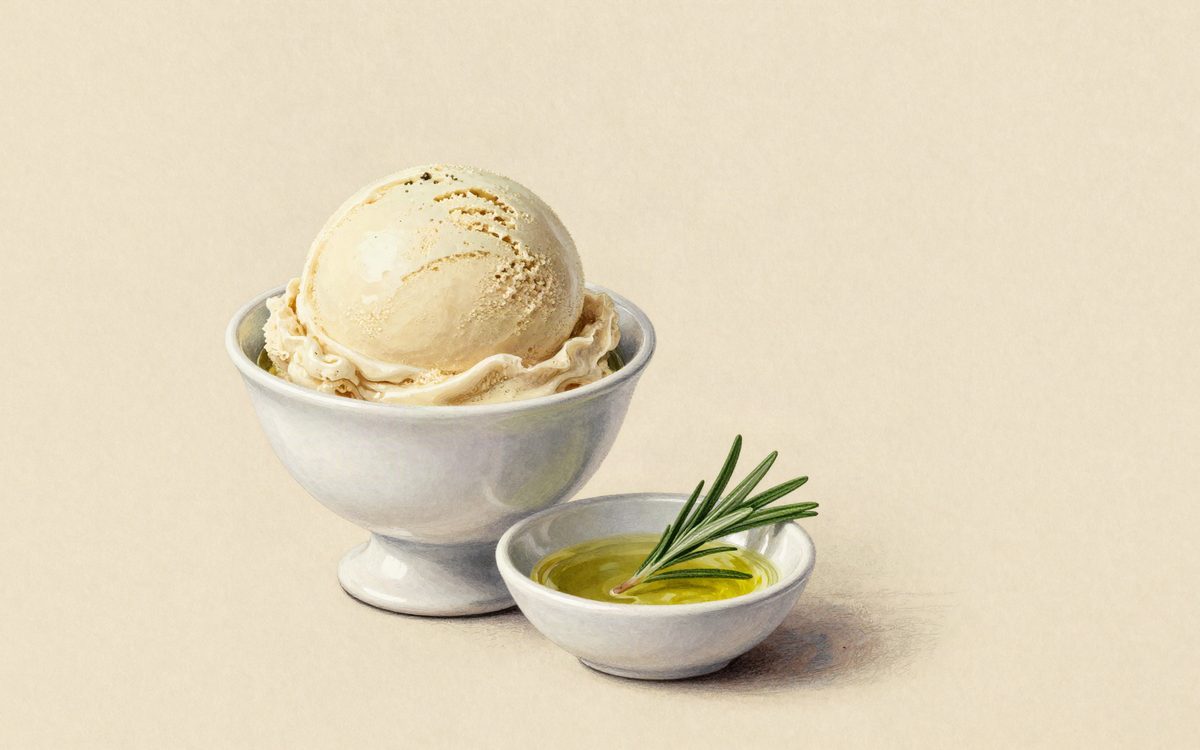
This one borrows its fat from the Mediterranean table, where olive oil does the job cream does elsewhere, and the balance follows that swap all the way down. Oil is 100% fat with no water in it, so 55 g per kilo puts 5.5 points of fat on the board before any dairy is counted, and total fat closes at 8.57%. Cream drops to 5 g, barely a rounding entry, while 703 g of whole milk becomes both the second fat source and the carrier of milk solids, with 47 g of skim milk powder taking MSNF to 10.82%. The 2 g of salt is functional too: without it the gelato reads as oily instead of fragrant.
The 2 g of salt is functional, not seasoning. In an oil based gelato salt is what stops the product from being read as greasy on the palate, and it is doing balance work as well: with PAC 585 those 2 g contribute 11.7 points to the 258.03 PAC total. The 4 g of soy lecithin is there for a reason specific to this fat. Olive oil is liquid at serving temperature and does not crystallise the way milk fat does, so without an emulsifier it will not stabilise the foam and it will migrate through the tub.
One thing should be said plainly: rosemary is not in the ingredient set this recipe was balanced against, so the numbers on this sheet describe the olive oil base. The herb goes in as an infusion on top, 2 to 3 g of whole sprigs per kilo, steeped and strained, and at that level it does not move any of the eight figures. The oil is what the balance is about, which is also why the confidence on this one is honest rather than absolute.
Ingredients
Makes 1000 g of finished base.
| Ingredient | Grams | Home measure |
|---|---|---|
| Whole Milk | 703 | 3 cups |
| Sugar (Sucrose) | 170 | 3/4 cup plus 2 tablespoons |
| Olive Oil | 55 | |
| Skim Milk Powder | 47 | 1/2 cup |
| Dextrose (Glucose) | 10 | 2 1/2 teaspoons |
| Heavy Cream 35% | 5 | 1 teaspoon |
| Carob Seed Flour | 4 | |
| Soy Lecithin | 4 | |
| Salt | 2 |
Loads these exact grams into the free balancer, ready to edit.
Method
Rosemary steeped 10 minutes and strained, oil streamed in at 60 to 65 C
- 1Whisk every dry ingredient together first: sugars, milk powder, stabiliser and salt. Dry-blending them stops the stabiliser clumping when it meets liquid.
- 2Warm the liquids to 40 C (104 F), then rain the dry mix in while whisking hard.
- 3Heat to 82 C (180 F) and hold for 2 minutes so the stabiliser hydrates.
- 4Chill in an ice bath to under 5 C (41 F) within 2 hours. Slow cooling is where bacteria and coarse crystals both start.
- 5Age 6 to 12 hours in the fridge under 5 C (41 F). This is when the stabiliser and the milk protein take up water.
- 6Freeze in a shallow metal pan 2 to 3 cm deep, breaking the crystals with a fork every 30 to 40 minutes, 4 to 6 times.
- 7Freeze firm, then temper 10 to 15 minutes in the fridge before scooping.
The balance
All six against the professional range for Milk Gelato.
Fat at 8.57 percent looks ordinary for a milk gelato until you see where it came from: 5.5 of those points are the olive oil, which forced cream down to 5 g and pushed whole milk up to 703 g, the largest milk line in this group. That single substitution then drives everything else. Milk and 47 g of milk powder take MSNF to 10.82 percent, high in an 8 to 11.5 range, which is also why lactose reads 5.9 percent of the mix and 9.49 percent of the water, the highest here, and still clears the sandiness check. PAC at 258.03 sits comfortably in 220 to 300, and 11.7 of those points come from just 2 g of salt, which is a reminder that salt in an oil base is doing more than seasoning. Water at 62.14 percent in a 58 to 64 range leaves the structure to the milk solids and the 4 g of carob seed flour, since there is no fruit and no egg here to hold anything.
Estimated nutrition: ~194 kcal · Fat 8.6 g · Sugars 17.9 g · Protein 4 g (per 100 g of mix, from the balanced composition).
The emulsion is the only thing that can genuinely ruin this. The oil goes in last, with the base at 60 to 65 C, poured in a thread under high shear from a stick blender or a homogeniser. Tipped in all at once, or added to a cold base, it will not disperse, and you get an oily film on the roof of the mouth and free oil released as it melts. For the rosemary, use 2 to 3 g per kilo of whole sprigs, infused in the hot base for no more than 10 minutes, then strained out. Rosemary carries camphor and 1,8 cineole, which extract fast into fat and go from aromatic to medicinal within minutes. This is the opposite of mint, which needs time. Never blitz the leaves into the base, because the resin stays. Choose a fruity extra virgin of low pungency: oleocanthal, the compound responsible for the peppery burn at the back of the throat, reads stronger at low temperature than it does at room temperature.
If it goes wrong
The oil was added to a cold base or poured in all at once, so it never emulsified.
Bring the base to 60 to 65 C and stream the 55 g in slowly under a running stick blender. The 4 g of soy lecithin only works if the oil is dispersed first.
The rosemary steeped too long, or the leaves were blended into the base. Camphor and cineole extract into fat very fast and the resin does not strain out.
Whole sprigs, 10 minutes maximum in the hot base, then lift them out. Taste at five minutes and pull early if it is already there.
A robust, high pungency oil. Oleocanthal is perceived more strongly cold, so an oil that tasted lively on bread can be aggressive in a frozen dessert.
Use a fruity extra virgin of mild pungency. There is no way to remove the burn once the base is made.
Suitable for: Vegetarian, Egg-free
Allergens: milk, soy
No ingredient in this recipe contains gluten.
- https://thewanderlustkitchen.com/rosemary-olive-oil-ice-cream/
- https://bakingwithsoul.com/2017/05/04/rosemary-olive-oil-ice-cream/
- https://www.agricolapiano.com/blogpiano/gelato-all-olio-extravergine-di-oliva/?lang=en
- The science behind it: Spice Infusion in Gelato
- Ingredient sheet: Olive Oil
Want to change an ingredient and watch the numbers move? Open the free balancer