Ricotta and Pistachio Gelato
Tangier and less sweet than the colour suggests, tasting of fresh dairy instead of cream, with the nut lingering as fat and salt once the cold has gone.
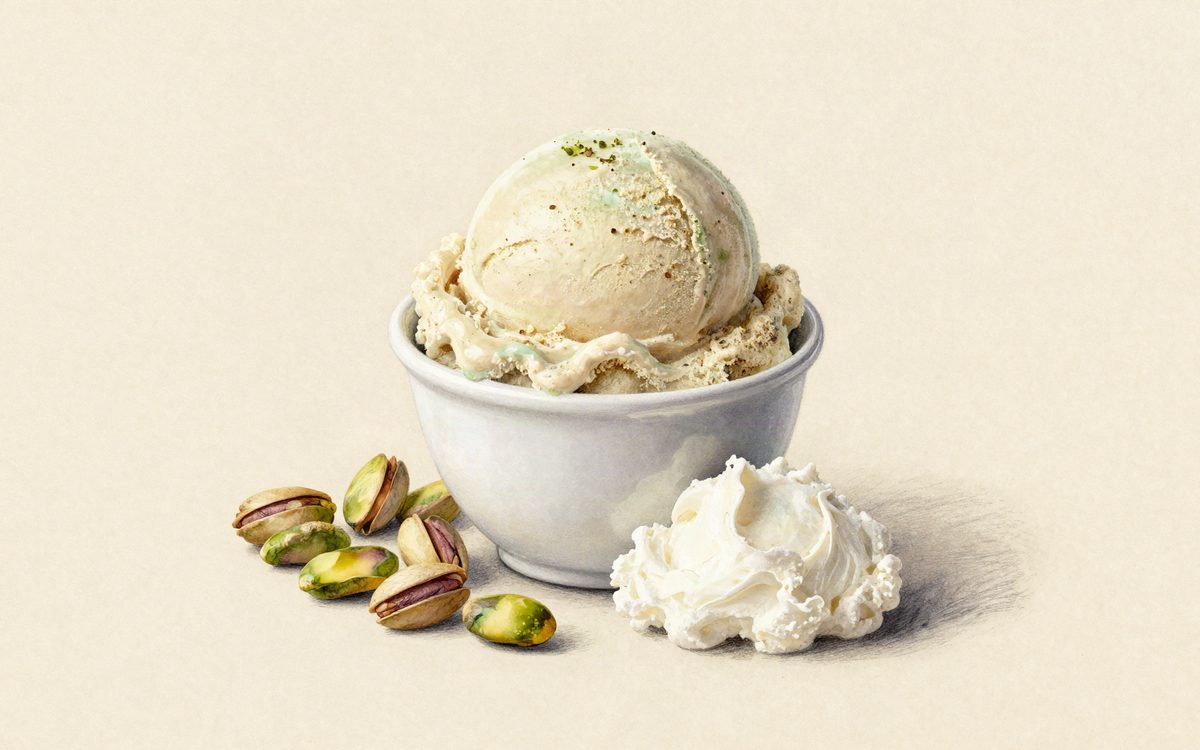
Across central and southern Italy the cheese day does not finish with the cheese. What is left is whey, and reheating it gives ricotta, a dairy that tastes of milk instead of cream, and that is the flavour this sheet is after: 200 g per kilo, set against 55 g of pure pistachio paste. The pairing is also the constraint. Cow ricotta is the one that survives a dose that size, because it delivers the most milk solids for the least protein, holding MSNF at 8.43 and protein at 4.78 percent. It also lets the cream fall to 55 g, since the nut paste has already brought fat of its own.
The pistachio is capped by the same budget. 55 g of 100 percent paste contributes around 11 g of protein, because pistachio is roughly 20 percent protein, and every gram of it competes with the cheese for the same 5 percent allowance. That is why the paste sits below the 80 to 100 g a pistachio solo would carry. Here the pistachio is the second voice and the ricotta is the body, which happens to be exactly the proportion in a cassata.
Everything else on the list follows from those two. 496 g of whole milk does the volume, cream drops to 55 g because the ricotta already brings fat and the total lands at 8.4 percent, and the milk powder line is almost switched off at 9 g since the cheese supplies the milk solids. Sugars stop at 17.71 percent and POD at 165.24, in the lower half of a 140 to 200 range, while 45 g of dextrose and 15 g of glucose syrup DE42 push PAC to 257.06 without adding sweetness the pistachio would not survive.
Ingredients
Makes 1000 g of finished base.
| Ingredient | Grams | Home measure |
|---|---|---|
| Whole Milk | 496 | 2 cups |
| Cow Ricotta | 200 | |
| Sugar (Sucrose) | 120 | 1/2 cup plus 2 tablespoons |
| Pistachio Paste 100% | 55 | |
| Heavy Cream 35% | 55 | 3 1/2 tablespoons |
| Dextrose (Glucose) | 45 | 1/4 cup |
| Glucose Syrup DE42 | 15 | 2 teaspoons |
| Non-Fat Dry Milk | 9 | 1 1/2 tablespoons |
| Stabilizer (Neutral) | 4 | |
| Salt | 1 |
Loads these exact grams into the free balancer, ready to edit.
Method
Dairy pasteurised alone, ricotta sieved and pistachio paste stirred in cold
- 1Whisk every dry ingredient together first: sugars, milk powder, stabiliser and salt. Dry-blending them stops the stabiliser clumping when it meets liquid.
- 2Warm the liquids to 40 C (104 F), then rain the dry mix in while whisking hard.
- 3Heat to 82 C (180 F) and hold for 2 minutes so the stabiliser hydrates.
- 4Off the heat, whisk in the paste, then blend 60 seconds so the fat emulsifies instead of separating.
- 5Chill in an ice bath to under 5 C (41 F) within 2 hours. Slow cooling is where bacteria and coarse crystals both start.
- 6Age 6 to 12 hours in the fridge under 5 C (41 F). This is when the stabiliser and the milk protein take up water.
- 7Freeze in a shallow metal pan 2 to 3 cm deep, breaking the crystals with a fork every 30 to 40 minutes, 4 to 6 times.
- 8Freeze firm, then temper 10 to 15 minutes in the fridge before scooping.
The balance
All six against the professional range for Milk Gelato.
MSNF at 8.43 percent and protein at 4.78 percent are the two walls of this recipe, and it is standing between them with very little room on either side. The cheese has to supply milk solids without dragging protein along, which is what fixed the choice of cow ricotta and the 200 g dose; the pistachio then had to fit into whatever protein allowance was left, which is what fixed it at 55 g. POD at 165.24 is deliberately in the lower half of a 140 to 200 window, because pistachio and fresh cheese both get flattened by sweetness, so the antifreeze work was handed to 45 g of dextrose and 15 g of glucose syrup instead, taking PAC to 257.06 in a 220 to 300 band. Fat at 8.4 percent comes mostly from the milk, the cheese and the nut paste rather than from cream, which is why only 55 g of cream is on the list. Lactose reads 4.59 percent of the mix and 7.34 percent of the water and passes the sandiness check.
Estimated nutrition: ~192 kcal · Fat 8.4 g · Sugars 17.7 g · Protein 4.8 g (per 100 g of mix, from the balanced composition).
One rule breaks this recipe if you get it wrong: the ricotta must not be pasteurised. Its whey proteins were already denatured when the cheese was made, and reheating above roughly 70 C causes secondary aggregation and syneresis, which shows up as white lumps and free water that turns to ice in the tub. Correct sequence: pasteurise the milk, cream, milk powder, sugars and stabiliser at 82 to 85 C for 30 seconds, chill completely to 4 C, push the ricotta through a fine sieve once or twice, and fold it into the already cold base with a whisk or a short burst of the stick blender. The pistachio paste goes in cold at the same point, or slack it out first in a little base at no more than 40 C. Age 6 to 12 hours at 4 C. Acidity matters here: fresh cow ricotta sits at pH 5.9 to 6.4 and is stable in a cold base, but old cheese or cheese made from acidified whey falls below 5.6 and will curdle on contact under agitation. Smell it and check it before you commit. Add no citrus juice, no acidified marsala and no acid fruit to this base. Churn or tray freeze immediately after ageing, because a ricotta base keeps for 24 to 36 hours at 4 C and no longer.
If it goes wrong
The cheese was old or made from acidified whey and had fallen below about pH 5.6. Under agitation it takes the casein down with it.
Use fresh cow ricotta at pH 5.9 to 6.4. A pronounced lactic smell is the warning sign, and once it has curdled there is no recovery.
The ricotta went through the pasteuriser. Above roughly 70 C it aggregates and releases water.
Heat only the milk, cream, milk powder, sugars and stabiliser. Chill to 4 C, then sieve the cheese and fold it in cold.
The 55 g of paste was dropped straight into a cold mix and never dispersed.
Loosen the paste with a little of the base at no more than 40 C, then stir that back in. A short stick blender pass is enough; a long one warms the mix.
Suitable for: Vegetarian, Egg-free
Allergens: milk, tree nuts
- Sicilians Creative in the Kitchen — Sicilian cassata ice cream (metodo tradicional: passar a ricota na peneira uma ou duas vezes e trabalhar com espatula ou fouet ate ficar cremosa e homogenea): https://www.sicilianicreativiincucina.it/zuccotto-gelato-di-cassata-siciliana/?lang=en
- David Lebovitz — Ricotta Ice Cream (base de ricota trabalhada a frio, sem cozimento da ricota): https://www.davidlebovitz.com/ricotta-ice-cream-gelato-recipe/
- Ice Cream Nation — Sicilian gelato-style ice cream (gelato siciliano tradicional feito com leite e sem ovos, tecnica sem creme ingles): https://www.icecreamnation.org/2011/08/sicilian-gelato/
- Luca Caviezel, Scienza e Tecnologia del Gelato Artigianale — capitulo sobre latticini nel gelato: comportamento de ricotta e queijos frescos no mix
- The science behind it: Ricotta in Gelato
- Ingredient sheet: Cow Ricotta
Want to change an ingredient and watch the numbers move? Open the free balancer