Ricotta Gelato
Milky, fresh and gently tangy rather than rich, with honey warmth underneath and a lift of lemon peel at the end that keeps it from sitting heavy.
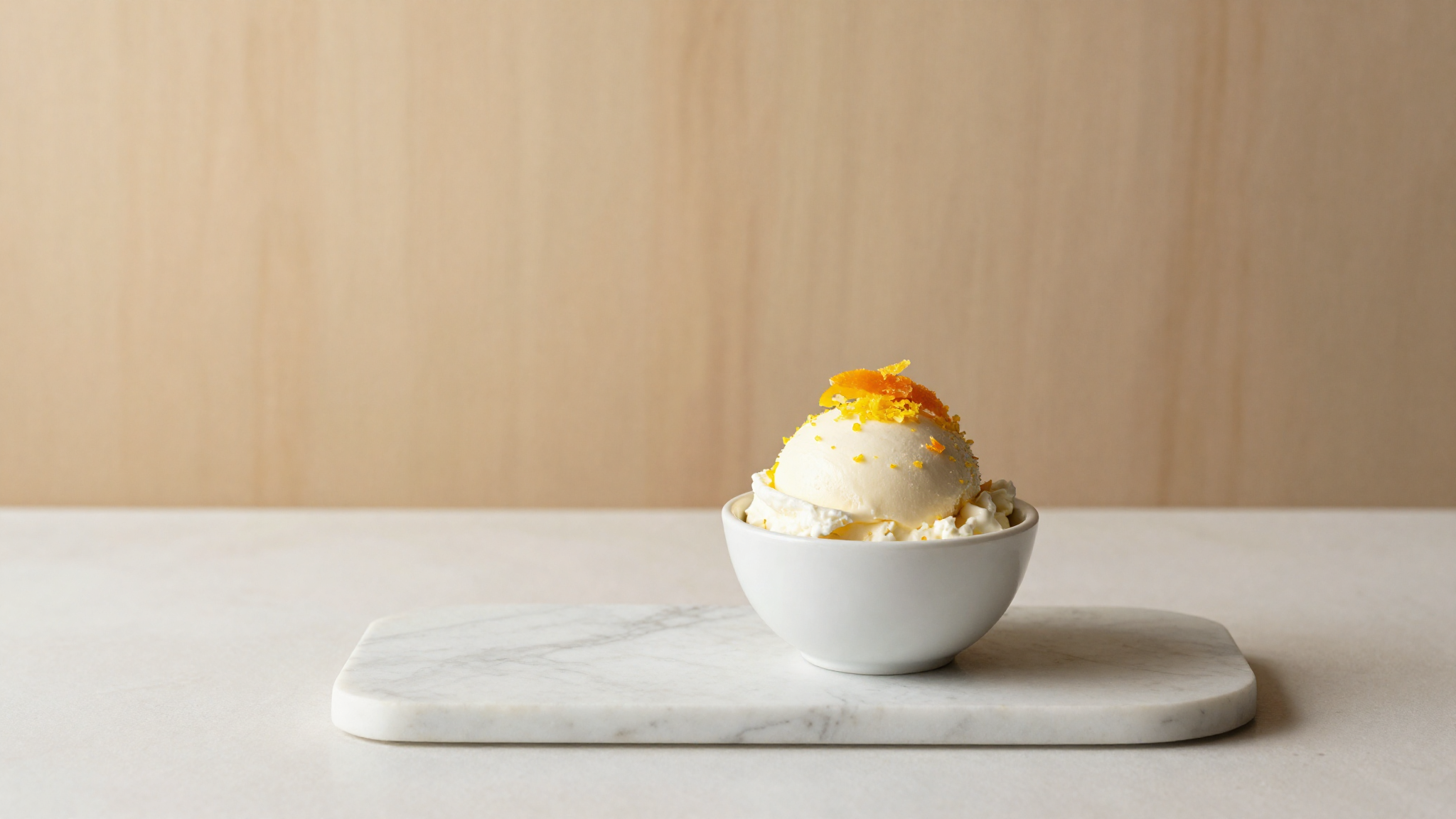
Central and southern Italy built this out of what cheesemaking leaves behind: the whey drawn off the curd, cooked a second time until it sets soft. That thrift is also the flavour, mild and lactic and barely sweet on its own, which is why cow ricotta goes in rather than sheep, and why 220 g per kilo counts as a real dose and not a hint. Acacia honey at 30 g is the classic Italian pairing and it earns the place twice, sweetening much like sucrose while antifreezing considerably harder, which keeps a base this loaded with solids soft enough to spoon. Lemon zest lifts the whole thing at the finish.
Cow ricotta rather than sheep, and that is a flavour decision this time. Sheep ricotta brings an ovine edge that works when the cheese is one voice in a cassata; here it is the only thing on the label, and the cow version is more neutral, more plainly milky and more consistent from tub to tub.
The 30 g of acacia honey is the pairing every Italian kitchen already makes, but it is earning its place technically. With POD 97 and PAC 143 it sweetens like sucrose while antifreezing nearly 50 percent harder, which matters on a base carrying 10.03 percent MSNF that would otherwise scoop stiff. PAC finishes at 258.98 in a 220 to 300 band. Acacia specifically, because it is the mildest of the common honeys; a chestnut or a heather honey would simply sit on top of the ricotta. 4 g of lemon zest gives a flat sweet dairy something to push against, and 160 g of cream takes fat to 9.45 percent in a 6 to 12 range.
Ingredients
Makes 1000 g of finished base.
| Ingredient | Grams | Home measure |
|---|---|---|
| Whole Milk | 400 | 1 2/3 cups |
| Cow Ricotta | 220 | |
| Heavy Cream 35% | 160 | 2/3 cup |
| Sugar (Sucrose) | 145 | 2/3 cup plus 1 tablespoon |
| Acacia Honey | 30 | |
| Skim Milk Powder | 26 | 1/4 cup plus 1 tablespoon |
| Dextrose (Glucose) | 10 | 2 1/2 teaspoons |
| Lemon Zest | 4 | |
| Carob Seed Flour | 4 | |
| Salt | 1 |
Loads these exact grams into the free balancer, ready to edit.
Method
Base pasteurised without the cheese, ricotta drained and twice sieved, folded in cold
- 1Whisk every dry ingredient together first: sugars, milk powder, stabiliser and salt. Dry-blending them stops the stabiliser clumping when it meets liquid.
- 2Warm the liquids to 40 C (104 F), then rain the dry mix in while whisking hard.
- 3Heat to 82 C (180 F) and hold for 2 minutes so the stabiliser hydrates.
- 4Chill in an ice bath to under 5 C (41 F) within 2 hours. Slow cooling is where bacteria and coarse crystals both start.
- 5Age 6 to 12 hours in the fridge under 5 C (41 F). This is when the stabiliser and the milk protein take up water.
- 6Fold the fruit in cold, after ageing. Heating it costs you the fresh aroma and nothing is gained.
- 7Freeze in a shallow metal pan 2 to 3 cm deep, breaking the crystals with a fork every 30 to 40 minutes, 4 to 6 times.
- 8Freeze firm, then temper 10 to 15 minutes in the fridge before scooping.
The balance
All six against the professional range for Milk Gelato.
Protein at 4.36 percent inside a 3 to 5 band is the number that fixed the ricotta dose, and MSNF at 10.03 percent inside 8 to 11.5 is what it bought in exchange. That trade is the whole recipe: the cheese is simultaneously the flavour and a large slice of the milk solids, so the milk powder line drops to 26 g, far less than a plain milk gelato would need. PAC at 258.98 is where the acacia honey shows up, because 30 g of a sugar with PAC 143 does more antifreeze work than 30 g of sucrose would on a base this rich in solids. Fat at 9.45 percent sits in the upper half of a 6 to 12 range, some of it from the cheese itself, which is why 160 g of cream was enough. Lactose is the highest of any milk base in this group at 5.47 percent of the mix and 8.8 percent of the water, and it still clears the sandiness check, but it leaves less margin than usual for a badly held tub.
Estimated nutrition: ~199 kcal · Fat 9.5 g · Sugars 17.9 g · Protein 4.4 g (per 100 g of mix, from the balanced composition).
Ricotta is what happens when whey protein is coagulated by heat. It has already been cooked once and it will not take a second cooking. Bring it to 85 C inside the mix and it contracts, expels water and turns into a perceptible grain. So the cheese never sees the pasteuriser: heat the milk, cream, milk powder, sugars and carob flour, chill the base below 8 C, and fold the ricotta in there. Draining is not optional. Commercial ricotta can arrive with 5 to 10 percent free whey, which quietly falsifies the water figure the sheet was balanced at, so leave it in a sieve for 12 to 24 hours in the fridge first. Then pass it through a fine sieve twice. A stick blender does not replace a sieve, because ricotta grain is aggregated protein and blending only breaks it into smaller grains that are still sandy. The honey goes into the mix at around 40 C so it dissolves without crystallising. At 220 g of cheese the body tends to go short and brittle, and the 4 g of carob seed flour and 10 g of dextrose are what stop that.
If it goes wrong
The ricotta was pasteurised with the base. Heat makes already coagulated whey protein contract and squeeze out water.
Pasteurise the dairy without the cheese, chill the base under 8 C, then stir the ricotta in cold. There is no way back once it has grained.
Undrained ricotta. Free whey adds water the sheet never counted, and the mix is no longer at the 62.13 percent it was balanced at.
Drain the cheese in a sieve for 12 to 24 hours before weighing the 220 g.
It was blended rather than sieved, or sieved only once. Blending makes the protein aggregates smaller, not smooth.
Push the drained ricotta through a fine sieve twice before it goes into the base.
Suitable for: Vegetarian, Egg-free
Allergens: milk
No ingredient in this recipe contains gluten.
- https://www.sicilyaddict.it/blogs/blog/la-ricetta-della-crema-di-ricotta-siciliana-per-dolci
- https://www.scuolagelato.it/bilanciamento-gelato-artigianale/
- https://www.alcremista.com/it/diario/suggerimenti/188-come-creare-la-propria-ricetta-di-gelato.html
- The science behind it: Ricotta in Gelato
- Ingredient sheet: Cow Ricotta
- The story of this recipe: Ricotta Gelato Recipe
Want to change an ingredient and watch the numbers move? Open the free balancer