Raspberry Sorbet
Cold and tart on contact, then the perfumed sweetness spreads and fades fast, leaving the mouth lifted and clean rather than coated in anything.
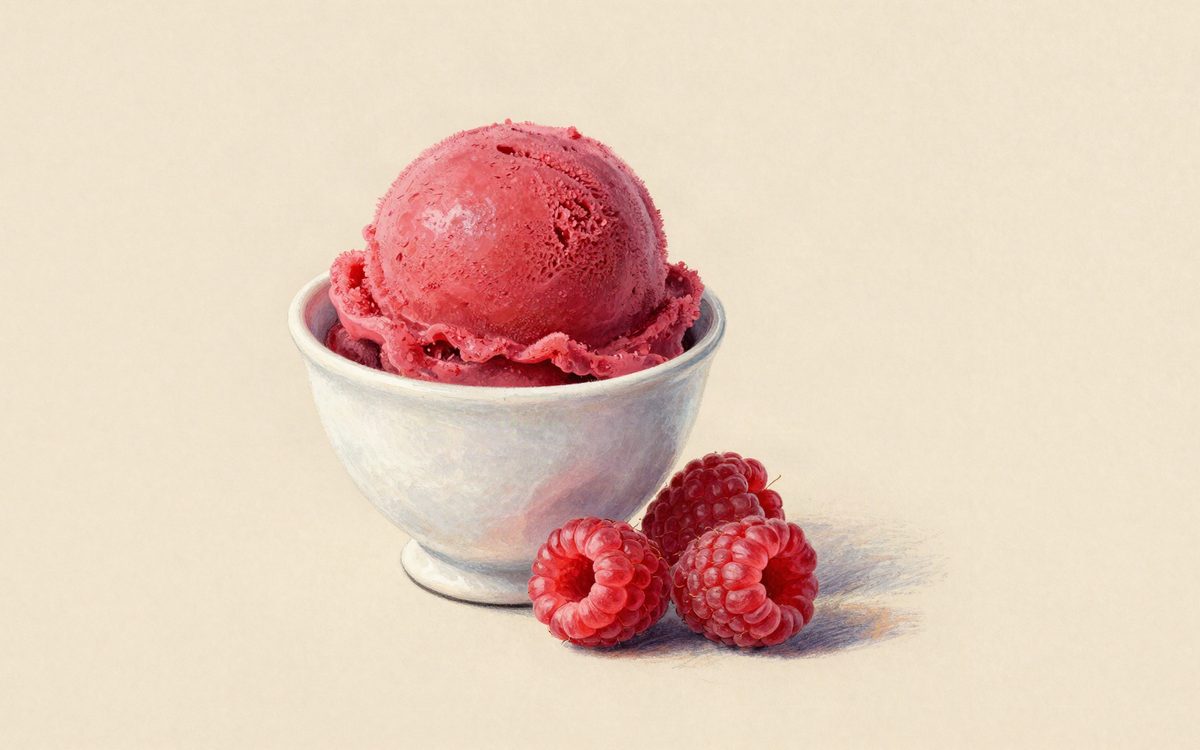
Straight from the cabinet this reads colder than a milk gelato, because there is no fat to soften the impression, and the first thing through is acid. Sweetness follows a beat behind and spreads wide, carrying the perfumed top notes that only appear once the cold has backed off. Then the melt clears completely, which is what a well made sorbetto is supposed to do. Holding it together underneath is a fruit load of 380 g per kilo, plus glucose powder and a little maltodextrin to supply the body that fat is not providing.
The sugar blend carries everything. Raspberry is only 5 percent sugar, so of the 26.93 percent total sugars in this mix the fruit supplied around 19 g and the blend supplied the rest. 100 g of sucrose sets the sweetness, 65 g of dextrose buys antifreeze at low sweetening power, and 90 g of glucose powder plus 6 g of maltodextrin buy dry extract almost silently. The result is PAC 313.47 in a 280 to 340 band and POD 205.33 in 200 to 270, so this is a sorbet that scoops soft without tasting like syrup.
There is no dairy at all here, which the numbers show plainly: MSNF reads 0.0 and fat 0.27 percent, and that fraction comes from the seeds and pulp rather than from anything added. Solids land at 30.75 percent against a 28 percent floor and water at 69.25 percent in a 66 to 72 range, so the structure is doing its work with sugar and 4 g of neutral stabiliser and nothing else.
Ingredients
Makes 1000 g of finished base.
| Ingredient | Grams | Home measure |
|---|---|---|
| Raspberry | 380 | |
| Water | 355 | 1 1/2 cups |
| Sugar (Sucrose) | 100 | 1/2 cup |
| Glucose Powder | 90 | 1/3 cup plus 2 tablespoons |
| Dextrose (Glucose) | 65 | 1/3 cup |
| Maltodextrin | 6 | |
| Stabilizer (Neutral) | 4 |
Loads these exact grams into the free balancer, ready to edit.
Method
Syrup heated and chilled on its own, raw puree stirred in last, tray frozen
- 1Whisk every dry ingredient together first: sugars, milk powder, stabiliser and salt. Dry-blending them stops the stabiliser clumping when it meets liquid.
- 2Warm the liquids to 40 C (104 F), then rain the dry mix in while whisking hard.
- 3Heat to 82 C (180 F) and hold for 2 minutes so the stabiliser hydrates.
- 4Chill in an ice bath to under 5 C (41 F) within 2 hours. Slow cooling is where bacteria and coarse crystals both start.
- 5Age 6 to 12 hours in the fridge under 5 C (41 F). This is when the stabiliser and the milk protein take up water.
- 6Fold the fruit in cold, after ageing. Heating it costs you the fresh aroma and nothing is gained.
- 7Freeze in a shallow metal pan 2 to 3 cm deep, breaking the crystals with a fork every 30 to 40 minutes, 4 to 6 times.
- 8Freeze firm, then temper 10 to 15 minutes in the fridge before scooping.
The balance
All six against the professional range for Sorbetto.
Because the fruit is only 5 percent sugar, the blend had to supply almost all of the 26.93 percent total sugars, and it had to do it without overshooting sweetness, which is why 65 g of dextrose and 90 g of glucose powder are on the list and POD stops at 205.33, just above the floor of a 200 to 270 range. PAC at 313.47 sits in the upper half of 280 to 340, which is what keeps it scoopable at cabinet temperature, around -12.5 C, instead of setting into a red brick. Solids at 30.75 percent give it just enough dry extract over the 28 percent floor to hold the water at 69.25 percent.
Estimated nutrition: ~124 kcal · Fat 0.3 g · Sugars 26.9 g · Protein 0.5 g (per 100 g of mix, from the balanced composition).
The anthocyanins run this recipe. Raspberry pigment degrades measurably with heat, so the fruit never sees the pasteuriser. Bring the water, sugars, maltodextrin and stabiliser to 85 C on their own, chill that syrup to 4 C, and only then stir in the raw puree. The second rule is about the order of operations: if you want the smooth classic texture, sieve the seeds out before you weigh the fruit, not after. Sieving removes solids, so weighing 380 g of whole fruit and then straining leaves the finished mix short of the 30.75 percent it was balanced at. No lemon and no acid correction: raspberry already sits close to pH 3.2 and there is no dairy here to protect, but pushing the pH lower shifts the colour and flattens the aroma.
If it goes wrong
The fruit was strained after weighing, so the real solids sit under 30.75 percent and the real water above 69.25 percent.
Sieve the pulp first, then weigh 380 g of sieved puree. The seeds are not solids you want in the count.
The puree went through the hot stage. Anthocyanin degrades with heat and in a sorbet with no dairy there is nothing to hide it behind.
Take the water, sugars, maltodextrin and stabiliser to 85 C on their own, chill that syrup to 4 C, and stir the raw fruit in only at the end.
The 4 g of neutral stabiliser was dropped straight into cold liquid and hydrated as a clump instead of dispersing.
Dry blend the stabiliser with a spoonful of the sucrose before it goes into the water, and take that syrup to 85 C so it hydrates fully.
Suitable for: Vegan, Vegetarian, Lactose-free, Egg-free
- https://www.sciencedirect.com/science/article/pii/S0023643822011872
- https://pastryartsmag.com/sponsored/simple-sorbet-science/
- https://www.iceicedaddy.com/en/sugar_expert.php
- The science behind it: Anthocyanin Color Stability in Sorbet
- Ingredient sheet: Raspberry
Want to change an ingredient and watch the numbers move? Open the free balancer