Raspberry Milk Gelato
Tart before it is creamy, the fruit cutting across the milk instead of dissolving into it, with a quick clean finish and no lingering fat on the palate.
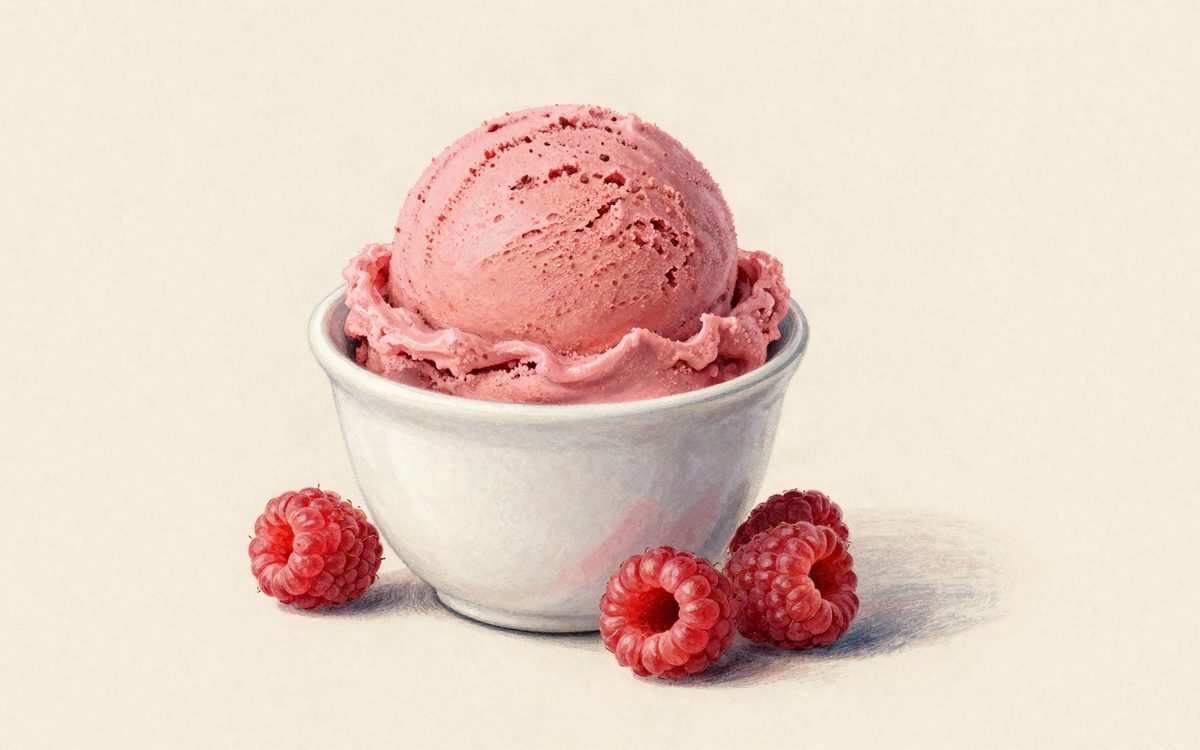
There is very little sugar inside this fruit: about 5% of its weight, with POD 6.2 and PAC 9.2, so what it contributes is acidity and aroma instead of sweetness or antifreeze. That absence is what lets the dose climb to 260 g/kg without the sugars breaching their ceiling; they close at 19.82%. Fat is held back on purpose, since milk fat coating the palate mutes the esters that make raspberry smell like raspberry, and no lemon juice goes in because the fruit is acidic enough on its own. The result reads as fruit first, with the dairy holding it up from underneath.
The sugar blend is doing two separate jobs. 110 g of sucrose and 20 g of dextrose carry the sweetness and most of the antifreeze, taking PAC to 263.76 in a 240 to 310 band. The 60 g of glucose powder is there for dry extract: it lifts solids to 37.14 percent so the fruit water has something to hold onto, and it does it without spending POD, which finishes at 172.59 against a 230 ceiling.
Fat is deliberately kept low. 135 g of cream puts it at 6.23 percent in a 3.5 to 8 range, and it stays there on purpose because milk fat coats the palate and mutes the esters that make raspberry smell like raspberry. Acidity is the other constraint: raspberry runs around pH 3.2 to 3.6, but at 26 percent fruit the buffering from 364 g of whole milk and 47 g of milk powder keeps the finished mix well above the point where casein flocculates. Nothing acidic is added on top for the same reason.
Ingredients
Makes 1000 g of finished base.
| Ingredient | Grams | Home measure |
|---|---|---|
| Whole Milk | 364 | 1 1/2 cups |
| Raspberry | 260 | |
| Heavy Cream 35% | 135 | 1/2 cup plus 1 tablespoon |
| Sugar (Sucrose) | 110 | 1/2 cup plus 1 tablespoon |
| Glucose Powder | 60 | 1/4 cup plus 1 tablespoon |
| Non-Fat Dry Milk | 47 | 1/2 cup |
| Dextrose (Glucose) | 20 | 1 1/2 tablespoons |
| Stabilizer (Neutral) | 3 | |
| Salt | 1 |
Loads these exact grams into the free balancer, ready to edit.
Method
Seeds sieved out, raw puree folded into the cold aged base, tray frozen
- 1Whisk every dry ingredient together first: sugars, milk powder, stabiliser and salt. Dry-blending them stops the stabiliser clumping when it meets liquid.
- 2Warm the liquids to 40 C (104 F), then rain the dry mix in while whisking hard.
- 3Heat to 82 C (180 F) and hold for 2 minutes so the stabiliser hydrates.
- 4Chill in an ice bath to under 5 C (41 F) within 2 hours. Slow cooling is where bacteria and coarse crystals both start.
- 5Age 6 to 12 hours in the fridge under 5 C (41 F). This is when the stabiliser and the milk protein take up water.
- 6Fold the fruit in cold, after ageing. Heating it costs you the fresh aroma and nothing is gained.
- 7Freeze in a shallow metal pan 2 to 3 cm deep, breaking the crystals with a fork every 30 to 40 minutes, 4 to 6 times.
- 8Freeze firm, then temper 10 to 15 minutes in the fridge before scooping.
The balance
All six against the professional range for Milk Gelato with Fruit.
Sugars at 19.82 percent look high for a fruit gelato until you notice where they came from. The raspberry contributed about 13 g of the roughly 198 g in the kilo, so the sucrose, dextrose and glucose powder lines are carrying almost the whole load rather than topping up what the fruit already had. That is the same reason POD stops at 172.59 with a 230 ceiling still open: glucose powder buys solids without buying sweetness, and the sheet keeps that headroom in case your fruit is riper than average. Fat at 6.23 percent in a 3.5 to 8 band is set deliberately, a flavour decision rather than a balance one. Lactose reads 4.65 percent of the mix and 7.4 percent of the water, so if this one comes out gritty, lactose is not the culprit.
Estimated nutrition: ~180 kcal · Fat 6.2 g · Sugars 19.8 g · Protein 3.5 g (per 100 g of mix, from the balanced composition).
Push the pulp through a sieve and take the seeds out before you weigh the 260 g. Raspberry seed does not soften in the freezer and it reads on the tongue as sand, which is exactly what people mistake for lactose sandiness. The puree goes in raw, into the cold base, after ageing. Raspberry aroma is dominated by volatile esters that start leaving above about 60 C, so pasteurising the fruit with the dairy turns it into jam. If you are using frozen fruit, thaw it under refrigeration and use the liquid it releases as well: that liquid concentrates both acid and aroma, and throwing it away shifts the water balance the sheet already accounted for. Anthocyanins shift colour with pH, so any acidity correction changes the colour as well as the flavour. Add the cold puree to the cold base under agitation, never the other way round.
If it goes wrong
Seeds. The pulp went in unsieved, or it was sieved after weighing so the seed load was never removed.
Sieve first, then weigh 260 g of sieved puree. Lactose here is 7.4 percent of the water and passes the sandiness check, so it is not the source of the grit.
The pH moved. Raspberry pigment is anthocyanin and it changes hue with acidity, so added lemon or a very alkaline water will shift it.
Do not correct the acidity of this base. The fruit at 260 g per kilo already sets the pH the colour was balanced at.
Acidic puree hitting a warm base, or a cold base with no agitation, so the fruit sat in a local pocket of low pH.
Chill the base fully, then pour the cold puree in slowly while stirring. The 364 g of milk and 47 g of milk powder buffer the acid, but only if the fruit is dispersed rather than dumped.
Suitable for: Vegetarian, Egg-free
Allergens: milk
- Corvitto, A. - Los secretos del helado: el helado sin secretos, Vilbo, 2004 (frutas de baixo acucar e compensacao com blend)
- USDA FoodData Central - composicao da framboesa crua (https://fdc.nal.usda.gov)
- Goff, H.D.; Hartel, R.W. - Ice Cream, 7a ed., Springer, 2013 (relacao gordura, liberacao de aroma e percepcao)
- Caviezel, L. - Scienza e tecnologia del gelato artigianale, Chiriotti Editori (gelato alla frutta com frutas vermelhas)
- The science behind it: Why Acidic Fruit Curdles Dairy Gelato, and How to Stop It
- Ingredient sheet: Raspberry
Want to change an ingredient and watch the numbers move? Open the free balancer