Prickly Pear Sorbet
Clean rather than cloying, cool and lightly scented, with an acid lift at the edges and a colour that stays vivid down to the last spoonful.
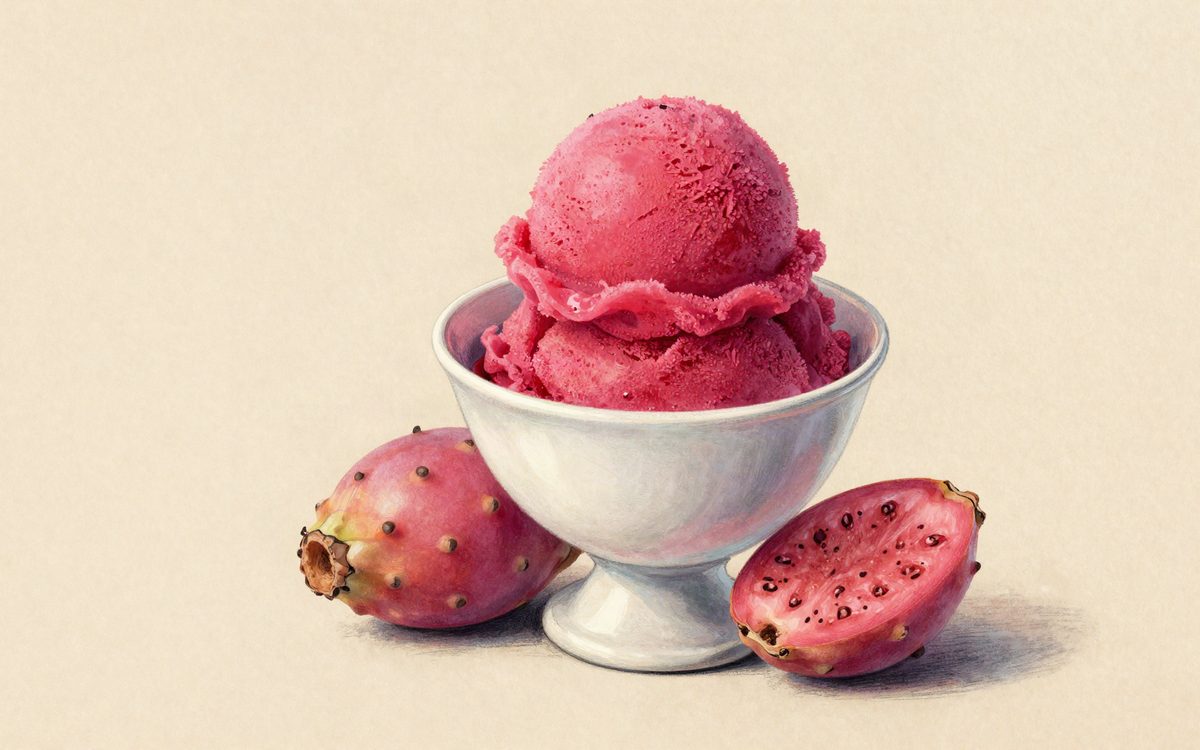
Ice is not what ruins this one at home. Flatness is. The fruit sits at a pH of 5.5 to 6, well above the 3 to 4 most fruit lands in, so a sorbet made straight from it tastes sweet and cloying, with nothing to push against. The colour goes the same way, because the magenta is betalain rather than anthocyanin, and betalain only holds inside a narrow band of acidity. Thirty grams of lemon juice per kilo does both jobs at once, sharpening the palate and keeping the pigment where it is stable. The fruit itself goes in at 470 g, above the floor for a sorbet of this kind, because any less reads as sweet pink water.
The acid is doing two jobs at once. The colour of prickly pear is betalain, not anthocyanin, and betalain only holds in a narrow pH window around 4 to 6, performing best near 3.6 under processing. Lowering the pH protects the magenta at the same time it fixes the taste.
Fruit goes in at 470 g, above the 45 percent floor, because the flavour is delicate and dilutes fast: below roughly 45 percent this turns into pink sugar water. Protein reads 0.39 percent against a 1 percent ceiling, so the dose was set by taste rather than by a wall. The fruit also brings 23.8 of PAC against 12.5 of sugar, which is why dextrose is held down to 20 g, and the sheet still lands at PAC 326.78 inside 280 to 340, with solids at 28.89 percent near the 28 floor and water at 71.11 percent near the top of its band.
Ingredients
Makes 1000 g of finished base.
| Ingredient | Grams | Home measure |
|---|---|---|
| Prickly Pear | 470 | |
| Water | 276 | 1 1/4 cups |
| Sugar (Sucrose) | 125 | 1/2 cup plus 2 tablespoons |
| Glucose Powder | 75 | 1/3 cup plus 1 tablespoon |
| Lemon Juice | 30 | |
| Dextrose (Glucose) | 20 | 1 1/2 tablespoons |
| Stabilizer (Neutral) | 4 |
Loads these exact grams into the free balancer, ready to edit.
Method
Cold tray, forked, puree never heated
- 1Whisk every dry ingredient together first: sugars, milk powder, stabiliser and salt. Dry-blending them stops the stabiliser clumping when it meets liquid.
- 2Warm the liquids to 40 C (104 F), then rain the dry mix in while whisking hard.
- 3Heat to 82 C (180 F) and hold for 2 minutes so the stabiliser hydrates.
- 4Chill in an ice bath to under 5 C (41 F) within 2 hours. Slow cooling is where bacteria and coarse crystals both start.
- 5Age 6 to 12 hours in the fridge under 5 C (41 F). This is when the stabiliser and the milk protein take up water.
- 6Fold the fruit in cold, after ageing. Heating it costs you the fresh aroma and nothing is gained.
- 7Freeze in a shallow metal pan 2 to 3 cm deep, breaking the crystals with a fork every 30 to 40 minutes, 4 to 6 times.
- 8Freeze firm, then temper 10 to 15 minutes in the fridge before scooping.
The balance
All six against the professional range for Sorbetto.
Solids at 28.89 percent and water at 71.11 percent sit close to the edges of their bands: 470 g of a fruit that is mostly water is a lot of water to carry, and the 75 g of glucose powder plus 4 g of stabiliser are what keep it from reading as ice. PAC finishes at 326.78 with dextrose held to just 20 g, because the fruit itself carries 23.8 of PAC against only 12.5 of sugar and there was no need to add more antifreeze.
Estimated nutrition: ~117 kcal · Fat 0.2 g · Sugars 27.4 g · Protein 0.4 g (per 100 g of mix, from the balanced composition).
The fruit is processed cold, without exception. Betacyanin is strongly heat sensitive, its degradation follows first order kinetics, and the tone slides from red to a brownish red with time and temperature, so pasteurising the puree destroys exactly what sells this flavour. Heat only the syrup of water, sugars and the 4 g of stabiliser to 85 C, chill it to 4 C, then fold in the cold puree and the 30 g of lemon. Handling is the other half of the job. The glochids, the fine hair like spines on the skin, are the real kitchen hazard: wear gloves, cut off both ends and carve the flesh out with a knife, never with bare hands. The pulp is full of hard woody seeds, so work in short pulses, because breaking a seed releases bitterness and dark specks, then pass through a medium mesh. No prolonged high speed blending. The pulp also carries mucilage, which already gives viscosity, so if the finished sorbet comes out rubbery the first thing to cut is stabiliser, down to 3 g per kilo, before touching anything else.
If it goes wrong
The puree was heated, or it sat warm too long. Betacyanin degrades with both temperature and time.
Pasteurise only the syrup at 85 C, chill it to 4 C, and add the puree and lemon cold. Keep the 30 g of lemon: the low pH is part of what protects the pigment.
The woody seeds were broken up by prolonged high speed blending.
Short pulses only, then a medium mesh sieve. The seeds should leave the kitchen whole.
The natural mucilage in the pulp is adding viscosity on top of the 4 g of stabiliser.
Drop the stabiliser to 3 g per kilo. Change that before you touch the sugars.
Suitable for: Vegan, Vegetarian, Lactose-free, Egg-free
- https://www.mdpi.com/2306-5710/7/1/2
- https://www.mdpi.com/2076-3417/12/7/3488
- https://pmc.ncbi.nlm.nih.gov/articles/PMC11261438/
- https://blog.giallozafferano.it/dolcipocodolci/sorbetteria-bilanciamento-sorbetti-con-zucchero-eritritolo/
- The science behind it: Betalain Color Stability in Gelato and Sorbetto Bases
- Ingredient sheet: Prickly Pear
- The story of this recipe: Prickly Pear Sorbet
Want to change an ingredient and watch the numbers move? Open the free balancer