Plum Sorbet
Anyone expecting jam gets the opposite: cold, tart fruit that lands quickly, reads bright and deep red, and clears without a syrupy tail.
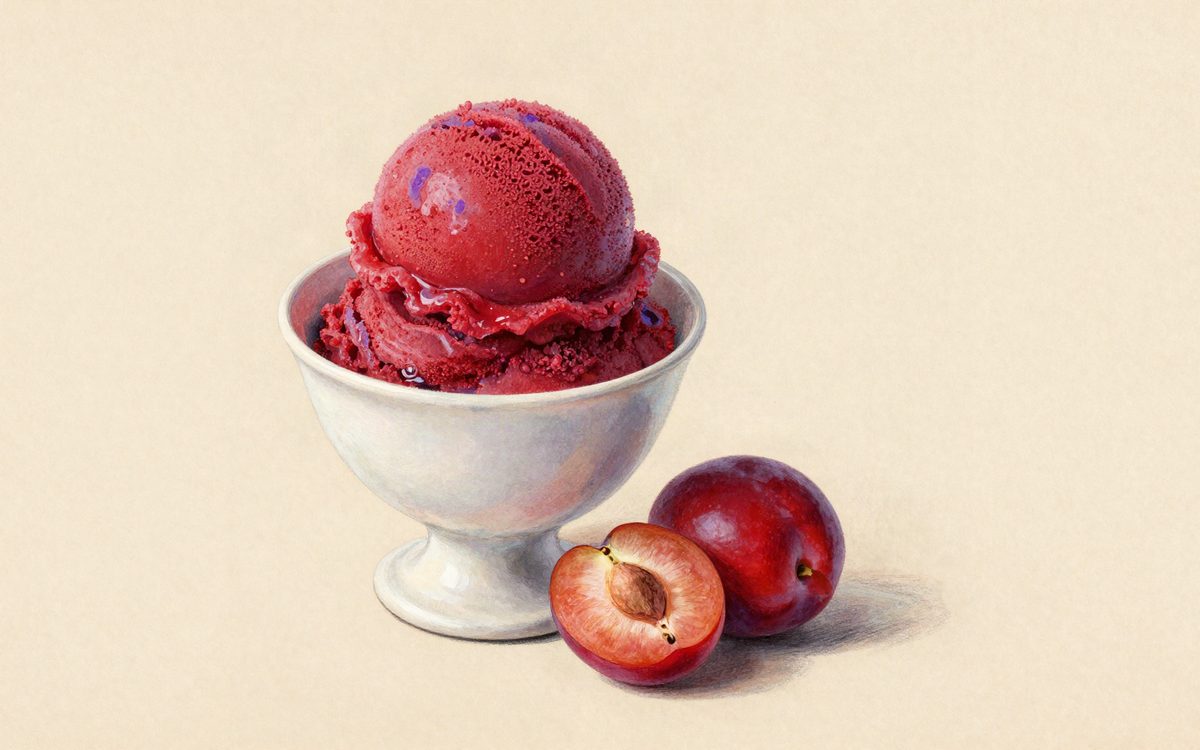
Make this the way you would make any berry sorbet and the tub will still be slushy in the morning. The fruit is unusually rich in sorbitol, which barely registers as sweetness but lowers the freezing point as hard as sugar does, so 430 g per kilo walk in carrying a heavy antifreeze load before anything else is weighed. Chase more flavour by pushing the sucrose up and it simply never firms. The way round it is the sugar blend: glucose powder does the work on solids while staying modest on both sweetness and freezing, dextrose is kept deliberately low so it can be pulled back, and 15 g of lemon juice holds the fruit sharp.
In practice, 430 g of plum per kilo inject roughly 77 points of PAC before a gram of added sugar is weighed. The finished sheet reads PAC 326.26 inside a 280 to 340 band, in its upper part, which is workable, but the real risk with this fruit is a sorbet that never firms. That is why dextrose stops at 40 g while glucose powder gets 75: glucose powder lifts dry extract with a modest PAC of 72 and a low POD of 44, which is precisely what a fruit that already fights freezing needs.
Plum carries about 1.0 g of protein per 100 g, and this mix reads 0.44 percent, well inside the 1 percent sorbet ceiling. POD lands at 231.35, mid band in 200 to 270. The 15 g of lemon backs up the malic acid in the skin without covering the fruit.
Ingredients
Makes 1000 g of finished base.
| Ingredient | Grams | Home measure |
|---|---|---|
| Red Plum | 430 | |
| Water | 311 | 1 1/3 cups |
| Sugar (Sucrose) | 125 | 1/2 cup plus 2 tablespoons |
| Glucose Powder | 75 | 1/3 cup plus 1 tablespoon |
| Dextrose (Glucose) | 40 | 3 1/2 tablespoons |
| Lemon Juice | 15 | |
| Stabilizer (Neutral) | 4 |
Loads these exact grams into the free balancer, ready to edit.
Method
Cold tray, forked, served two degrees colder
- 1Whisk every dry ingredient together first: sugars, milk powder, stabiliser and salt. Dry-blending them stops the stabiliser clumping when it meets liquid.
- 2Warm the liquids to 40 C (104 F), then rain the dry mix in while whisking hard.
- 3Heat to 82 C (180 F) and hold for 2 minutes so the stabiliser hydrates.
- 4Chill in an ice bath to under 5 C (41 F) within 2 hours. Slow cooling is where bacteria and coarse crystals both start.
- 5Age 6 to 12 hours in the fridge under 5 C (41 F). This is when the stabiliser and the milk protein take up water.
- 6Fold the fruit in cold, after ageing. Heating it costs you the fresh aroma and nothing is gained.
- 7Freeze in a shallow metal pan 2 to 3 cm deep, breaking the crystals with a fork every 30 to 40 minutes, 4 to 6 times.
- 8Freeze firm, then temper 10 to 15 minutes in the fridge before scooping.
The balance
All six against the professional range for Sorbetto.
One indicator is doing the arguing here. PAC at 326.26 sits high in a 280 to 340 band: 430 g of plum brought about 77 of those points on their own, so the added sugars had to be chosen for dry extract rather than for antifreeze, hence 75 g of glucose powder against only 40 g of dextrose. Solids at 29.37 percent with water at 70.63 percent put this on the wetter side of the sorbet band, which is where the skin and the acid keep it from tasting thin.
Estimated nutrition: ~117 kcal · Fat 0 g · Sugars 27.6 g · Protein 0.4 g (per 100 g of mix, from the balanced composition).
Blend the plums with the skin on and do not peel them: the anthocyanin that makes this sorbet red lives in the epidermis, and a peeled plum gives you a beige dessert. The trade off is tannin, so do not overwork it. A short blitz and a medium mesh sieve is the whole technique; grinding the skin fine or forcing it through a fine sieve under pressure extracts an astringent bitterness that will not go away. This is the recipe in the set most likely to come out soft, because of the native sorbitol, and the correct response to a sticky product at -12 C is to cut dextrose, never to add sucrose, which would only sweeten it. Pasteurise the syrup at 85 C, chill to 4 C, and add the pulp and lemon cold. Serve at -12 to -13 C, a degree or two colder than an ordinary fruit sorbet, for the same reason.
If it goes wrong
The plums were peeled. The colour is in the skin, not the flesh.
Blend the 430 g with the skin on and strain through a medium mesh afterwards.
The skin was over processed, or the pulp was pushed through a fine sieve under pressure, extracting tannin.
Short pulses only, then a medium sieve with no pressing. What stays behind is the part you did not want.
Native sorbitol plus added dextrose. The fruit alone put around 77 points of PAC into the mix before anything was added.
Cut the dextrose from 40 g and hold serving temperature at -12 to -13 C. Do not raise sucrose, which would only sweeten it.
Suitable for: Vegan, Vegetarian, Lactose-free, Egg-free
- https://www.tandfonline.com/doi/full/10.1080/09637486.2019.1600664
- https://www.compoundchem.com/2015/09/01/plums-prunes/
- https://foodintolerances.org/en/food-dictionary/sorbitol-content-of-food
- https://blog.giallozafferano.it/dolcipocodolci/sorbetteria-bilanciamento-sorbetti-con-zucchero-eritritolo/
- The science behind it: Anthocyanin Color Stability in Sorbet
- Ingredient sheet: Red Plum
Want to change an ingredient and watch the numbers move? Open the free balancer