Pistachio and White Chocolate Gelato
Green oil and toasted nut come forward before the sugar does, over a dense milky body, with a finish that stays savoury rather than sweet.
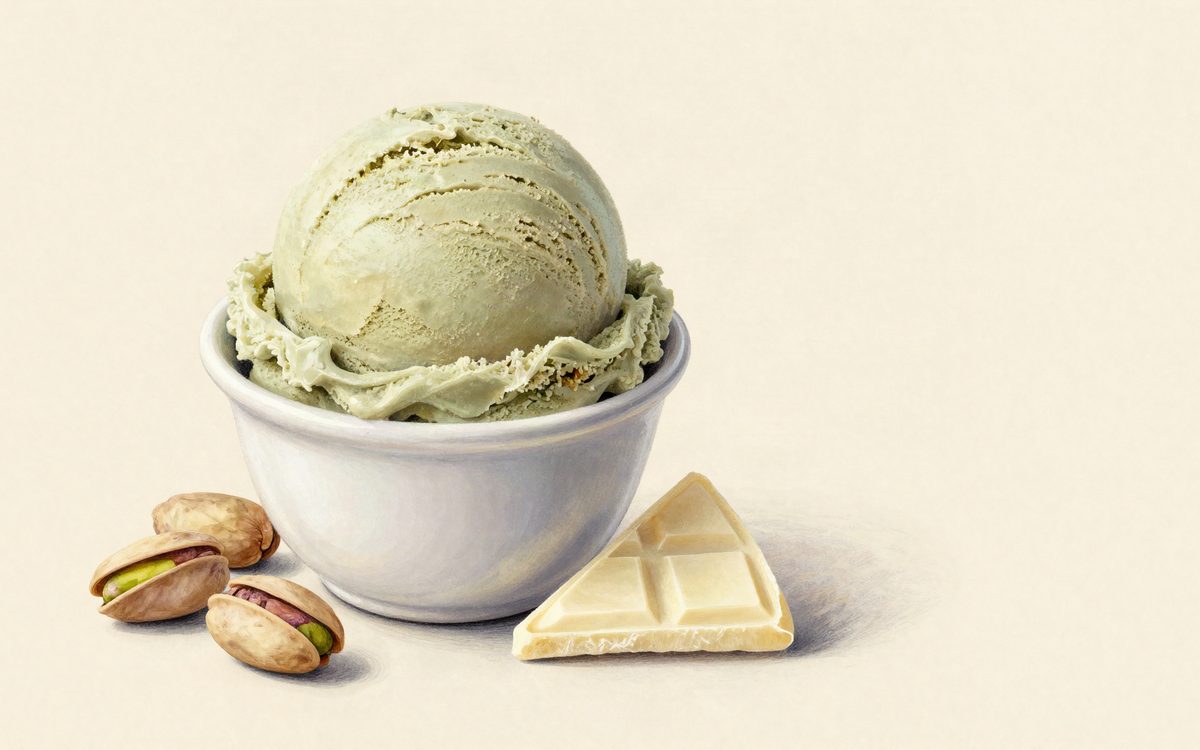
On the slopes of Etna, the town of Bronte grows the pistachio this pairing is built around, dark green and oily rather than pale and sweet. Setting white chocolate beside it is the risk. At 75 g per kilo the chocolate is not a flavouring but a premix, carrying about 44 g of sugar, 24 g of fat and 12 g of milk solids into the kilo before a drop of milk is measured, so free sucrose falls to 85 g. The pistachio paste holds at 70 g instead of climbing higher, because the fat and the body it would otherwise have to supply have already arrived inside the chocolate.
That is why sucrose here is 85 g instead of the 140 g a plain pistachio gelato takes. Total sugars close at 17.95 percent inside a 16 to 22 band. Left alone, the chocolate would have carried them straight through the ceiling, and that is the classic failure of this pairing: it ends up tasting like sweet white chocolate with a rumour of nut.
Pistachio paste sits at 70 g, slightly under the usual 80 to 100 professional band, because the chocolate is already paying for fat and body. Between the two, fat closes at 9.98 percent inside 6 to 12 and protein at 4.56 percent against a 5 ceiling, since the paste alone is about 20 percent protein and 70 g of it is 14 g per kilo. Solids reach 39.4 percent, higher than the plain pistachio sheet, with water down at 60.6 percent. The 1 g of salt is what keeps the nut readable against all that chocolate.
Ingredients
Makes 1000 g of finished base.
| Ingredient | Grams | Home measure |
|---|---|---|
| Whole Milk | 642 | 2 2/3 cups |
| Sugar (Sucrose) | 85 | 1/3 cup plus 2 tablespoons |
| White Chocolate | 75 | |
| Pistachio Paste 100% | 70 | |
| Heavy Cream 35% | 60 | 1/4 cup |
| Dextrose (Glucose) | 45 | 1/4 cup |
| Non-Fat Dry Milk | 13 | 2 1/2 tablespoons |
| Glucose Syrup DE42 | 5 | 3/4 teaspoon |
| Stabilizer (Neutral) | 4 | |
| Salt | 1 |
Loads these exact grams into the free balancer, ready to edit.
Method
Chilled tray, forked, chocolate emulsified before ageing
- 1Whisk every dry ingredient together first: sugars, milk powder, stabiliser and salt. Dry-blending them stops the stabiliser clumping when it meets liquid.
- 2Warm the liquids to 40 C (104 F), then rain the dry mix in while whisking hard.
- 3Heat to 82 C (180 F) and hold for 2 minutes so the stabiliser hydrates.
- 4Melt the chocolate to 45 C (113 F) and stir it into the hot base off the heat, then blend 60 seconds until glossy.
- 5Off the heat, whisk in the paste, then blend 60 seconds so the fat emulsifies instead of separating.
- 6Chill in an ice bath to under 5 C (41 F) within 2 hours. Slow cooling is where bacteria and coarse crystals both start.
- 7Age 6 to 12 hours in the fridge under 5 C (41 F). This is when the stabiliser and the milk protein take up water.
- 8Freeze in a shallow metal pan 2 to 3 cm deep, breaking the crystals with a fork every 30 to 40 minutes, 4 to 6 times.
- 9Freeze firm, then temper 10 to 15 minutes in the fridge before scooping.
The balance
All six against the professional range for Milk Gelato.
Sugars at 17.95 percent are the number this recipe was designed around. The chocolate alone brings about 44 g of the kilo's sugar, so sucrose had to come down to 85 g to keep the total inside 16 to 22, and the rest of the sweetening work moved to 45 g of dextrose plus 5 g of glucose syrup DE42, which lift PAC to 261.43 while POD stays at a modest 166.47. Fat at 9.98 percent is the second constraint: the chocolate and the paste together fix a large part of it before the dairy is chosen, which is why cream stops at 60 g and milk powder at 13 g. MSNF still clears its floor at 8.59 percent, solids land at 39.4 percent in a 36 to 42 band, and the lactose check passes at 4.68 percent of the mix.
Estimated nutrition: ~208 kcal · Fat 10 g · Sugars 18 g · Protein 4.6 g (per 100 g of mix, from the balanced composition).
White chocolate lives in a narrow thermal window. Cocoa butter starts separating above about 45 C and the milk solids in the chocolate caramelise and grain above about 50 C, so it never goes into the pasteurisation. Sequence: pasteurise milk, cream, milk powder, sugars and stabiliser at 82 to 85 C, drop the base to 55 to 60 C, melt the 75 g of chocolate separately at 40 to 45 C and stream it in with an immersion blender, then add the 70 g of pistachio paste at around 45 C and blend to a smooth emulsion. Chill hard to 4 C straight after. Do not let the base loiter between 20 and 35 C, because cocoa butter crystallises there in an unstable form and the gelato comes out waxy. Age 8 to 12 hours at 4 C. On colour: 100 percent pistachio paste turns olive brown under light and oxygen, so keep the base covered and use it within 48 hours. If your paste is raw Sicilian rather than roasted, its note is greener and more fragile, so add it last, below 40 C.
If it goes wrong
The base spent too long between 20 and 35 C, so the cocoa butter from the 75 g of chocolate set in an unstable crystal form.
After emulsifying the chocolate at 55 to 60 C, chill the base hard to 4 C. An ice bath is enough, a slow fridge is not.
The chocolate was taken over 50 C, where its milk solids caramelise and grain, or it was melted with the base and the cocoa butter split.
Melt the chocolate on its own at 40 to 45 C and stream it into the base off the heat. Once it has grained, it does not come back.
Sucrose was topped up to the level a normal gelato takes, so the chocolate's own 44 g of sugar pushed the total past what the nut can compete with.
Keep sucrose at 85 g and the salt at 1 g. This sheet is at 17.95 percent sugars on purpose, not by accident.
Suitable for: Vegetarian, Egg-free
Allergens: milk, tree nuts
- Aussie Blends — Pistachio Paste Gelato Flavoring (dosagem recomendada de pasta de pistache 80-100 g/kg de mix acabado): https://www.aussieblends.com/products/pistachio-dolce-delizia-gourmet-flavoring
- Homebody Eats — How To Make A Gelato Recipe From Scratch (a lactose do leite ja e contada nos solidos magros; dextrose nao deve passar de 25% da sacarose total): https://homebodyeats.com/how-to-make-a-gelato-recipe-from-scratch/
- The Gelato Alcreamist — How to create your own gelato recipe at home (acucares 16-22%, gorduras 6-12%): https://www.alcremista.com/en/diary/tips-tricks/158-how-to-create-your-own-gelato-recipe.html
- Luker Chocolate — 5 things to get right when reducing sugar in chocolate applications (o acucar do chocolate afeta ponto de congelamento e textura quando o chocolate e usado como ingrediente de sorvete): https://lukerchocolate.com/en/knowledge-base/sugar-reduction-chocolate-formulation-applications
- The science behind it: Pistachio Paste in Gelato
- Ingredient sheet: Pistachio Paste 100%
Want to change an ingredient and watch the numbers move? Open the free balancer