Pistachio Gelato
You taste savoury before you taste sweet, then green resin, then a fat that coats slowly and keeps the nut going long after the spoon is empty.
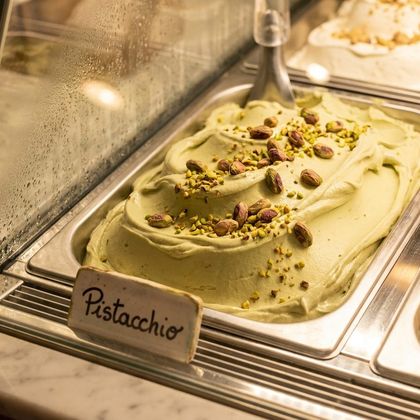
On the volcanic slopes of Etna, around Bronte, the nut that gives this flavour its name comes out dark green and resinous rather than merely sweet, and a gelato built on it asks for nothing else: 100 per cent paste, no colour, no blend. Trade practice puts the dose between 80 and 100 g per kilo, and this one lands at 82. The reason is protein. A milk base has to hold its MSNF, and that alone commits close to 2.9 per cent protein before the nut turns up, leaving barely two points for the paste to spend. At 82 g it spends 1.64, and the sheet still has room to choose its cream.
That leaves roughly 2.1 points for pistachio, which caps the paste near 100 g against the 5 percent protein ceiling. At 82 g the paste contributes 16.4 g of protein and 37.7 g of fat, the mix closes at 4.77 percent protein and 7.56 percent fat, and fat still has room inside its 6 to 12 band. That headroom is what lets 40 g of cream and 22 g of milk powder onto the sheet without anything hitting a wall.
The sugar is deliberately split: 140 g of sucrose and 35 g of dextrose. Dextrose buys PAC without dragging perceived sweetness up with it, which matters because pistachio itself reads low on sweetness. PAC lands at 258.36 mid band in 220 to 300 and POD at 175.86 under a 200 ceiling. Built on sucrose alone, this base would have to choose between too hard and too sweet. The 4 g of carob seed flour holds free water without the elastic, bouncy body xanthan would give, and the 1 g of salt does not salt anything: it cancels the bitterness of skin left in the paste.
Ingredients
Makes 1000 g of finished base.
| Ingredient | Grams | Home measure |
|---|---|---|
| Whole Milk | 676 | 2 3/4 cups |
| Sugar (Sucrose) | 140 | 2/3 cup plus 1 tablespoon |
| Pistachio Paste 100% | 82 | |
| Heavy Cream 35% | 40 | 2 1/2 tablespoons |
| Dextrose (Glucose) | 35 | 3 tablespoons |
| Non-Fat Dry Milk | 22 | 4 tablespoons |
| Carob Seed Flour | 4 | |
| Salt | 1 |
Loads these exact grams into the free balancer, ready to edit.
Method
Cold tray, forked, paste blended into the chilled base
- 1Whisk every dry ingredient together first: sugars, milk powder, stabiliser and salt. Dry-blending them stops the stabiliser clumping when it meets liquid.
- 2Warm the liquids to 40 C (104 F), then rain the dry mix in while whisking hard.
- 3Heat to 82 C (180 F) and hold for 2 minutes so the stabiliser hydrates.
- 4Off the heat, whisk in the paste, then blend 60 seconds so the fat emulsifies instead of separating.
- 5Chill in an ice bath to under 5 C (41 F) within 2 hours. Slow cooling is where bacteria and coarse crystals both start.
- 6Age 6 to 12 hours in the fridge under 5 C (41 F). This is when the stabiliser and the milk protein take up water.
- 7Freeze in a shallow metal pan 2 to 3 cm deep, breaking the crystals with a fork every 30 to 40 minutes, 4 to 6 times.
- 8Freeze firm, then temper 10 to 15 minutes in the fridge before scooping.
The balance
All six against the professional range for Milk Gelato.
Protein at 4.77 percent against a 5 percent ceiling is the tightest figure on this sheet, and it is the one that fixed the paste at 82 g rather than 100. MSNF at 8.42 percent sits just over its 8 percent floor for the same reason: every extra point of milk solids would have brought protein with it. Around that, fat 7.56 percent has slack in 6 to 12, solids close at 37.8 percent in a 36 to 42 band and water at 62.2 percent in 58 to 64, which is where a milk gelato belongs. The sandiness check passes at 4.59 percent lactose on the mix and 7.37 percent on the water, so whatever else goes wrong here, crystallised lactose is not it.
Estimated nutrition: ~189 kcal · Fat 7.6 g · Sugars 17.8 g · Protein 4.8 g (per 100 g of mix, from the balanced composition).
The specific risk with pistachio is colour. The chlorophyll and carotenoids in the paste oxidise and turn brown under prolonged heat, so the paste does not go into the pasteurisation. Heat the white base only, milk, cream, milk powder, sugars and the carob seed flour, at 85 C for 30 seconds or 65 C for 30 minutes, chill it to 4 C, and only then emulsify the 82 g of paste into the cold base with an immersion blender. Age 6 to 12 hours at 4 C before churning or trays. One more thing about 100 percent paste: it separates in the jar, oil on top, solid underneath. Stir the jar back to uniform before you weigh, otherwise the 37.7 g of fat this recipe is counting on is not what went in. There is no acid on this sheet, so there is no curdling risk to manage.
If it goes wrong
The paste was pasteurised with the base. Chlorophyll and carotenoids do not survive prolonged heat.
Pasteurise the white base alone, chill to 4 C, then blend the paste into the cold base. Do not correct the colour with dye, which only advertises poor paste.
The paste jar was separated. The top 82 g is mostly oil, the bottom 82 g is mostly solid, and neither is the ingredient the sheet balanced.
Stir the whole jar to uniform before weighing. The recipe is counting on 37.7 g of fat and 16.4 g of protein from those 82 g.
Residual skin in the paste. Pistachio skin is where the bitterness lives.
Keep the 1 g of salt per kilo. It is there for exactly this and it will not make the gelato taste salty.
Suitable for: Vegetarian, Egg-free
Allergens: milk, tree nuts
No ingredient in this recipe contains gluten.
- https://www.pastrychefresource.com/product-page/pistachio-paste
- https://www.recipesfromitaly.com/easy-pistachio-gelato-recipe/
- https://www.dairyscience.info/ice-cream/154-ice-cream-mix.html
- The science behind it: Pistachio Paste in Gelato
- Ingredient sheet: Pistachio Paste 100%
- The story of this recipe: Pistacchio Bronte Gelato
Want to change an ingredient and watch the numbers move? Open the free balancer