Persimmon Sorbet
Thick and honeyed on the first spoon, gently tart at the close, and never icy, because the fruit carries most of the body before any syrup does.
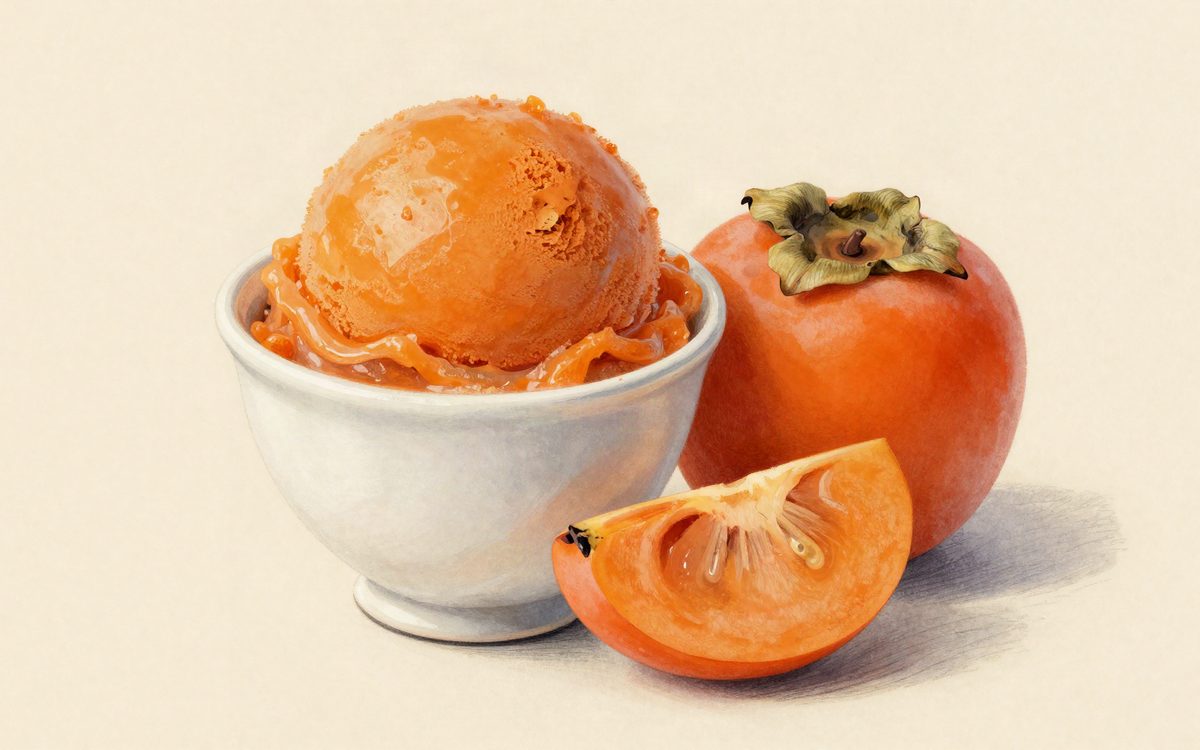
There is a version of this that tastes of very little and freezes hard, and it starts at the greengrocer: firm fruit, picked early, brings astringency instead of sugar and leaves the mouth dry and the texture coarse. Properly ripe fruit has the opposite fault, sweet with almost no acidity to finish on, which is where the 25 g of lemon juice earns its place and stops the whole thing reading flat. The rest is structure. At roughly 19 percent solids this is unusually substantial for a sorbet, so 450 g per kilo builds the body before any syrup does, and glucose powder adds solids without pushing the sweetness any higher.
POD closes at 237.25, mid band in a 200 to 270 range. Ripe persimmon tastes sweet but its own POD is a modest 15, so almost all of the perceived sweetness comes from the added 120 g of sucrose and has to be held in check. That is the job of the 75 g of glucose powder: solids without sweetness. It is also why there is no maltodextrin on this list, unlike most fruit sorbets, and why dextrose stops at 25 g.
Lemon juice goes up to 25 g per kilo, more than a stone fruit sorbet needs, because ripe persimmon is close to acid free. Without that correction the sorbet reads as flat sweetness with no finish, and the acid also does colour work by keeping the orange alive. Protein sits at 0.32 percent, low in a 0 to 1 band, loose enough that on protein alone the fruit could go higher. Confidence on this one is moderate rather than high, because the result depends heavily on cultivar and on ripeness, two things the formulation cannot control.
Ingredients
Makes 1000 g of finished base.
| Ingredient | Grams | Home measure |
|---|---|---|
| Persimmon | 450 | |
| Water | 301 | 1 1/4 cups |
| Sugar (Sucrose) | 120 | 1/2 cup plus 2 tablespoons |
| Glucose Powder | 75 | 1/3 cup plus 1 tablespoon |
| Lemon Juice | 25 | |
| Dextrose (Glucose) | 25 | 2 tablespoons |
| Stabilizer (Neutral) | 4 |
Loads these exact grams into the free balancer, ready to edit.
Method
Syrup pasteurised alone, puree and lemon folded in cold, 4 hour age
- 1Whisk every dry ingredient together first: sugars, milk powder, stabiliser and salt. Dry-blending them stops the stabiliser clumping when it meets liquid.
- 2Warm the liquids to 40 C (104 F), then rain the dry mix in while whisking hard.
- 3Heat to 82 C (180 F) and hold for 2 minutes so the stabiliser hydrates.
- 4Chill in an ice bath to under 5 C (41 F) within 2 hours. Slow cooling is where bacteria and coarse crystals both start.
- 5Age 6 to 12 hours in the fridge under 5 C (41 F). This is when the stabiliser and the milk protein take up water.
- 6Fold the fruit in cold, after ageing. Heating it costs you the fresh aroma and nothing is gained.
- 7Freeze in a shallow metal pan 2 to 3 cm deep, breaking the crystals with a fork every 30 to 40 minutes, 4 to 6 times.
- 8Freeze firm, then temper 10 to 15 minutes in the fridge before scooping.
The balance
All six against the professional range for Sorbetto.
POD at 237.25 sits mid band in a 200 to 270 range, and it explains the odd sugar list. Sucrose is high at 120 g because the fruit itself contributes so little sweetening power at POD 15, and the moment the sucrose is set, every remaining gram of solids has to come from something that does not sweeten, which is why glucose powder is at 75 g and maltodextrin is absent entirely. Solids close at 30.54 percent inside 28 to 34, helped considerably by a fruit that is 19 percent dry matter to begin with. Sugars finish at 27.31 percent in a 25 to 31 range and PAC at 326.35 in 280 to 340, so the texture is soft and open rather than icy, which matters because cold sharpens whatever astringency the fruit still carries. Protein at 0.32 percent sits low in a 0 to 1 range and has real slack.
Estimated nutrition: ~123 kcal · Fat 0.1 g · Sugars 27.3 g · Protein 0.3 g (per 100 g of mix, from the balanced composition).
This recipe lives or dies on astringency. Persimmon contains soluble tannin, which precipitates the proteins in saliva and produces that dry mouth, numb tongue sensation. As the fruit ripens, the tannin polymerises and becomes insoluble, and the astringency disappears with it. The practical rule is to use either a non astringent cultivar such as Fuyu, firm and ripe, or an astringent cultivar such as Rama Forte or Hachiya in a gel state, almost liquefied. Never something in between. One underripe fruit contaminates the whole batch, and the defect does not disappear with sugar or with freezing: cold increases the perception of astringency. Taste every fruit raw before it goes into the blender. The second rule is not to pasteurise persimmon pulp together with the syrup. Heated soluble tannin complexes with pectin and produces a chalky, gritty texture, the same fault that turns persimmon jam into paste. Heat the syrup alone at 85 C, chill it to 4 C, and fold the puree and the lemon in cold at the end. Age 4 hours.
If it goes wrong
Soluble tannin from underripe fruit, which precipitates saliva proteins. Freezing makes the sensation stronger, not weaker.
There is no fix after the fact. Prevent it: taste each fruit raw before blending, and use only Fuyu that is firm and ripe or Hachiya that is almost liquid.
The pulp was heated with the syrup. Soluble tannin complexes with the fruit pectin under heat and sets that texture.
Pasteurise the water, sugars and stabiliser alone at 85 C, chill to 4 C, then fold the 450 g of raw puree and the 25 g of lemon in cold.
The lemon was cut back or left out. Ripe persimmon has almost no titratable acidity of its own.
Use the full 25 g.
Suitable for: Vegan, Vegetarian, Lactose-free, Egg-free
- https://www.sciencedirect.com/science/article/abs/pii/S0925521497000641
- https://sciencemeetsfood.org/persimmons-incredibly-inedibly-astringent/
- https://www.frontiersin.org/journals/plant-science/articles/10.3389/fpls.2023.1260644/full
- https://mail.growables.org/information/TropicalFruit/documents2/PersimmonUF5.pdf
- The science behind it: Polyphenol Oxidase
- Ingredient sheet: Persimmon
Want to change an ingredient and watch the numbers move? Open the free balancer