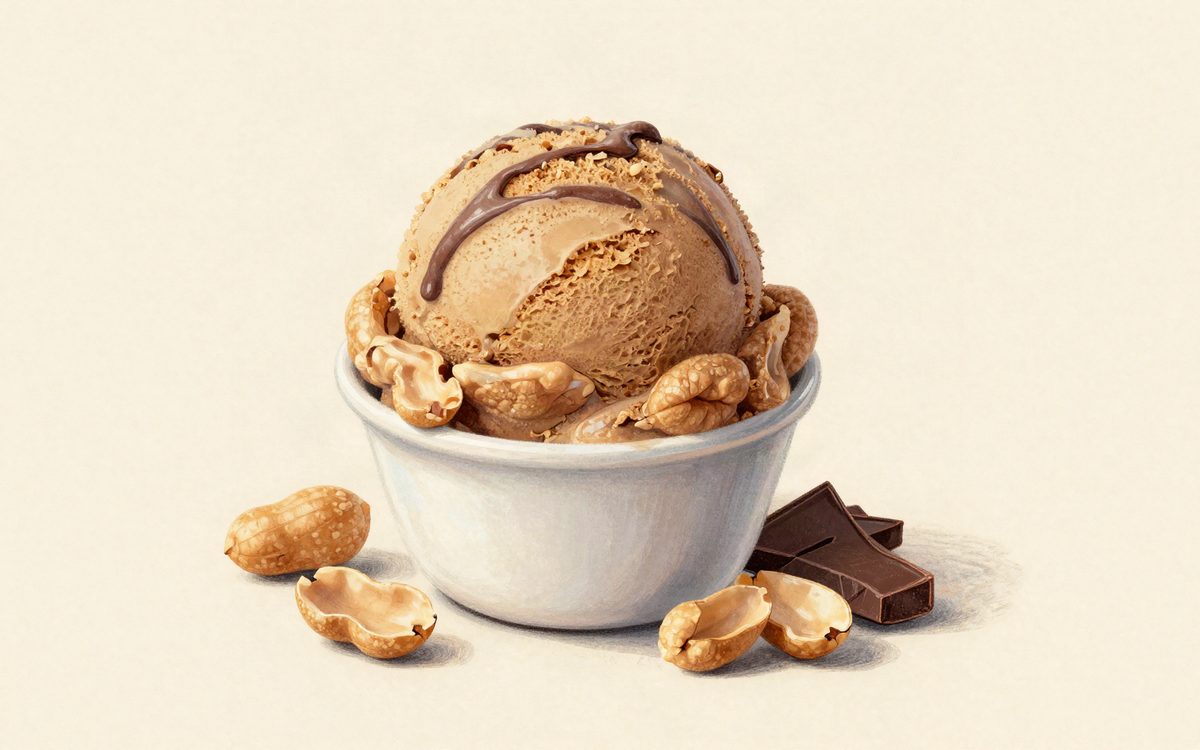
Peanut Butter Chocolate Gelato
Salt and roast arrive first, the chocolate settles in behind them, and the spoonful clings to the roof of the mouth the way nut paste always does.
Reading this label takes one line: peanuts, and possibly salt. Anything longer belongs to a different recipe. Supermarket peanut butter carries added sugar, palm oil and emulsifiers, and each of them lands inside a formula already counted to the gram, so the fat finishes somewhere you did not plan and the sweetness arrives from a source you cannot adjust. The purity also matters for the protein arithmetic, since pure paste runs 24.4 percent protein and a milk gelato is capped at 5 percent. Sixty-two grams per kilo alongside 45 g of chocolate at 70 percent land protein at 4.86 percent, with 2 g of salt pushing the roast forward.
So the peanut dose is arithmetic, not preference. 62 g of paste brings 15.1 g of protein, 45 g of dark 70 percent chocolate brings 3.15 g, they total 18.3 g, and the sheet closes at 4.86 percent protein. At 70 g of peanut the number lands on exactly 5.00 and the solver only resolves with zero slack, which is not a recipe anyone should publish. 62 g per kilo sits below the 90 to 100 g a peanut gelato would carry on a more generous protein band, and it is the honest number here.
The chocolate is the cocoa vehicle instead of cocoa powder for the same reason: 7 percent protein against 20, so nearly three times the cocoa flavour per gram of protein spent. It also arrives with 13.5 g of sugar and 17 g of fat, which is why the cream stops at 45 g and fat still closes at 8.66 percent inside a 6 to 12 range even with 31 g coming from the peanut. Salt goes in at 2 g per kilo, double the usual dose, because roasted peanut with dark chocolate is the pairing that flattens fastest without it.
Ingredients
Makes 1000 g of finished base.
| Ingredient | Grams | Home measure |
|---|---|---|
| Whole Milk | 650 | 2 3/4 cups |
| Sugar (Sucrose) | 110 | 1/2 cup plus 1 tablespoon |
| Peanut Paste 100% | 62 | |
| Dark Chocolate 70% | 45 | |
| Heavy Cream 35% | 45 | 3 tablespoons |
| Dextrose (Glucose) | 35 | 3 tablespoons |
| Glucose Syrup DE42 | 25 | 1 tablespoon |
| Non-Fat Dry Milk | 22 | 4 tablespoons |
| Stabilizer (Neutral) | 4 | |
| Salt | 2 |
Loads these exact grams into the free balancer, ready to edit.
Method
Chocolate blended in at 60 to 65 C, peanut paste at 50 C, 12 hour age
- 1Whisk every dry ingredient together first: sugars, milk powder, stabiliser and salt. Dry-blending them stops the stabiliser clumping when it meets liquid.
- 2Warm the liquids to 40 C (104 F), then rain the dry mix in while whisking hard.
- 3Heat to 82 C (180 F) and hold for 2 minutes so the stabiliser hydrates.
- 4Melt the chocolate to 45 C (113 F) and stir it into the hot base off the heat, then blend 60 seconds until glossy.
- 5Off the heat, whisk in the paste, then blend 60 seconds so the fat emulsifies instead of separating.
- 6Chill in an ice bath to under 5 C (41 F) within 2 hours. Slow cooling is where bacteria and coarse crystals both start.
- 7Age 6 to 12 hours in the fridge under 5 C (41 F). This is when the stabiliser and the milk protein take up water.
- 8Freeze in a shallow metal pan 2 to 3 cm deep, breaking the crystals with a fork every 30 to 40 minutes, 4 to 6 times.
- 9Freeze firm, then temper 10 to 15 minutes in the fridge before scooping.
The balance
All six against the professional range for Milk Gelato.
Two ceilings are pressing from opposite ends. Protein sits at 4.86 percent against a 5 percent cap, and MSNF at 8.21 percent against an 8 percent floor, which means the dairy cannot be reduced to make room for more peanut and the peanut cannot be raised without breaking the protein limit. Everything else on the sheet is a consequence of that squeeze. Solids reach 39.41 percent inside a 36 to 42 range, in the upper half because nut paste and chocolate are almost entirely dry matter, which also explains why there is no headroom to add stabiliser later. Fat closes at 8.66 percent in 6 to 12 with only 45 g of cream, since the peanut and the chocolate supply 48 g of it themselves. PAC at 259.38 in a 220 to 300 band and sugars at 17.84 percent give a body that scoops at the -11 to -14 C of a gelato cabinet without tasting sweet, which is what a bitter chocolate and a savoury nut both need.
Estimated nutrition: ~201 kcal · Fat 8.7 g · Sugars 17.8 g · Protein 4.9 g (per 100 g of mix, from the balanced composition).
Use 100 percent peanut paste, with no salt, no sugar and no hydrogenated fat. Commercial stabilised peanut butter contains palm oil that crystallises around -12 C and leaves a waxy film in the mouth. Natural paste separates, so homogenise the whole jar before you weigh. Order matters: pasteurise the complete dairy base at 82 to 85 C, cool to 60 to 65 C, melt the chocolate separately and blend it in with a stick blender, then add the peanut paste at around 50 C and blend to a proper emulsion. Peanut and chocolate together contribute 48 g per kilo of non dairy vegetable fat, which does not partially destabilise during churning the way milk fat does, so expect lower overrun and do not try to compensate with more stabiliser: solids are already at 39.41 percent against a 42 percent ceiling. Age 12 hours at 4 C, and treat that as mandatory rather than optional, because 4.86 percent protein needs the hydration time or the body turns sandy and the tub shrinks. The allergen risk is real: peanut is one of the major declarable allergens, so cleaning the machine between flavours is not negotiable. Do not use alkalised cocoa and do not add bicarbonate. Above pH 7.5 the peanut darkens and picks up a metallic note.
If it goes wrong
Stabilised commercial peanut butter. The palm oil in it crystallises around -12 C, right inside the cabinet window this gelato is served in.
Use paste whose label reads peanuts and nothing else. Stir the jar to a uniform paste before weighing the 62 g, since natural paste separates.
The ageing step was skipped or cut short. At 4.86 percent protein the mix needs time at 4 C for the proteins to hydrate fully.
Age 12 hours at 4 C before churning. There is no shortcut here, and no amount of extra stabiliser substitutes for it.
The 48 g per kilo of peanut and cocoa butter fat does not partially destabilise during churning the way milk fat does, so less air is held.
Expect it and work with it. Do not add stabiliser to compensate, because solids are already at 39.41 percent against a 42 percent ceiling.
Suitable for: Vegetarian, Egg-free
Allergens: milk, peanuts
- The Gelato Alcreamist — How to create your own gelato recipe at home: balancing the ingredients (faixas de acucares 16-22% e gorduras 6-12% para gelato de leite): https://www.alcremista.com/en/diary/tips-tricks/158-how-to-create-your-own-gelato-recipe.html
- Homebody Eats — How To Make A Gelato Recipe From Scratch (papel dos solidos magros do leite e limite de dextrose a 25% da sacarose): https://homebodyeats.com/how-to-make-a-gelato-recipe-from-scratch/
- H. Douglas Goff & Richard W. Hartel, Ice Cream, 7th ed., Springer — capitulo de mix composition: limites de MSNF e o efeito da proteina sobre corpo, batimento e arenosidade
- Structural Properties Before and After Ripening of Ice Cream Made with Different Dairy Fat Bases (a fonte de gordura altera significativamente o overrun alcancavel): https://www.ncbi.nlm.nih.gov/pmc/articles/PMC12470061/
- The science behind it: Starch vs Fat Nut Pastes
- Ingredient sheet: Peanut Paste 100%
Want to change an ingredient and watch the numbers move? Open the free balancer