Peach Milk Gelato
Soft and quietly floral, the sort of flavour that arrives late and fades gently, with just enough acidity to keep the fruit from disappearing under the cream.
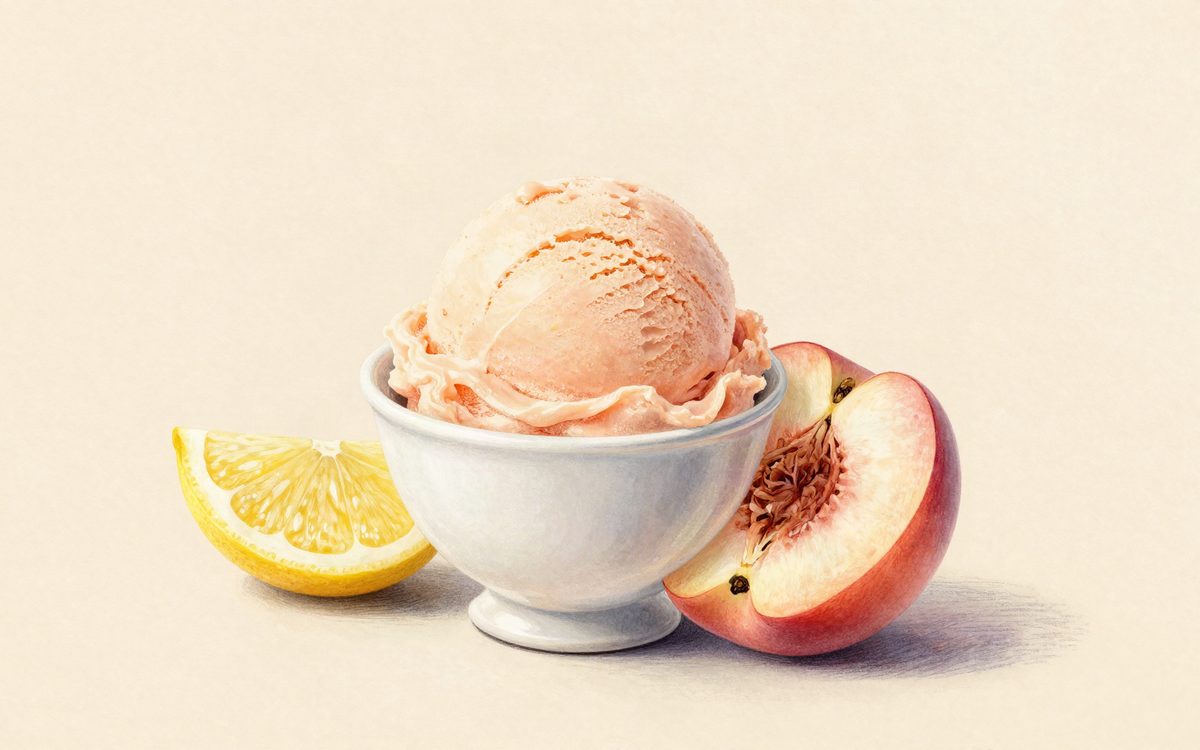
Almost nine tenths of the weighed fruit is water, and that one figure shapes everything after it. At 300 g per kilo, the classic dose for gelato alla pesca, the dry matter has to be put back somewhere, so the skimmed milk powder climbs to 51 g and glucose powder adds body without adding sweetness. The PAC then sits low in the band on purpose, since a slack base makes a delicate fruit read as watery while a firmer one gives the aroma something to sit against. Added sucrose stops at 100 g, lower than a strawberry sheet needs, because the fruit turns up with sugar of its own. What lands on the tongue is gentle and floral, more perfume than punch.
The water gets answered with dry matter rather than with less fruit. Skimmed milk powder goes up to 51 g per kilo, which puts MSNF at 8.64 percent inside a 5 to 9.5 range and gives the base body the fruit cannot supply. Another 50 g of glucose powder buys dry extract without adding sweetness. Solids finish at 34.91 percent in the lower half of a 32 to 40 range, and water at 65.09 percent in a 60 to 68 band.
PAC lands at 253.6, low in a 240 to 310 range, and that is a deliberate choice rather than a coincidence. A delicate fruit sitting on a very soft base reads as watery in the mouth. Fat comes to 5.78 percent inside 3.5 to 8, from 130 g of cream and nothing else. That is enough fat to carry aroma and, just as important, not so much that it smothers a scent this quiet.
Ingredients
Makes 1000 g of finished base.
| Ingredient | Grams | Home measure |
|---|---|---|
| Whole Milk | 337 | 1 1/3 cups |
| Peach | 300 | |
| Heavy Cream 35% | 130 | 1/2 cup plus 1 tablespoon |
| Sugar (Sucrose) | 100 | 1/2 cup |
| Non-Fat Dry Milk | 51 | 1/2 cup plus 1 tablespoon |
| Glucose Powder | 50 | 1/4 cup |
| Dextrose (Glucose) | 20 | 1 1/2 tablespoons |
| Lemon Juice | 8 | |
| Stabilizer (Neutral) | 3 | |
| Salt | 1 |
Loads these exact grams into the free balancer, ready to edit.
Method
Blanched and peeled fruit, raw puree folded into the aged base cold
- 1Whisk every dry ingredient together first: sugars, milk powder, stabiliser and salt. Dry-blending them stops the stabiliser clumping when it meets liquid.
- 2Warm the liquids to 40 C (104 F), then rain the dry mix in while whisking hard.
- 3Heat to 82 C (180 F) and hold for 2 minutes so the stabiliser hydrates.
- 4Chill in an ice bath to under 5 C (41 F) within 2 hours. Slow cooling is where bacteria and coarse crystals both start.
- 5Age 6 to 12 hours in the fridge under 5 C (41 F). This is when the stabiliser and the milk protein take up water.
- 6Fold the fruit in cold, after ageing. Heating it costs you the fresh aroma and nothing is gained.
- 7Freeze in a shallow metal pan 2 to 3 cm deep, breaking the crystals with a fork every 30 to 40 minutes, 4 to 6 times.
- 8Freeze firm, then temper 10 to 15 minutes in the fridge before scooping.
The balance
All six against the professional range for Milk Gelato with Fruit.
Solids at 34.91 percent sit in the lower half of a 32 to 40 range, and that is the fruit talking: at 11.5 percent solids, 300 g of peach arrives as roughly 265 g of water and about 35 g of dry matter. The 51 g of milk powder and 50 g of glucose powder exist to drag the number back over the floor. PAC at 253.6 is low in the band on purpose, because a softer set would make a shy fruit read watery, while a harder one would numb it. Around those two, the rest of the sheet has room to breathe. POD at 166.4 against a 230 ceiling leaves headroom for a sweeter peach, protein reads 3.52 percent inside 2 to 4.5, and lactose comes to 4.71 percent of the mix and 7.24 percent of the water, well under the level where lactose crystallises and turns the body sandy.
Estimated nutrition: ~169 kcal · Fat 5.8 g · Sugars 19 g · Protein 3.5 g (per 100 g of mix, from the balanced composition).
Peach is the fruit that gains from a short blanch. Drop the whole fruit into boiling water for 30 seconds, shock it in ice, and the skin slips off. Then blend it raw. The skin carries a bitter note and the fuzz, and its tannin dulls the milk fat you have paid for. Peach oxidises almost as fast as banana, so always blend with the 8 g of lemon juice in the jug from the start. Choose a yellow clingstone peach at full ripeness. A white peach at 8 percent sugar simply does not cross 5.78 percent milk fat, and the gelato comes out with no identifiable flavour. Do not cook the puree. Heated peach loses the lactones, gamma decalactone above all, that give it its varietal aroma, and gains the character of tinned compote. Add the cold puree to the cold, already aged base immediately before churning.
If it goes wrong
The puree was pasteurised with the dairy. The lactones that carry peach aroma do not survive it, and what remains is compote.
Pasteurise the milk, cream, powder and sugars on their own, chill, age, then fold the raw puree in cold just before churning.
Oxidation. The fruit was blended without acid, or was cut and left standing before it went in.
Put the 8 g of lemon juice in the jug before the fruit, not after, and blend the peach straight into it.
A white or underripe peach at around 8 percent sugar cannot be tasted through 5.78 percent milk fat and 8.64 percent MSNF.
Use fully ripe yellow clingstone.
Suitable for: Vegetarian, Egg-free
Allergens: milk
- Goff, H. D.; Hartel, R. W. Ice Cream, 7a ed. Springer, 2013 (cap. 3)
- Caviezel, L. Il gelato artigianale. Chiriotti Editori (gelato alla pesca e tratamento de frutas de caroco)
- Corvitto, A. Los secretos del helado: el helado sin secretos. Vilbo, 2004
- USDA FoodData Central, pessego cru: https://fdc.nal.usda.gov/
- The science behind it: Polyphenol Oxidase
- Ingredient sheet: Peach
- The story of this recipe: Peach Gelato Recipe
Want to change an ingredient and watch the numbers move? Open the free balancer