Passion Fruit Gelato (Milk Base)
Tropical acid lands bright and floral over a cool milk base, tart through the middle, and the texture stays smooth all the way down with no grain in it.
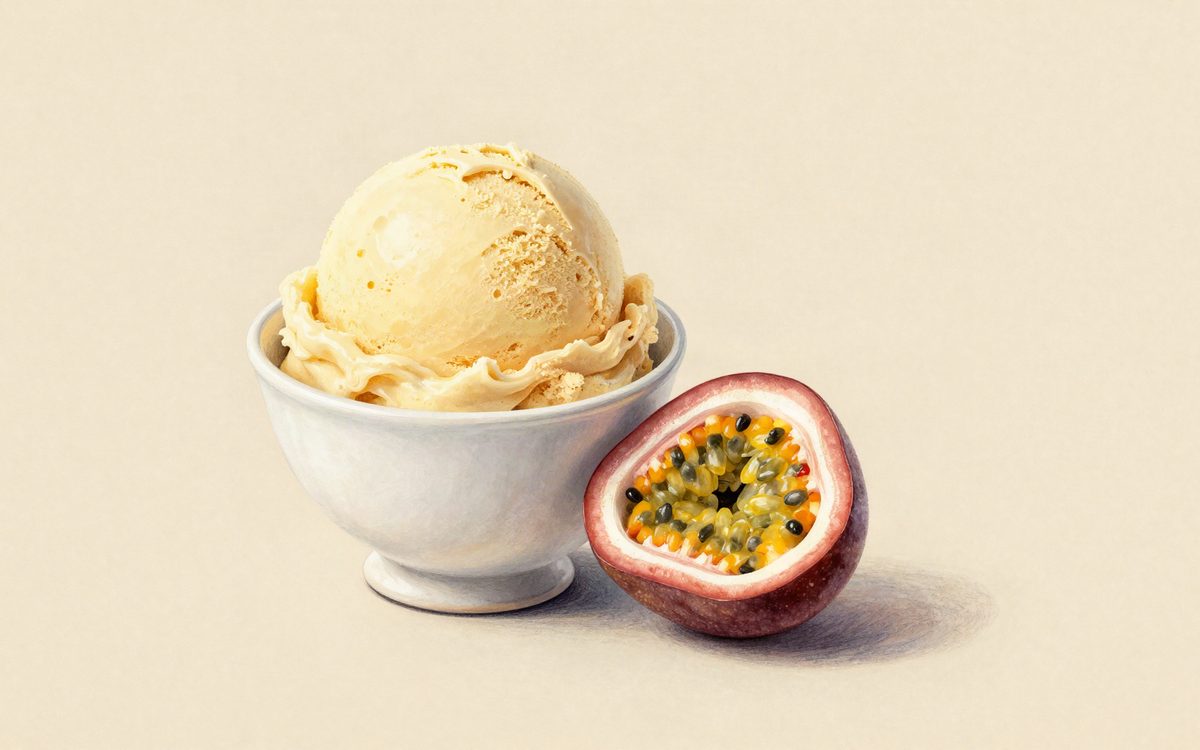
Grainy texture with a watery layer sitting on top is the usual way tropical fruit ruins a dairy base, and it happens long before the machine runs. The pulp carries a titratable acidity of 3 to 5 percent as citric acid and a pH between 2.8 and 3.3, well under casein's isoelectric point at pH 4.6. Push past roughly 15 percent pulp and the mix crosses that line, the caseins flocculate, and what comes out is curdled. This sheet stops at 150 g per kilo for exactly that reason, low against the 230 to 280 the other fruit-in-milk recipes carry. The aroma survives the cut easily, because few fruits give this much scent per gram.
The dose still works because passion fruit has one of the highest aroma intensities per gram of any fruit used in gelateria. What it does not have, at 150 g, is mass: it contributes only about 15 g of sugar and 22.5 g of solids to the kilo.
So the rest of the formula compensates. Whole milk climbs to 497 g, 39 g of non-fat dry milk go in to reach MSNF of 8.9 percent inside a 5 to 9.5 band, and 60 g of glucose powder carry solids and body without adding sweetness, closing total solids at 35.73 percent against 32 to 40. Cream at 125 g puts fat at 6.23 percent, mid band in 3.5 to 8, which is deliberate: a heavier fat load would coat the palate and blunt exactly the sharp aromatic top note the flavour is bought for.
Ingredients
Makes 1000 g of finished base.
| Ingredient | Grams | Home measure |
|---|---|---|
| Whole Milk | 497 | 2 cups |
| Passion Fruit Pulp | 150 | |
| Heavy Cream 35% | 125 | 1/2 cup plus 1 tablespoon |
| Sugar (Sucrose) | 105 | 1/2 cup plus 1 tablespoon |
| Glucose Powder | 60 | 1/4 cup plus 1 tablespoon |
| Non-Fat Dry Milk | 39 | 1/3 cup plus 1 tablespoon |
| Dextrose (Glucose) | 20 | 1 1/2 tablespoons |
| Stabilizer (Neutral) | 3 | |
| Salt | 1 |
Loads these exact grams into the free balancer, ready to edit.
Method
White base aged first, cold pulp poured into it, then tray freeze
- 1Whisk every dry ingredient together first: sugars, milk powder, stabiliser and salt. Dry-blending them stops the stabiliser clumping when it meets liquid.
- 2Warm the liquids to 40 C (104 F), then rain the dry mix in while whisking hard.
- 3Heat to 82 C (180 F) and hold for 2 minutes so the stabiliser hydrates.
- 4Chill in an ice bath to under 5 C (41 F) within 2 hours. Slow cooling is where bacteria and coarse crystals both start.
- 5Age 6 to 12 hours in the fridge under 5 C (41 F). This is when the stabiliser and the milk protein take up water.
- 6Fold the fruit in cold, after ageing. Heating it costs you the fresh aroma and nothing is gained.
- 7Freeze in a shallow metal pan 2 to 3 cm deep, breaking the crystals with a fork every 30 to 40 minutes, 4 to 6 times.
- 8Freeze firm, then temper 10 to 15 minutes in the fridge before scooping.
The balance
All six against the professional range for Milk Gelato with Fruit.
Two indicators carry the compensation work forced by a fruit dose that had to stay low. Total solids at 35.73 percent against 32 to 40 could not come from the fruit, which delivers roughly 22.5 g, so 60 g of glucose powder and 39 g of milk powder supply them instead. MSNF at 8.9 percent against 5 to 9.5 is the second, and it is what justifies that milk powder line in a formula already carrying 497 g of whole milk. Around them, sugars read 19.52 against 17 to 25, fat 6.23 against 3.5 to 8, POD 168.32 against 150 to 230, PAC 259.41 against 240 to 310, water 64.27 against 60 to 68 and protein 3.52 against 2 to 4.5. Lactose comes to 4.85 percent of the mix and 7.55 percent of the water, so sandiness is not a concern. Curdling is, and that is a mixing order problem rather than a numbers problem.
Estimated nutrition: ~174 kcal · Fat 6.2 g · Sugars 19.5 g · Protein 3.5 g (per 100 g of mix, from the balanced composition).
This is the sheet in the batch with a genuine risk of curdling, and the rules are not negotiable. The pulp never goes near heat and never touches a warm base. Pasteurise the white base alone at 85 C, chill to 4 C, age 6 to 12 hours, then add the cold pulp by pouring it slowly into the base while stirring constantly, never the other way round. Pour milk onto pulp and the first contact happens at a local pH near 3, the caseins coagulate on the spot, and no amount of stirring undoes it. Work with the base as cold as you can get it, since casein tolerates acid far better at 4 C than at 20 C. Do not use pulp with whole seeds, and freeze immediately after mixing, because an acidified mix left standing for hours only increases the chance of flocculation. No lemon juice here: the fruit brings all the acid this base can take.
If it goes wrong
The mixing order was reversed, or the base was still warm. At first contact the local pH sat near 3 and the casein coagulated on the spot.
Chill the base to 4 C and pour the 150 g of cold pulp into it in a thin stream while stirring, never base into pulp.
An acidified dairy mix was left to stand. Flocculation is time dependent as well as pH dependent.
Add the pulp at the end of ageing, not before it, and freeze straight away.
Serving too cold, which mutes aroma, or pulp from underripe fruit. It is almost never a dose problem, and doubling the pulp is what curdles the base.
Keep 150 g, use pulp from wrinkled, fully ripe fruit, and serve a little warmer at around minus 11 to minus 12 C so the aroma opens.
Suitable for: Vegetarian, Egg-free
Allergens: milk
- Goff, H.D.; Hartel, R.W. - Ice Cream, 7a ed., Springer, 2013 (estabilidade da caseina e efeito do pH em mixes lacteos)
- Corvitto, A. - Los secretos del helado: el helado sin secretos, Vilbo, 2004 (limite de frutas acidas em base leite)
- USDA FoodData Central - composicao do maracuja, polpa (https://fdc.nal.usda.gov)
- Belitz, H.-D.; Grosch, W.; Schieberle, P. - Food Chemistry, 4a ed., Springer, 2009 (ponto isoeletrico e precipitacao acida da caseina)
- The science behind it: Why Acidic Fruit Curdles Dairy Gelato, and How to Stop It
- Ingredient sheet: Passion Fruit Pulp
Want to change an ingredient and watch the numbers move? Open the free balancer