Paçoca Gelato (Brazilian Peanut Candy)
Somewhere between a sweet and a gelato in feel, dry and salted at the edge, with toasted nut and raw sugar that keep going after the cold has left.
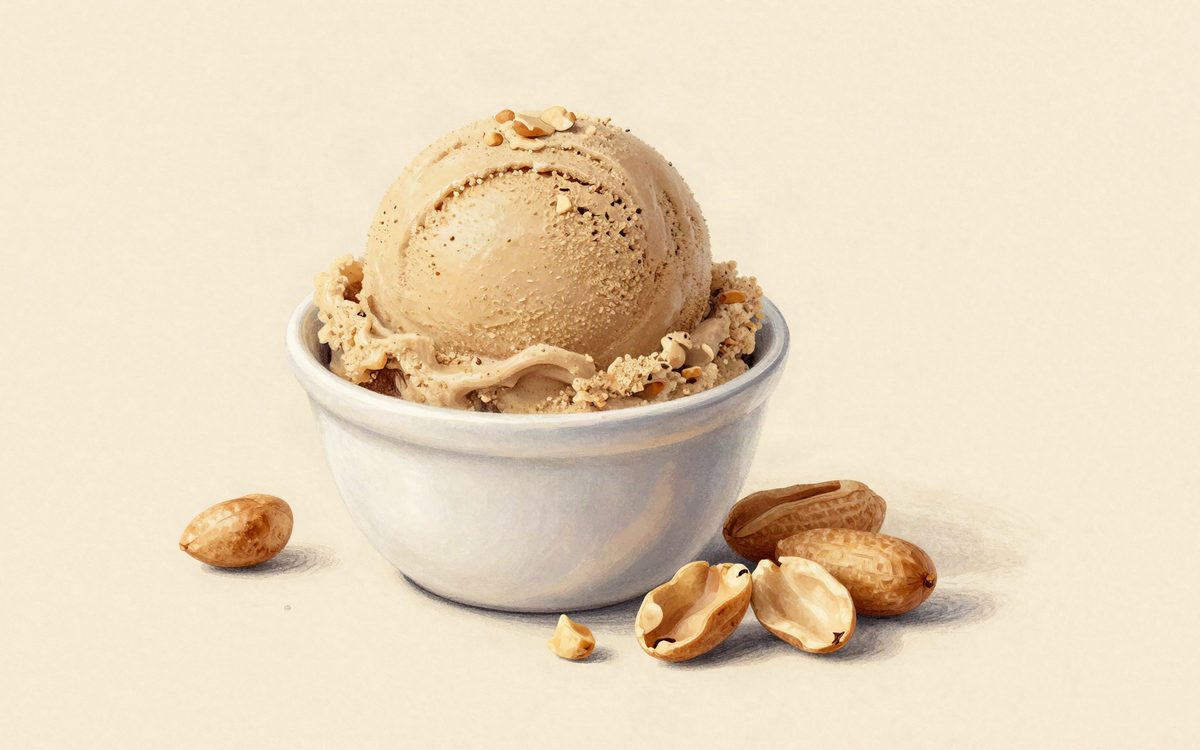
Every June, festa junina stalls across Brazil sell the same sweet: peanuts ground with rapadura until the mixture holds together and then falls apart again in the mouth. That crumbling, dry, salt-edged texture is what this gelato is built to carry. The candy goes in at 100 g per kilo, and since it is already 43 percent sugar, 27 percent fat and 17 percent protein, the rest of the sheet gets out of its way: free sucrose comes down to 110 g and cream climbs to 100 g to restore fat that a finished sweet cannot supply on its own. Salt at 2 g keeps the roast forward instead of letting it slide into plain sweetness.
Brazilian recipes point at around 140 g per kilo, and at that dose the sheet does not close, with protein going past 5.3 percent and out of the band. At 110 g it closes with almost no slack left. The number here is 100 g, where the candy contributes about 17 g of protein, 43 g of sugar and 27 g of fat, and protein lands at 4.86 percent against a 5 percent ceiling: tight, but with real room to work. Flavour loses less than you would expect, because paçoca is already roasted peanut ground with sugar, so the taste is concentrated rather than diluted.
The rest of the list is the consequence. Sucrose drops to 110 g, low for a milk gelato, precisely because the candy already delivered 43 g of sugar. Heavy cream comes up to 100 g to make up for a fat contribution that is modest next to a pure peanut paste, and fat settles at 8.45 percent. MSNF sits at 8.48 percent, right above the 8 percent floor, which is why the 23 g of non-fat dry milk cannot be trimmed.
Ingredients
Makes 1000 g of finished base.
| Ingredient | Grams | Home measure |
|---|---|---|
| Whole Milk | 636 | 2 2/3 cups |
| Sugar (Sucrose) | 110 | 1/2 cup plus 1 tablespoon |
| Peanut Brittle (Paçoca) | 100 | |
| Heavy Cream 35% | 100 | 1/3 cup plus 1 tablespoon |
| Dextrose (Glucose) | 25 | 2 tablespoons |
| Non-Fat Dry Milk | 23 | 1/4 cup |
| Carob Seed Flour | 4 | |
| Salt | 2 |
Loads these exact grams into the free balancer, ready to edit.
Method
Candy dissolved at 55 C, chilled hard, shallow tray with three blends
- 1Whisk every dry ingredient together first: sugars, milk powder, stabiliser and salt. Dry-blending them stops the stabiliser clumping when it meets liquid.
- 2Warm the liquids to 40 C (104 F), then rain the dry mix in while whisking hard.
- 3Heat to 82 C (180 F) and hold for 2 minutes so the stabiliser hydrates.
- 4Chill in an ice bath to under 5 C (41 F) within 2 hours. Slow cooling is where bacteria and coarse crystals both start.
- 5Age 6 to 12 hours in the fridge under 5 C (41 F). This is when the stabiliser and the milk protein take up water.
- 6Freeze in a shallow metal pan 2 to 3 cm deep, breaking the crystals with a fork every 30 to 40 minutes, 4 to 6 times.
- 7Freeze firm, then temper 10 to 15 minutes in the fridge before scooping.
The balance
All six against the professional range for Milk Gelato.
Protein at 4.86 percent against a 3 to 5 band is the constraint that wrote this recipe. It is the highest protein reading of the milk bases in this batch, and it comes almost entirely from the candy, which is why 100 g is the ceiling and not a preference. MSNF at 8.48 percent against 8 to 11.5 is the second: it sits barely above the floor, so the milk powder is load bearing. The rest falls into place around them, with solids 37.76 against 36 to 42, sugars 17.57 against 16 to 22, fat 8.45 against 6 to 12, POD 176.3 against 140 to 200, PAC 255.97 against 220 to 300 and water 62.24 against 58 to 64. Lactose reads 4.62 percent of the mix and 7.43 percent of the water, the lowest of the three dairy sheets here, so sandiness from lactose is not the risk. Sandiness from the candy's own sugar is.
Estimated nutrition: ~193 kcal · Fat 8.5 g · Sugars 17.6 g · Protein 4.9 g (per 100 g of mix, from the balanced composition).
The specific problem with paçoca is that it is a compacted solid held together by crystallised sugar, and cold agitation will not dissolve it. Crumble it completely and blend it into the base while the base is still warm, between 50 and 60 C, or you will be left with cores of crystalline sugar that eat like grit and get blamed on lactose. Do not pasteurise with the candy in the pot: its sugar plus the milk proteins caramelise and the flavour drifts towards dulce de leche with peanuts. This is a peanut allergen sheet, with the same line segregation you would apply to a peanut butter base. If you want visible chunks, crumble extra paçoca in after churning, so it stays outside the 1000 g of the balanced mix.
If it goes wrong
The paçoca was mixed into a cold base and its crystallised sugar never dissolved.
Crumble it and blend it in at 50 to 60 C. It is not lactose: at 4.62 percent of the mix and 7.43 percent of the water, lactose is well under the sandiness line.
The candy went into the pasteuriser and its sugar browned against the milk protein at 85 C.
Pasteurise the white base alone, cool to 55 C, then dissolve the 100 g of paçoca into it.
The paçoca was pushed to 140 g, following recipes written without a balance sheet, and protein went past 5.3 percent.
Hold the dose at 100 g, which keeps protein at 4.86. If you want more presence, add crumbled candy on top at serving rather than into the mix.
Suitable for: Vegetarian, Egg-free
Allergens: milk, peanuts
- https://receitas.band.com.br/colunistas/carole-crema/sorvete-de-amendoim-com-pacoca-saiba-como-fazer-a-receita-da-chef-carole-crema-16501584
- https://msabores.com/sorvete-de-pacoca/
- https://www.dairyscience.info/ice-cream/154-ice-cream-mix.html
- The science behind it: Starch vs Fat Nut Pastes
- Ingredient sheet: Peanut Brittle (Paçoca)
Want to change an ingredient and watch the numbers move? Open the free balancer