Olive Oil Gelato
Under the milk sweetness runs something grassy and faintly peppery, the melt is thin and clean, and the fruit of the oil stays on the palate.
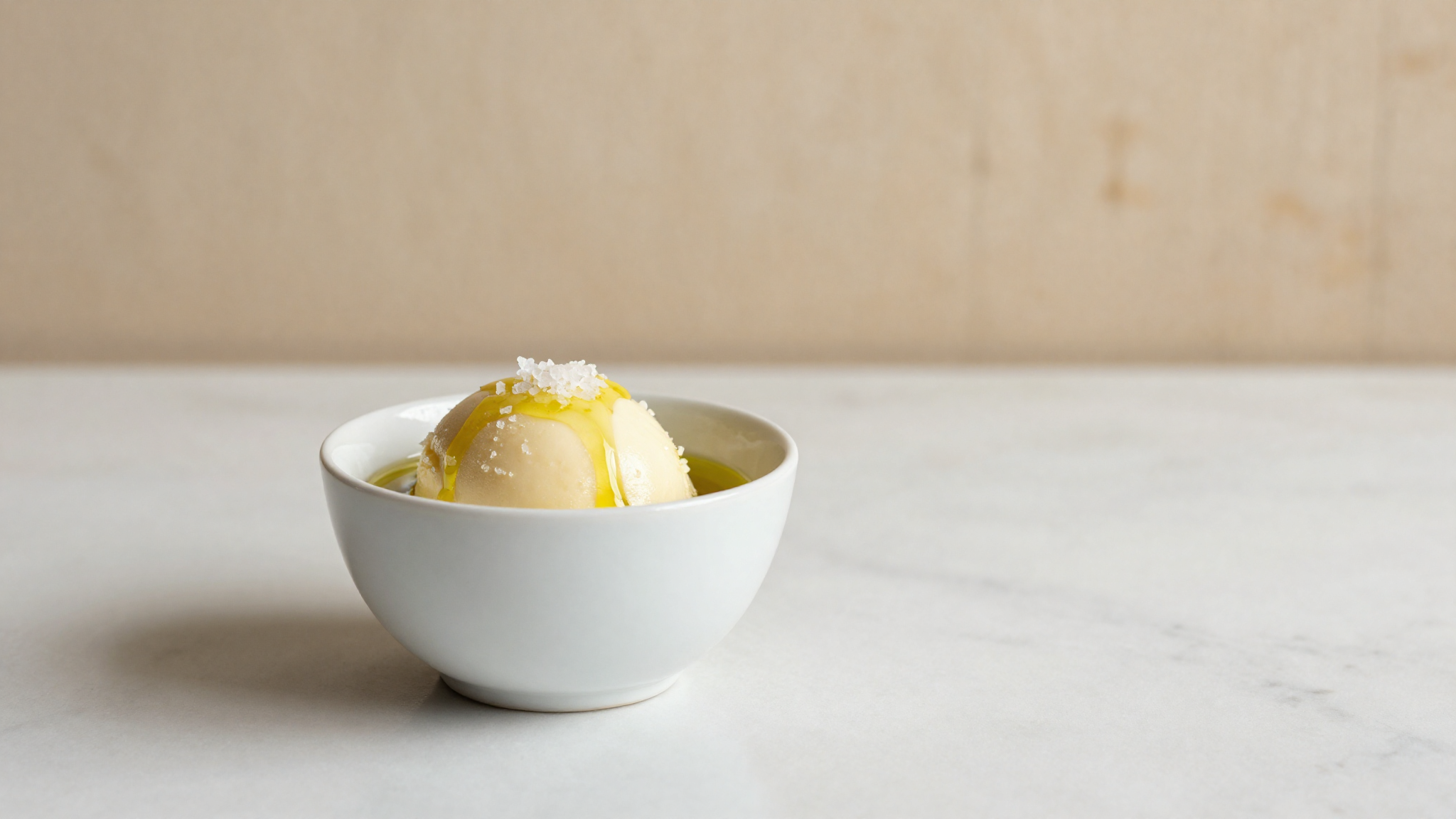
Around the Mediterranean the everyday fat comes out of a press, and this sheet takes that literally: there is no cream line in it at all. Whole milk runs at 700 g per kilo and 65 g of extra virgin oil supplies most of the fat, which closes at 9.19 percent. Oil is pure fat and pure solids and does nothing at all for the freezing behaviour, so the sugars have to cover that side on their own. The bitterness people brace for is largely tamed in the bowl, because the oil binds to milk protein and the pungency drops, which is why a medium fruity oil suits this better than a mild one. It goes in cold, after ageing.
Sixty five grams sounds shy next to published Italian versions, which run from 90 g on a water base up to 200 g in very rich home recipes, but the ceiling is arithmetic. Olive oil moves exactly two of the eight indicators, fat and total solids. Its POD is zero and its PAC is zero, so it does nothing at all for freezing behaviour. Push it past roughly 80 g per kilo and fat leaves the band while PAC has not moved a millimetre, which is why the professional window on a balanced milk base sits at 60 to 80 g.
Everything the oil refuses to do falls on the sugars. Sucrose at 165 g and dextrose at 20 g bring PAC to 267.44 in a 220 to 300 band and push POD to 186.75 against a 200 ceiling, the highest sweetening power of any milk base in this batch. That is the trade: a fat you cannot lean on for freezing has to be paid for on the sugar side.
Soy lecithin at 2 g is not decoration. Olive oil stays liquid at fridge temperature and never crystallises the way milk fat does, so it cannot build the foam by itself and it will coalesce and weep if nothing holds the emulsion together. On flavour, work from the University of Naples Federico II shows the oil's intensity is damped by the bonds it forms with milk protein, so the bitter and peppery edge reads much softer in a dairy base than it does on a spoon.
Ingredients
Makes 1000 g of finished base.
| Ingredient | Grams | Home measure |
|---|---|---|
| Whole Milk | 700 | 3 cups |
| Sugar (Sucrose) | 165 | 3/4 cup plus 2 tablespoons |
| Olive Oil | 65 | |
| Skim Milk Powder | 42 | 1/3 cup plus 2 tablespoons |
| Dextrose (Glucose) | 20 | 1 1/2 tablespoons |
| Carob Seed Flour | 4 | |
| Soy Lecithin | 2 | |
| Salt | 2 |
Loads these exact grams into the free balancer, ready to edit.
Method
Oil emulsified in cold, shallow tray, three stick blender passes
- 1Whisk every dry ingredient together first: sugars, milk powder, stabiliser and salt. Dry-blending them stops the stabiliser clumping when it meets liquid.
- 2Warm the liquids to 40 C (104 F), then rain the dry mix in while whisking hard.
- 3Heat to 82 C (180 F) and hold for 2 minutes so the stabiliser hydrates.
- 4Chill in an ice bath to under 5 C (41 F) within 2 hours. Slow cooling is where bacteria and coarse crystals both start.
- 5Age 6 to 12 hours in the fridge under 5 C (41 F). This is when the stabiliser and the milk protein take up water.
- 6Freeze in a shallow metal pan 2 to 3 cm deep, breaking the crystals with a fork every 30 to 40 minutes, 4 to 6 times.
- 7Freeze firm, then temper 10 to 15 minutes in the fridge before scooping.
The balance
All six against the professional range for Milk Gelato.
Two indicators explain the whole ingredient list. Fat at 9.19 percent against 6 to 12 is what caps the oil at 65 g, because the oil alone puts 6.5 points in before the milk contributes anything. MSNF at 10.29 percent against 8 to 11.5 is what forces 42 g of skim milk powder into a formula that has no cream to lean on: with 700 g of whole milk and nothing else dairy, the solids have to come from powder. Around those two, solids read 38.35 against 36 to 42, sugars 18.32 against 16 to 22, POD 186.75 against 140 to 200, PAC 267.44 against 220 to 300, water 61.65 against 58 to 64 and protein 3.8 against 3 to 5. Lactose comes to 5.61 percent of the mix and 9.1 percent of the water, and the sandiness check passes.
Estimated nutrition: ~199 kcal · Fat 9.2 g · Sugars 18.3 g · Protein 3.8 g (per 100 g of mix, from the balanced composition).
The oil never sees the pasteuriser. Bring milk, sugars, milk powder, carob and lecithin to 82 to 85 C, cool to 4 C and age 6 to 12 hours. Only at the end of ageing do you add the olive oil in a thin stream with a stick blender running, for 60 to 90 seconds, until the emulsion is fine and uniform. Heated to 85 C the polyphenols and the hexanal that carries the grassy note simply degrade and you are left with plain fat. The main risk here is coalescence: a coarse emulsion pools oil in the tub and the overrun collapses with it. Keep the churn short and serve at about minus 12 C. Choose a light to medium fruity oil, since an intense one leaves a bitter tail that the cold will not cover.
If it goes wrong
The emulsion was coarse. Either the 2 g of lecithin was skipped or the oil was stirred in rather than blended.
Keep the lecithin and add the 65 g of oil in a thin stream with the stick blender running for a full 60 to 90 seconds, with the base at 4 C.
An intensely fruity oil. Cold numbs sweetness far more than it numbs bitterness, so a robust oil reads harsher frozen than it does at room temperature.
Use a light to medium fruity extra virgin. The dose stays at 65 g, since the oil supplies most of the 9.19 percent fat.
The oil went into the pot and was pasteurised at 85 C along with everything else.
Pasteurise the white base alone and add the oil cold, at the end of the 6 to 12 hour age.
Suitable for: Vegetarian, Egg-free
Allergens: milk, soy
No ingredient in this recipe contains gluten.
- https://shop.nemox.com/gelato-alloliva-una-ricetta-a-tutto-olio-extravergine/
- https://oliocristofaro.it/olio-oliva-gelato-ricerca-tradizione/
- https://coppiniarteolearia.com/blogs/blog/gelato-allolio-extravergine-di-oliva
- The science behind it: Olive Oil Gelato
- Ingredient sheet: Olive Oil
- The story of this recipe: Olive Oil Gelato
Want to change an ingredient and watch the numbers move? Open the free balancer