Nutella Gelato
Sweetness hits hard and quits early; what stays is a long roasted-nut finish, with enough salt in it to keep the whole thing honest.
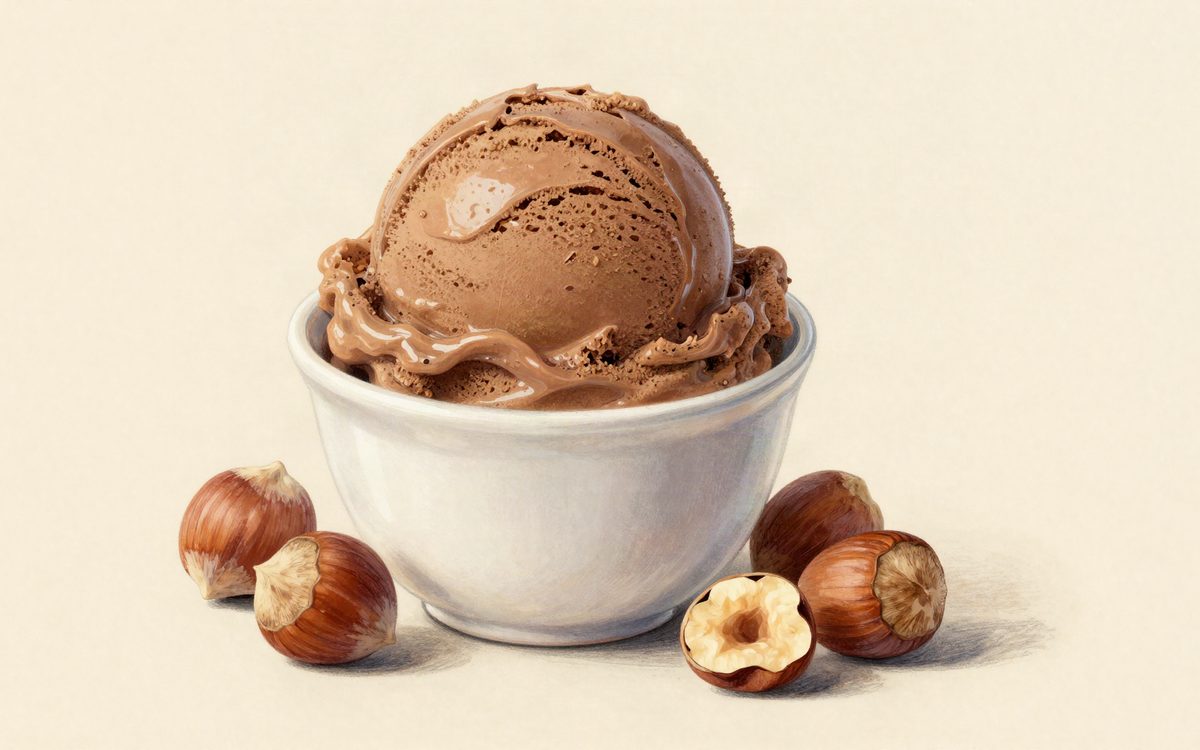
What sits at the top of the ingredient list decides what the tub will taste like. On this jar sugar leads and hazelnut runs at roughly 13%, which eats as sweetness that hits hard and nut flavour that quits early. A better spread pushes the nut up the list and the sugar down, but either way 150 g per kilo is a practical ceiling: those 150 g put 76.5 g of sugar and 46.5 g of fat into the mix before anything else is weighed, and free sucrose has to fall to 55 g to make room. The repair is not a different brand but 25 g of unsweetened hazelnut paste and 8 g of cocoa, added back to lengthen the finish.
The spread has a real defect and the recipe corrects it. It is only around 13 percent hazelnut, which gives a short nut flavour and a long sweet one. Twenty five grams of unsweetened hazelnut paste restores the intensity without adding any more sugar, and 8 g of 22 to 24 percent cocoa powder darkens the mix and brings a bitter edge that cuts the confectionery character. The cocoa dose is deliberately homeopathic: more of it and the flavour stops being recognisable as what people came for.
There is no cream on this sheet at all. Whole milk sits at 697 g and the fat still closes at 8.84 percent, because the spread and the hazelnut paste between them already put more than 6 percent fat into the mix before any dairy fat is counted. Skim milk powder is likewise only 10 g, since 697 g of whole milk carries most of the MSNF, which lands at 8.54 percent in the 8 to 11.5 band.
Ingredients
Makes 1000 g of finished base.
| Ingredient | Grams | Home measure |
|---|---|---|
| Whole Milk | 697 | 3 cups |
| Nutella | 150 | |
| Sugar (Sucrose) | 55 | 1/4 cup plus 1 tablespoon |
| Dextrose (Glucose) | 45 | 1/4 cup |
| Hazelnut Paste (unsweetened) | 25 | |
| Skim Milk Powder | 10 | 1 1/2 tablespoons |
| Cocoa Powder 22-24% | 8 | |
| Glucose Powder | 5 | 1 1/4 teaspoons |
| Carob Seed Flour | 4 | |
| Salt | 1 |
Loads these exact grams into the free balancer, ready to edit.
Method
Warm blend at 60 C, overnight age, then shallow tray
- 1Whisk every dry ingredient together first: sugars, milk powder, stabiliser and salt. Dry-blending them stops the stabiliser clumping when it meets liquid.
- 2Warm the liquids to 40 C (104 F), then rain the dry mix in while whisking hard.
- 3Heat to 82 C (180 F) and hold for 2 minutes so the stabiliser hydrates.
- 4Off the heat, whisk in the paste, then blend 60 seconds so the fat emulsifies instead of separating.
- 5Chill in an ice bath to under 5 C (41 F) within 2 hours. Slow cooling is where bacteria and coarse crystals both start.
- 6Age 6 to 12 hours in the fridge under 5 C (41 F). This is when the stabiliser and the milk protein take up water.
- 7Freeze in a shallow metal pan 2 to 3 cm deep, breaking the crystals with a fork every 30 to 40 minutes, 4 to 6 times.
- 8Freeze firm, then temper 10 to 15 minutes in the fridge before scooping.
The balance
All six against the professional range for Milk Gelato.
Fat at 8.84 percent and sugars at 17.83 percent were both largely decided by one ingredient before the solver started. At 31 percent fat and 51 percent sugar, 150 g of spread fixes 46.5 g of fat and 76.5 g of sugar per kilo, which is why the cream line disappeared entirely and why free sucrose fell to 55 g. PAC at 259.27 inside 220 to 300 is then held mostly by dextrose rather than sucrose, 45 g against 55 g, an unusual ratio for a milk gelato and the direct consequence of having so much of the sugar budget already spent on sucrose that came in with the spread. Around them, POD reads 169.89 against 140 to 200, solids 38.20 against 36 to 42, MSNF 8.54 against 8 to 11.5, protein 4.15 against 3 to 5, water 61.80 against 58 to 64. Lactose comes to 4.66 percent of the mix and 7.53 percent of the water.
Estimated nutrition: ~197 kcal · Fat 8.8 g · Sugars 17.8 g · Protein 4.2 g (per 100 g of mix, from the balanced composition).
What is specific to this flavour is that the spread cannot go into the pot at the start. Its palm oil separates if it is taken to 85 C under strong agitation, and the result is a greasy film on the surface of the ageing mix. Dissolve the spread and the hazelnut paste into the already pasteurised base at 60 to 65 C with a stick blender, never over direct heat. The cocoa is the opposite case, it needs heat: slake the 8 g with a little cold milk into a smooth paste before the temperature goes up, or it clumps and never disperses again. Age 6 to 12 hours at 4 C so the hazelnut fat has time to crystallise, and do not run past 12 hours. This is a sweet, low acid base and a comparatively easy target for contamination.
If it goes wrong
The spread was heated with the base. Its palm oil separates around 85 C under agitation and does not go back in.
Pasteurise the dairy base on its own, drop it to 60 to 65 C, and only then blend in the 150 g of spread and the 25 g of hazelnut paste.
The 8 g of cocoa powder went into a hot mix and sealed itself into clumps on contact.
Slake the cocoa with a little cold milk into a smooth paste before any heat is applied, then bring the mix up to temperature.
The 25 g of unsweetened hazelnut paste was skipped. The spread alone is only around 13 percent hazelnut, long on sugar and short on nut.
Keep the pure paste in. It adds nut intensity without touching the sugars line, which is already at 17.83 percent.
Suitable for: Vegetarian, Egg-free
Allergens: milk, soy, tree nuts
- https://www.thepetitecook.com/nutella-gelato/
- https://kitchenprojects.substack.com/p/kitchen-project-129-all-about-gianduja
- https://icecreamcalc.com/knowledge-base/balancing/
- https://www.dairyscience.info/ice-cream/154-ice-cream-mix.html
- The science behind it: Hazelnut Paste in Gelato
- Ingredient sheet: Nutella
Want to change an ingredient and watch the numbers move? Open the free balancer