No Sugar Added Strawberry Sorbet
What surprises is not the sweetness but the roundness: sharp and cold at the start, soft through the middle, fruit still there once the cold has gone.
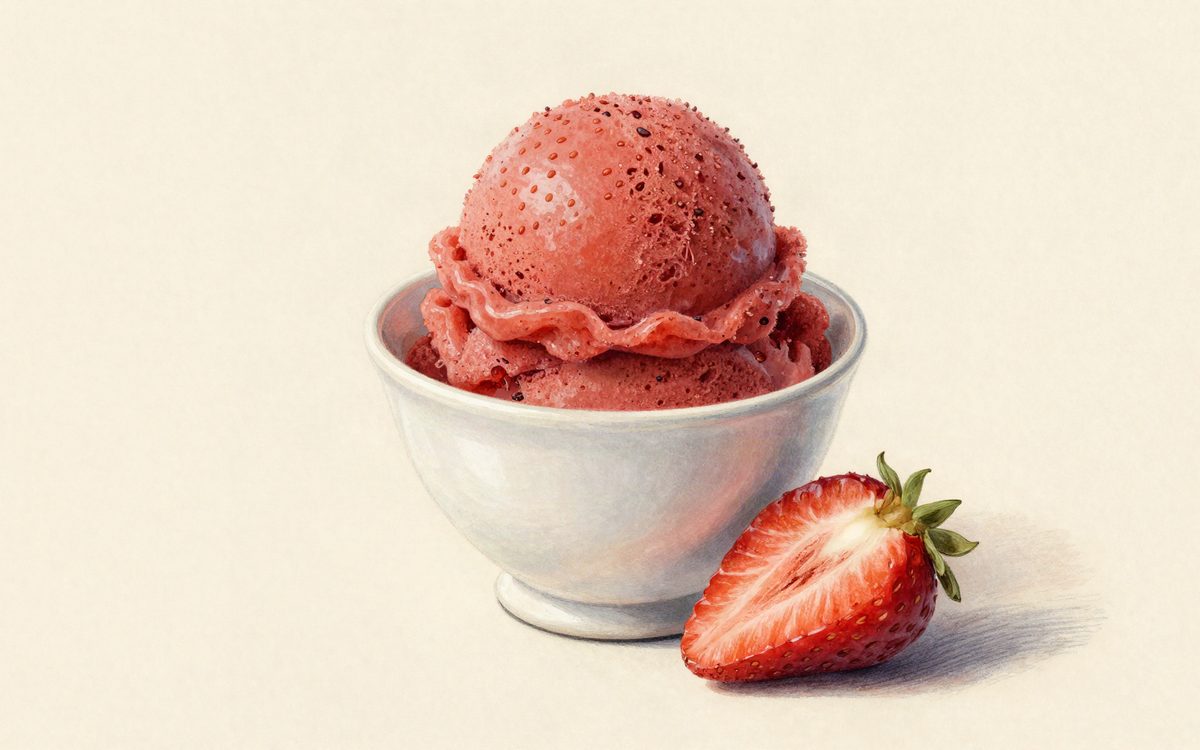
Acid lands first, bright and narrow, the lemon and the fruit together at a pH near 3.4. Then comes the part a mix with no sucrose in it has no right to: the texture goes round instead of sandy, maltitol holding the volume and isomalt padding the solids underneath. Xylitol brings the sweetness those two leave missing, and a cooling edge along with it, which reads here as freshness rather than as anything chemical. What remains once the cold has cleared is fruit, and it can be, at 450 g per kilo, with 15 g of lemon juice keeping the colour and the aroma awake.
With sucrose out, no single sweetener can cover it, so the recipe uses four and gives each one a job. Maltitol takes the volume at 118 g, the best POD to PAC ratio among the polyols. Isomalt at 117 g is low PAC ballast, lifting solids to 31.03 percent inside 28 to 34 without pushing through the 340 PAC ceiling. Xylitol at 23 g supplies the sweetening power needed to clear the POD floor of 200, and the sheet closes at 207.57. Polydextrose at 13 g adds solids and body with no sugar at all.
Fifteen grams of lemon juice takes the pH close to 3.4, which brightens the strawberry aroma and helps hold the colour. Strawberry runs about 0.7 percent protein, so at 450 g this sheet reads protein at 0.32 percent against the 1 percent ceiling of the sorbet band.
Ingredients
Makes 1000 g of finished base.
| Ingredient | Grams | Home measure |
|---|---|---|
| Strawberry | 450 | |
| Water | 260 | 1 cup |
| Maltitol | 118 | |
| Isomalt | 117 | |
| Xylitol | 23 | |
| Lemon Juice | 15 | |
| Polydextrose | 13 | |
| Stabilizer (Neutral) | 4 |
Loads these exact grams into the free balancer, ready to edit.
Method
Cold fruit into cold syrup, fork stirred tray
- 1Whisk every dry ingredient together first: sugars, milk powder, stabiliser and salt. Dry-blending them stops the stabiliser clumping when it meets liquid.
- 2Warm the liquids to 40 C (104 F), then rain the dry mix in while whisking hard.
- 3Heat to 82 C (180 F) and hold for 2 minutes so the stabiliser hydrates.
- 4Chill in an ice bath to under 5 C (41 F) within 2 hours. Slow cooling is where bacteria and coarse crystals both start.
- 5Age 6 to 12 hours in the fridge under 5 C (41 F). This is when the stabiliser and the milk protein take up water.
- 6Fold the fruit in cold, after ageing. Heating it costs you the fresh aroma and nothing is gained.
- 7Freeze in a shallow metal pan 2 to 3 cm deep, breaking the crystals with a fork every 30 to 40 minutes, 4 to 6 times.
- 8Freeze firm, then temper 10 to 15 minutes in the fridge before scooping.
The balance
All six against the professional range for Sorbetto.
PAC 325.6 inside 280 to 340 and solids 31.03 percent inside 28 to 34 are the pair that dictated the sweetener list. Reaching those solids with maltitol alone would have carried the PAC too high, which is why 117 g of isomalt is in there as low antifreeze ballast, and reaching the sweetness with isomalt alone would have left the mix flat, which is why 23 g of xylitol is in there to lift POD to 207.57 in the 200 to 270 band. Sugars close at 27.50 percent against 25 to 31, with the 450 g of strawberry contributing only a small share of that since the fruit is around 5 percent sugar. Water reads 68.97 against 66 to 72, fat 0.14 percent against a 1 percent ceiling, MSNF zero as the band requires, and protein 0.32 against 1.
Estimated nutrition: ~125 kcal · Fat 0.1 g · Sugars 27.5 g · Protein 0.3 g (per 100 g of mix, from the balanced composition).
There is no fat and no MSNF here, so all of the body comes from solids plus the 4 g of stabiliser, and that makes the balance less forgiving than any milk base. Do not pasteurise the fruit. Take the water, the sweeteners and the stabiliser to 85 C, cool the syrup to 4 C, and only then fold in the raw strawberry. Cooking gives a jam note and darkens the anthocyanins within minutes, which is how a bright red sorbet becomes a brownish one. Isomalt dissolves slowly, so it belongs in the hot syrup phase and never at the end. The honest warning this recipe has to carry: the formula runs around 26 percent polyols, so a 100 g portion delivers roughly 26 g of polyol, above the usual threshold of gastrointestinal tolerance, and the portion recommendation has to be visible. Serve at -12 C. The acid in the fruit depresses the freezing point on its own, so this churns softer than PAC 325.6 suggests on paper.
If it goes wrong
The fruit was heated with the syrup. Strawberry anthocyanins degrade in minutes at syrup temperature and the aroma turns cooked.
Heat only water, sweeteners and stabiliser to 85 C, chill the syrup to 4 C, then fold in the 450 g of raw strawberry.
The isomalt went in late or into a syrup that was not hot enough. It is the slowest dissolving item on the sheet at 117 g.
Add the isomalt at the start of the 85 C syrup phase and hold until it is fully in solution before cooling.
The mix carries around 26 percent polyols, so a 100 g portion delivers about 26 g, well past most people's tolerance in one sitting.
Serve in small portions and state the polyol load. This is a sheet where the serving size is part of the recipe, not an afterthought.
Suitable for: Vegan, Vegetarian, Lactose-free, Egg-free, No added sugar
- Goff, H. D.; Hartel, R. W. Ice Cream, 7a ed. Springer, 2013 (capitulo sobre sorbets e sistemas sem gordura)
- Corvitto, A. Los secretos del helado: el helado sin secretos. Vilbo, 2004 (balanceamento de sorbetes por PAC e solidos)
- USDA FoodData Central, composicao do morango cru: https://fdc.nal.usda.gov/
- Regulamento (UE) 1169/2011, Anexo III: https://eur-lex.europa.eu/eli/reg/2011/1169/oj
- The science behind it: No-Added-Sugar Gelato Recipe
- Ingredient sheet: Strawberry
Want to change an ingredient and watch the numbers move? Open the free balancer