No Sugar Added Chocolate Gelato
Deep and frankly bitter, cocoa first with sweetness a step behind, and it still scoops soft after the fridge rest the method calls for instead of setting into the usual sugar free block.
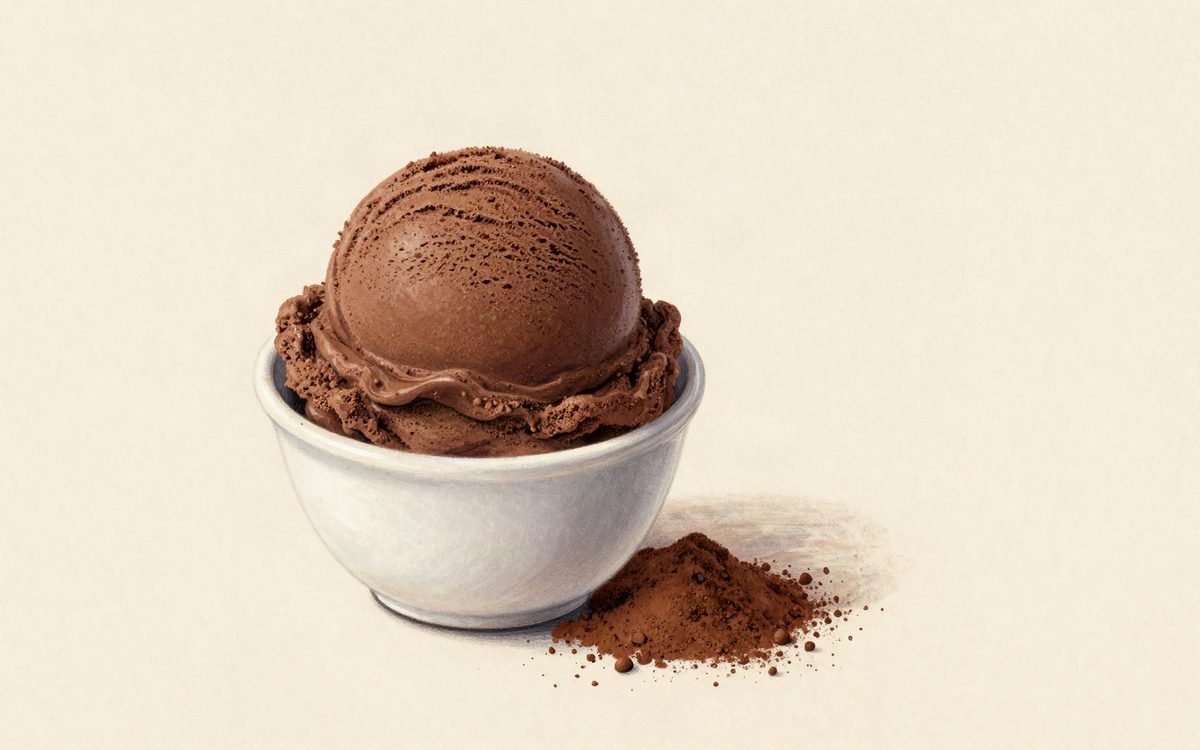
Buying badly here cannot be fixed later in the mix. Cocoa powder is sold at very different fat levels, and the 22 to 24 percent kind is what this sheet counts on; the thin supermarket sort brings less cocoa butter with it, and 60 g of that will taste dusty where this should taste deep. Cocoa paste is the other label to read, and it should say cocoa and nothing else. Then the sweeteners: weigh maltitol and xylitol yourself instead of buying a bagged blend, because a blend hides its own POD and PAC, and this recipe leans on both to land at PAC 259.73, which is where the tub still gives to a spoon.
With sucrose out, the sweetening is a two part job. Maltitol takes the volume at 148 g because it has the best POD to PAC ratio among the polyols, POD 85 against PAC 99, so it can carry the mix into the 16 to 22 percent sugars band without blowing the PAC ceiling. Xylitol at 27 g, POD 100 and PAC 220, finishes the sweetening power and pulls PAC up to 259.73, which is where the base is still spoonable rather than solid. Sugars close at 17.61 percent.
Sugar does more than sweeten, and what it leaves behind when you remove it is body. That gap is covered by 24 g of non fat dry milk, which brings MSNF to 8.63 percent inside the 8 to 11.5 band. The limit on that powder is not taste but protein: cocoa powder is around 20 percent protein, so 60 g of it already spends 12 g of the 50 g ceiling per kilo, and the sheet closes at 4.64 percent against a 5 percent limit.
Ingredients
Makes 1000 g of finished base.
| Ingredient | Grams | Home measure |
|---|---|---|
| Whole Milk | 681 | 2 3/4 cups |
| Maltitol | 148 | |
| Cocoa Powder 22-24% | 60 | |
| Heavy Cream 35% | 35 | 2 1/2 tablespoons |
| Xylitol | 27 | |
| Non-Fat Dry Milk | 24 | 1/4 cup |
| Cocoa Paste | 20 | |
| Stabilizer (Neutral) | 4 | |
| Salt | 1 |
Loads these exact grams into the free balancer, ready to edit.
Method
Coldest shelf, stir every 40 minutes, temper before scooping
- 1Whisk every dry ingredient together first: sugars, milk powder, stabiliser and salt. Dry-blending them stops the stabiliser clumping when it meets liquid.
- 2Warm the liquids to 40 C (104 F), then rain the dry mix in while whisking hard.
- 3Heat to 82 C (180 F) and hold for 2 minutes so the stabiliser hydrates.
- 4Off the heat, whisk in the paste, then blend 60 seconds so the fat emulsifies instead of separating.
- 5Chill in an ice bath to under 5 C (41 F) within 2 hours. Slow cooling is where bacteria and coarse crystals both start.
- 6Age 6 to 12 hours in the fridge under 5 C (41 F). This is when the stabiliser and the milk protein take up water.
- 7Freeze in a shallow metal pan 2 to 3 cm deep, breaking the crystals with a fork every 30 to 40 minutes, 4 to 6 times.
- 8Freeze firm, then temper 10 to 15 minutes in the fridge before scooping.
The balance
All six against the professional range for Milk Gelato.
POD 161.31 is the most telling number on this sheet. It sits low in the 140 to 200 band, lower than any sucrose built chocolate gelato would land, because polyols sweeten less per gram than sugar does and the recipe accepts that instead of dosing around it. The result reads as a darker, drier chocolate, which suits the 60 g of cocoa powder. PAC at 259.73 is the second anchor: maltitol is a weak freezing point depressant for its sweetness, so left alone the base would freeze like a brick, and the 27 g of xylitol at PAC 220 is what lifts the mix into the scoopable part of the 220 to 300 window. The rest holds: solids 38.06 against 36 to 42, sugars 17.61 against 16 to 22, fat 6.09 against 6 to 12, MSNF 8.63 against 8 to 11.5, protein 4.64 against 3 to 5, water 61.94 against 58 to 64. Lactose is 4.70 percent of the mix and 7.59 percent of the water, so the sandiness risk here is polyol crystallisation rather than lactose.
Estimated nutrition: ~183 kcal · Fat 6.1 g · Sugars 17.6 g · Protein 4.6 g (per 100 g of mix, from the balanced composition).
Cocoa powder has to be dispersed dry into a portion of the sweetener before it meets any liquid, or it clumps and no blender will rescue it afterwards. Pasteurise at 82 to 85 C with two to three minutes of hold, since that is the temperature that hydrates the starch in the cocoa and develops the aroma. The hot mix will look thinner than the finished product should be, and that is normal: the cocoa keeps taking up free water across the 6 to 12 hour age at 4 C, so never adjust the recipe based on hot viscosity. The alert specific to a no sugar added base is the serving temperature. Maltitol depresses the freezing point less per unit of sweetness than sucrose does, so this mix freezes harder than the numbers feel. Serve at -11 or -12 C, not at -14 C. Total polyol load is around 17.5 percent of the mass, which in the EU carries a mandatory laxative effect statement. The 1 g of salt is not a detail either: in a base with no sucrose it restores perceived sweetness and cuts the metallic finish that xylitol leaves.
If it goes wrong
The 60 g of cocoa powder met liquid before it was dispersed. Cocoa hydrates on contact and forms sealed lumps.
Rub the cocoa dry into part of the maltitol first, then bring it into the milk and take the mix to 82 to 85 C.
Polyol sweetened bases freeze harder than sugar bases at the same sweetness, and PAC 259.73 was made for a serving temperature of -11 to -12 C.
Move the tub to the warmest part of the freezer or let it stand until it reaches -11 to -12 C before serving. Do not serve it at -14 C.
The 27 g of xylitol left unbalanced. Xylitol has a marked cooling effect and a metallic tail in a mix with no sucrose to cover it.
Keep the 1 g of salt on the sheet. It restores perceived sweetness and suppresses the metallic finish, and it is doing real work here.
Suitable for: Vegetarian, Egg-free, No added sugar
Allergens: milk
- Beckett, S. T. Industrial Chocolate Manufacture and Use, 5a ed. Wiley, 2017 (comportamento da manteiga de cacau e dos solidos de cacau em sistemas congelados)
- Goff, H. D.; Hartel, R. W. Ice Cream, 7a ed. Springer, 2013 (cap. 3 e cap. 11)
- Corvitto, A. Los secretos del helado: el helado sin secretos. Vilbo, 2004 (substituicao de sacarose por poliois e efeito sobre a curva de congelamento)
- Regulamento (UE) 1169/2011, Anexo III: https://eur-lex.europa.eu/eli/reg/2011/1169/oj
- The science behind it: No-Added-Sugar Gelato Recipe
- Ingredient sheet: Cocoa Powder 22/24
Want to change an ingredient and watch the numbers move? Open the free balancer